
c. 1530 – 1612·Feast February 17; May 12
St. Hermogenes of Moscow
Hieromartyr Patriarch Who Rallied Russia Against the Polish Invaders
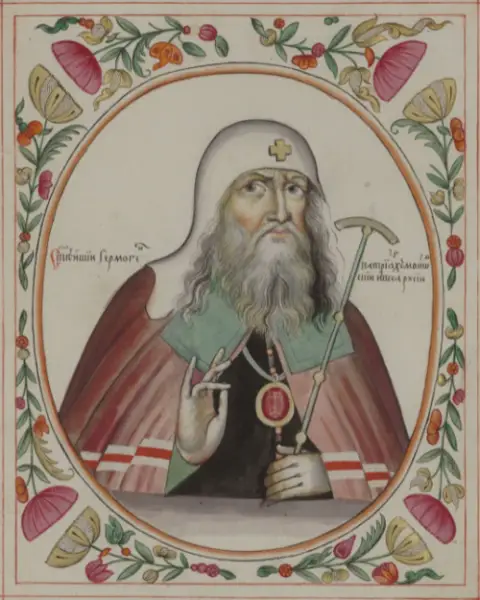
Overview
Hermogenes, known in the world as Yermolay, rose from Kazan to become Patriarch of Moscow and all Russia at the gravest hour of the Time of Troubles. Appointed Metropolitan of the newly conquered Tatar city when the Moscow patriarchate was established in 1589, he won renown for drawing Volga Tatars to the Orthodox faith. Raised to the primatial see on 3 July 1606 with the support of Tsar Vasily IV, he proved the unbending conscience of the Russian Church through impostors, civil war, and foreign occupation. He defied False Dmitry I over his marriage plans, anathematized the rebel Bolotnikov, and refused every pressure to legitimize the Polish candidature of Wladyslaw unless the prince converted to Orthodoxy. When Polish troops held the Kremlin, Hermogenes smuggled letters to the towns of Russia, calling the people to rise. For this he was imprisoned in the Chudov Monastery, where, from his cell, he blessed the volunteer army of Minin and Pozharsky. Beaten and starved by his captors, he died in February 1612, months before the liberation his stand had inspired, and was later honored as a hieromartyr of the Russian land.
The Complete Life
From Kazan to the Episcopate
The man who would die as Patriarch of Moscow began life in the Volga city of Kazan around 1530, bearing the secular name Yermolay. Little survives of his childhood, but his path led him into the clergy of a frontier diocese only lately won from the Kazan Khanate. When the Holy Synod of 1589 created the patriarchate of Moscow and organized the church's new hierarchy, Hermogenes was made Metropolitan of Kazan. In that post, over the following two decades, he gained a reputation that reached far beyond his diocese: a steady stream of Muslim Volga Tatars embraced Eastern Orthodoxy under his ministry, and the metropolitan of Kazan became known as one of the most effective missionary bishops of the young patriarchate. The experience formed him in the habits that would mark his patriarchate, a conviction that the faith was worth contending for, patience with peoples only newly gathered into the church, and an unshakable firmness when belief and power came into conflict.
§ Introduction
Patriarch in a Divided Land
Hermogenes was elevated to the primatial see in the summer of 1606, and the circumstances of his enthronement revealed both the turmoil of the age and the esteem he had earned. Summoned to Moscow by the impostor False Dmitry I to sit in the newly instituted Senate, he learned of the tsar's plan to marry Marina Mniszech, a Roman Catholic, and declared firmly against the alliance. For that candor he was sent from the capital, only to return months later in honor when the pretender fell and Patriarch Ignatius was deposed with him. The new tsar, Vasily IV, helped Hermogenes to the patriarchate, and on 3 July 1606 the assembly of holy hierarchs installed him at the Dormition Cathedral. Metropolitan Isidore handed him the staff of the holy hierarch Peter, the tsar presented a panagia, a white klobuk, and a staff, and the patriarch made his entrance in the ancient manner, riding upon a donkey. Throughout Vasily's reign Hermogenes backed the crown's work of pacification, and he pronounced an anathema against Ivan Bolotnikov and the rebel force he led.
§ Patriarch of Moscow
Courage in the Time of Troubles
When Vasily IV was dethroned and Polish soldiers seized the Moscow Kremlin, the patriarch became the last unbroken voice of Russian resistance. The occupiers meant to crown the Polish prince Wladyslaw as tsar, and Hermogenes opposed the plan absolutely, conditioning any agreement on Wladyslaw's conversion to Orthodoxy. Boyars threatened him with knives; he refused to sign the petitions sent to the Polish king, and his refusal kept the coronation from ever taking place. In December 1610 he took the struggle beyond the capital, distributing letters to Russian towns and calling on the population to take up arms against the occupiers. When Prokopy Lyapunov's volunteer army at last drew near to Moscow, the occupiers demanded that the patriarch anathematize it; he defied them, cursed the Roman Catholics, and blessed the national cause instead. Arrested for it, he was thrown into the Chudov Monastery, and there, hearing that a new army had been mustered by Kuzma Minin and commanded by Prince Pozharsky, he blessed them both from his cell. His tormentors answered that blessing with blows and starvation.
§ Time of Troubles
Martyrdom in the Chudov Monastery
Hermogenes died on 17 February 1612 in the Chudov Monastery where his captors confined him, beaten and starved to death for refusing to abandon the cause of an occupied nation. He did not live to see the deliverance his witness had hastened; the volunteer army he blessed went on to expel the Polish garrison and end the Time of Troubles, but the patriarch perished within earshot, as it were, of the triumph. His body was buried in the Chudov Monastery, and in 1654 it was transferred with honor to the Dormition Cathedral of Moscow, the church where he had been enthroned. There the memory of the imprisoned patriarch who starved rather than submit kept its place among the memorials of the Russian Church, awaiting the age when his glorification would make his endurance a public possession of all the faithful.
§ Death and legacy
Glorification as a Hieromartyr
Veneration of Hermogenes grew with the centuries, and in 1913 it received formal expression. During repair works that year, the remains believed to be those of the patriarch came to light by accident in one of the Chudov Monastery's crypts. The discovery fell in the very year of the Romanov Dynasty Tercentenary, and in connection with those celebrations the Russian Orthodox Church canonized him as a hieromartyr and translated his relics to the nearby Dormition Cathedral. The church fixed his commemoration on two days, one the anniversary of his martyrdom in February, the other the May date on which his glorification entered its memory. Thus the martyr of the Time of Troubles entered the calendar of the church he had refused to surrender, honored precisely in the fidelity that cost him his life.
§ Death and legacy
The Deliverance He Inspired
The uprising that freed Moscow from the Poles owes more to Hermogenes than to any other single figure of the hierarchy. His letters, carried from the occupied capital to the towns of Russia, converted passive suffering into national resistance; his blessing of Minin and Pozharsky's army joined the authority of the Church to the militia of the people; and his death by starvation in a Polish prison fixed the cause as something worth a martyr's blood. Later generations read his story as the proof that an occupied country is never finally conquered while its pastors keep their nerve. He is depicted in the art of Russia holding the letters that roused the land, his figure stands on the Millennium Monument in Novgorod among the makers of Russian history, and the Orthodox Church keeps his feast in February and May alike. To the faithful he remains the hieromartyr whose inflexibility, alike to prayers and threats, became a pledge of his country's deliverance.
§ Death and legacy
Timeline
- 1530
Born at Kazan and given the secular name Yermolay
§ Introduction
- 1589
Appointed Metropolitan of Kazan at the Holy Synod that established the patriarchate of Moscow
§ Introduction
- 1606
Summoned to the Senate by False Dmitry I, he condemned the proposed marriage to Marina Mniszech and was exiled from the capital
§ Introduction
- 3 Jul 1606
Installed as Patriarch of Moscow and all the Rus' at the Dormition Cathedral before the assembly of holy hierarchs
§ Patriarch of Moscow
- Dec 1610
Sent letters to towns across Russia urging the populace to rise against the Polish occupiers
§ Time of Troubles
- 17 Feb 1612
Beaten and starved to death by his captors in the Chudov Monastery after blessing the army of Minin and Pozharsky
§ Time of Troubles
- 1654
His body was transferred from the Chudov Monastery to the Dormition Cathedral in Moscow
§ Death and legacy
- 1913
His relics were discovered in a crypt of the Chudov Monastery during repair works, and he was glorified as a hieromartyr amid the Romanov Tercentenary
§ Death and legacy
In Their Own Words
He endured to the end and was accounted worthy of the crown of martyrdom: inflexible alike to prayers and threats, he was starved to death in prison, to be a pledge of deliverance to his country
The Record
- Major works
- Letters to the Russian towns calling them to rise against the Polish occupation
- Patron of
- Patron of Russia's deliverance from invaders, invoked for steadfastness in persecution
- Symbols
- Patriarchal vestments and staff·Scroll of letters·Hieromartyr's cross
- Canonization
- Glorified as a hieromartyr by the Russian Orthodox Church in 1913, in connection with the Romanov Tercentenary
Prayer
Bibliography
Show 7 sources
- Maureen Perrie. Pretenders and Popular Monarchism in Early Modern Russia. Cambridge University Press, 1995. ISBN 0-521-47274-1. Page 210.
- Robert Auty, Dimitri Obolensky. Companion to Russian Studies. Cambridge University Press, 1981. ISBN 0-521-28038-9. Page 108.
- Reverend R Thornton. Lives of Eminent Russian Prelates. Kessinger Publishing, 2004. ISBN 1-4179-4649-0. Page 3.
- A N Mouravieff. A History of the Church of Russia, 1842, reprinted 2004. ISBN 1-4179-1250-2. Page 166.
- Orthodox Church in America.
- Ὠ ἅγιος Ἀρμογένης ὁ Ἁερομάρτυρας Πατριάρχης Μοσχάς. 12 Μαΐη. ΜΕΓΑΣ ΣΥΝΑΞΑΡΙΣΤΗΣ.
- Brockhaus and Efron Encyclopedic Dictionary (in Russian). 1906.
Profile text adapted from the Wikipedia article, licensed CC BY-SA 4.0.
Pray with this saint every day
Save St. Hermogenes of Moscow to your favorites, read the full profile, and get feast-day reminders in the Saints app.
Get the Saints AppFree on the App Store for iPhone and iPad