
died 19 June 1607·Feast Not recorded in the source; repose remembered 19 June
St. Job of Moscow
First Patriarch of Moscow and All Russia
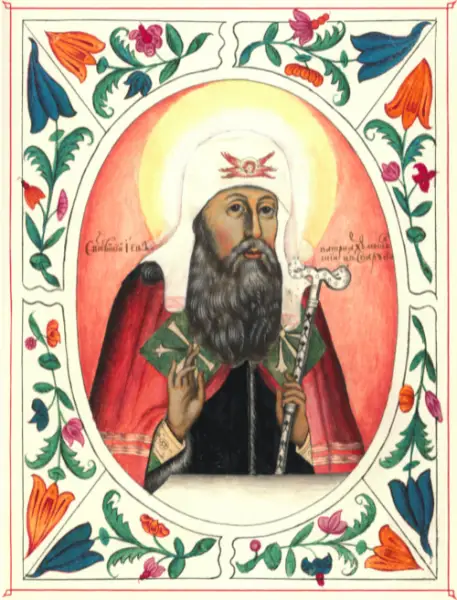
Overview
Job, baptized Ioann, served as Metropolitan of Moscow and all Rus' from 1587 and became the first Patriarch of Moscow and all Rus' when the patriarchate was established in 1589. A monk of Staritsa who knew the Scriptures by heart, he rose through the abbeys of the capital with the favor of Ivan the Terrible and the patronage of Boris Godunov, and as patriarch he gave the young Moscow patriarchate its canonical footing, its liturgical books, and its missionary reach into the Volga and Siberia. When Constantinople's Jeremias II raised Moscow to a patriarchate, Job was consecrated its first occupant on 26 January 1589, and the councils of the Orthodox world confirmed the new rank in 1590 and 1593. A loyal servant of the Godunov interest, he headed the inquiry into Tsarevich Dmitry's death, crowned Boris Godunov, and stood as head of state between Feodor's death and the new reign. He refused to recognize False Dmitry I and was deposed for it in June 1605, exiled to his native Staritsa, where he went blind. Restored to favor under Vasily IV, he died in 1607 and was canonized four centuries later.
The Complete Life
A Monastic Vocation at Staritsa
The future first patriarch of Russia was born Ioann in the town of Staritsa near Tver. Even in adolescence he stood apart, having committed most of the biblical texts to memory and set his heart on the monastic life. His father had other designs and insisted that the boy marry, but the young man found his opening in a pilgrimage: asking leave to visit his confessor at the Uspensky Monastery in their native town, he arrived in 1551 and immediately took the vows his heart had long desired, assuming the religious name Job. He spent fifteen years in that cloister, and in 1566 the community made him its abbot, aided by the patronage of Ivan the Terrible, who had made Staritsa one of his residences during the Oprichnina. Contemporaries and later historians alike described the monk of Staritsa as humble, morally irreproachable, and learned by the standards of his age, a churchman whose labors served the welfare of the church and the furtherance of Orthodox Christianity.
§ Early life
From the Abbeys of Moscow to the Episcopate
Job's rise through the hierarchy of Muscovy proceeded by steady steps through the great monasteries and sees of the realm. In 1571 he was transferred to the capital as abbot of the Simonov Monastery, and in 1575 he took over the abbacy of the Novospassky Monastery. In 1581 came episcopal consecration as Bishop of Kolomna. Contemporary judgment of his gifts was mixed, but his talent for reciting the longest prayers from memory with great expressiveness drew the attention of Boris Godunov, the rising power at court. Under the reign of Feodor I, whose government Godunov controlled, Job received the archbishopric of Rostov and then, in 1587, the metropolitanate of Moscow and all Russia. Whatever his limits, the church placed in his hands the highest office short of the patriarchate at the precise moment when that office itself was about to be created, and the abbots and bishops' path he had traveled gave him the administrative experience the new dignity would demand.
§ Abbot and bishop
Establishing the Patriarchate of Moscow
The creation of a patriarchate at Moscow was Job's great historical work. Godunov argued that ecclesiastical authority in Russia should be strengthened, and persuaded Jeremias II of Constantinople to establish the new rank; on 26 January 1589 Job was consecrated first patriarch of Moscow with the Byzantine patriarch's blessing. In the decree of establishment the Russian tsardom was called a third Rome, and a patriarchal residence rose in the Kremlin beside the Church of the Twelve Apostles. Constantinople confirmed the new status by council in 1590, and in 1593 the four other Orthodox patriarchs ratified it with the support of forty-two bishops. Job's patriarchate then set about ordering the church's inner life. He resisted Godunov's proposal for a university staffed with foreign professors, fearing heterodox influence would endanger the purity of the Russian Church, and instead directed Russian churchmen in correcting the service books and preparing them for publication. He promoted the glorification of Russian saints, ordering celebrations for Basil Fool for Christ in 1588 and for Joseph Volotsky, favored the building of cathedrals and monasteries, and encouraged missionary work in the newly conquered Astrakhan Khanate and Siberia, while corresponding and exchanging gifts with Catholicos Nicholas V of Georgia.
§ Patriarch of Moscow
Deposition, Exile, and Restoration
The last years of Job's patriarchate were consumed by the succession crisis that became the Time of Troubles. After Tsarevich Dmitry died mysteriously at Uglich in 1591, Job headed the official inquiry and, with the church council and the boyar duma, announced that the tsarevich had died by accident. When Feodor died and Irina Godunova refused the throne, the patriarch became head of state in 1598 and led the procession that implored Boris Godunov to accept the crown. His loyalty to the Godunov cause undid him: when False Dmitry I advanced on Moscow, Job denounced the impostor and tried to keep the capital loyal to the dead tsar. Armed supporters of the pretender burst into the Dormition Cathedral, a boyar declared the patriarch a traitor, and on 24 June 1605 a council removed him on pretexts of age and infirmity, installing Ignatius in his place. Exiled to his old monastery at Staritsa, Job went completely blind. Only after the impostor's murder and Ignatius's imprisonment did he return to Moscow, where on 20 February 1607, at Tsar Vasily Shuisky's request, he joined Patriarch Hermogen in the Liturgy at the Dormition Cathedral, extended forgiveness to the Muscovites, and bestowed his blessing upon them. He died that June, a very sick man, in his native Staritsa.
§ Civil career
Honored After Four Centuries
Job's memory was kept first in the place of his burial and translation. His relics were moved in 1652 to the Dormition Cathedral of the Moscow Kremlin, where they remained, and the first patriarch of Moscow lay among the hierarchs of the see he had founded. The formal recognition of his sanctity came at a symbolic hour: in 1989, the four-hundredth anniversary of the patriarchate he inaugurated, the Russian Orthodox Church glorified him as a saint. The canonization closed a circle that had opened in 1589, when a monk of Staritsa received the new patriarchal dignity from the patriarch of Constantinople and carried the Russian Church into a new canonical age. Venerated as the founder of that institution and as a confessor who lost his office rather than betray his conscience, Job stands in the calendar of the Russian Church beside the very throne he first occupied.
§ Death
The Office He Founded
Every later patriarch of Moscow has occupied a throne that Job first filled, and the institution he headed shaped the Russian Church for four centuries. The councils that confirmed his rank in 1590 and 1593 gave Moscow a place in the Orthodox world commensurate with the might of its tsardom, and the decree proclaiming Russia a third Rome gave ideological expression to the new standing that endured long after Job's death. Within the church his patriarchate left corrected service books, a program of canonizations that gathered the Russian saints into public veneration, and missions reaching from the Volga to Siberia. His political career, so entangled with Godunov and so harshly judged in the inquiry over Tsarevich Dmitry, showed the perils of a church closely bound to state power; yet his refusal to bless the impostor, even at the price of office, showed the limits a patriarch could still impose. Blind and deposed, he blessed the people who had forsaken him, and that final act of forgiveness has become the purest monument of his episcopate.
§ Civil career
Timeline
- 1551
Arrived at the Uspensky Monastery in Staritsa and took monastic vows, assuming the name Job
§ Early life
- 1566
Became abbot of the Staritsa monastery with the help of Ivan the Terrible
§ Abbot and bishop
- 1571
Transferred to Moscow as abbot of the Simonov Monastery
§ Abbot and bishop
- 1575
Appointed abbot of the Novospassky Monastery
§ Abbot and bishop
- 1581
Consecrated Bishop of Kolomna
§ Abbot and bishop
- 1587
Appointed Archbishop of Rostov and then Metropolitan of Moscow and all Russia under Feodor I
§ Abbot and bishop
- 1588
Enrolled Basil Fool for Christ among the saints and ordered the church to keep his memory
§ Patriarch of Moscow
- 26 Jan 1589
Consecrated the first Patriarch of Moscow and all Rus' with the blessing of Patriarch Jeremias II of Constantinople
§ Patriarch of Moscow
- 1590
A council in Constantinople confirmed the new patriarchal status of Moscow
§ Patriarch of Moscow
- 1591
Headed the official inquiry into the death of Tsarevich Dmitry at Uglich and founded the Donskoy Monastery in Moscow
§ Patriarch of Moscow
- 1593
The four other Orthodox patriarchs ratified Moscow's new rank at a council supported by forty-two bishops
§ Patriarch of Moscow
- 21 Feb 1598
Became head of state after Feodor's death and led a religious procession to urge Boris Godunov to accept the throne
§ Civil career
- 24 Jun 1605
Formally removed from office by a council citing old age, deposed in favor of Ignatius, and exiled to Staritsa
§ Civil career
- 20 Feb 1607
Celebrated the Liturgy jointly with Patriarch Hermogen at the Dormition Cathedral, forgiving and blessing the people of Moscow
§ Civil career
- 19 Jun 1607
Died at Staritsa after a long illness and blindness
§ Death
- 1652
His relics were transferred to the Dormition Cathedral of the Moscow Kremlin
§ Death
- 1989
Glorified as a saint by the Russian Orthodox Church, four hundred years after his consecration as first patriarch
§ Death
In Their Own Words
Job was known as a humble man of impeccable morals, learned for his times, who worked for the good of the church and the promotion of Orthodox Christianity
The Record
- Major works
- Correction and preparation of the service books for publication·Establishment of the Moscow patriarchate's liturgical and canonical foundation
- Patron of
- Invoked for the unity and stability of the Russian Church
- Symbols
- Patriarchal vestments and white klobuk·Gospel book
- Canonization
- Canonized by the Russian Orthodox Church in 1989, on the four-hundredth anniversary of the Moscow patriarchate
Prayer
Bibliography
Show 6 sources
- "Repose of St Job the Patriarch of Moscow, and All Russia". Orthodox Church in America.
- James R. Millar, ed. Encyclopedia of Russian History (2003) 2:706–707.
- Gavrilkin, Konstantin (3 February 2014). In McGuckin, John Anthony (ed.). The Concise Encyclopedia of Orthodox Christianity. John Wiley & Sons. pp. 401–411. ISBN 978-1-118-75933-2.
- Rock, Stella (17 August 2006). In Angold, Michael (ed.). The Cambridge History of Christianity: Volume 5, Eastern Christianity. Cambridge University Press. pp. 253–275. ISBN 978-0-521-81113-2.
- Kent, Neil (2021). A Concise History of the Russian Orthodox Church. Academica Press. ISBN 978-1-68053-907-3.
- "Иов, патриарх всероссийский". Brockhaus and Efron Encyclopedic Dictionary (in Russian). 1906.
Profile text adapted from the Wikipedia article, licensed CC BY-SA 4.0.
Pray with this saint every day
Save St. Job of Moscow to your favorites, read the full profile, and get feast-day reminders in the Saints app.
Get the Saints AppFree on the App Store for iPhone and iPad