
1865 – 1925·Feast April 7 (Repose); October 9 (Glorification)
St. Tikhon of Moscow
Apostle to America and Confessor Patriarch Under the Bolsheviks
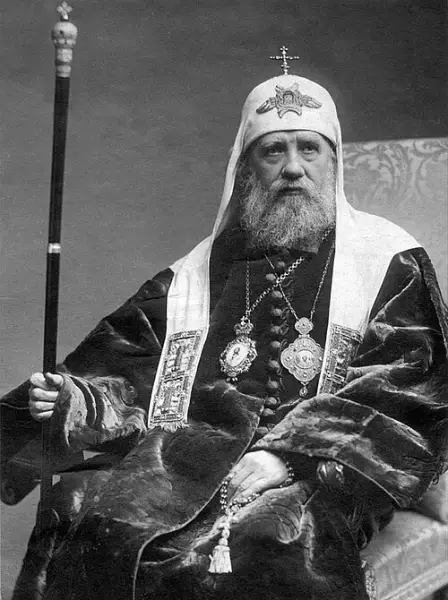
Overview
Tikhon, born Vasily Ivanovich Bellavin, shepherded the Orthodox Church across two continents and into its fiercest persecution. A seminarian of Pskov and graduate of the Saint Petersburg Academy, he took monastic vows in 1891 and rose swiftly through the episcopate: Bishop of Lublin in 1897, then Bishop of the Aleutian Islands and Alaska in 1898. In North America he reorganized the diocese, built St. Nicholas Cathedral in New York, founded a monastery in Pennsylvania, received thousands of Byzantine Catholics into Orthodoxy, and won the affection of emigrants from many nations before returning to Russia in 1907. Elevated through the sees of Yaroslavl, Vilno, and Moscow, he was chosen by lot on 5 November 1917 as the first Patriarch of Moscow in nearly two centuries, days after the Bolshevik seizure of power. He condemned the murder of the imperial family, protested the persecution of the church, and passed from house arrest to a Soviet-sponsored deposition without surrendering his office. He died in 1925 widely revered as a confessor, and was glorified by the Russian Church in 1981 and 1989.
The Complete Life
From Pskov Seminarian to Bishop
The future patriarch was born Vasily Ivanovich Bellavin on 31 January 1865 at Klin, in Toropets County of Pskov Governorate, the son of a land of ancient churches and monastic observance. His education followed the church's paths: from 1878 to 1884 he studied at the Pskov Theological Seminary, and in 1888 he graduated from the Saint Petersburg Theological Academy, still a layman. He returned to the Pskov Seminary as an instructor of moral and dogmatic theology, but the academy's lecture hall was a way station rather than a destination. In 1891, at twenty-six, he received monastic tonsure and the name Tikhon, taken in honor of the eighteenth-century saint Tikhon of Zadonsk, whose gentle pastoral spirit would mark his own. His advancement was rapid: consecrated Bishop of Lublin on 19 October 1897, he had proved within a decade a churchman of administration, teaching, and monastic discipline, ready for the extraordinary charge that came next.
§ Early life
Restorer of the Patriarchate
Called back to Russia in 1907, Tikhon governed the see of Yaroslavl and, from December 1913, that of Vilno in Lithuania, while the empire around him slid into war and revolution. The upheaval made him the church's man of the hour: on 21 June 1917 the diocesan congress, clergy and laity together, chose him ruling bishop of Moscow, on 14 August he was raised to the dignity of Metropolitan of Moscow, and the next day the Local Council of the Russian Church, the first such assembly since the seventeenth century, opened in the capital. Days after the Bolshevik takeover of Petrograd, the council voted on 28 October 1917 to restore the patriarchate, suspended for roughly two hundred years of Synodal rule. On 5 November, after the council named three candidates, Metropolitan Vladimir of Kiev announced that the lot had fallen to Tikhon. The church's ancient primatial office was reborn in the hands of a bishop who had served it in exile, in America, and in the provinces, and who would now carry it into persecution.
§ Return to Russia and restoration of the Patriarchate
Apostle to America
On 14 September 1898 Bellavin received the appointment that made him Bishop of the Aleutian Islands and Alaska, and the nine years he spent in the New World earned him the title by which Orthodoxy remembers him still: Apostle to America. He traveled constantly among the emigrant communities of New York, Chicago, and the mining and steel towns of Pennsylvania and Ohio, eventually becoming a naturalized American citizen. In 1900 he reorganized the diocese, renaming it the Diocese of the Aleutian Islands and North America, and governed it with two auxiliary bishops, Innocent in Alaska and Raphael Hawaweeny in Brooklyn. His crowning work rose in Manhattan: he blessed the cornerstone of St. Nicholas Cathedral in May 1901 in a ceremony attended by Mayor Seth Low, Russian diplomats, and thronging worshippers, and celebrated the first liturgies there in 1902. He consecrated churches for Syrian Antiochians in Brooklyn and for the flock of St. Vladimir's in Chicago, blessed a Pennsylvania monastery that would later found an Orthodox seminary, and consecrated the Holy Trinity church in Winnipeg. He received the carpatho-Russian Uniates returning to Orthodoxy, dialogued with the Episcopal Church, and moved his see from San Francisco to New York as archbishop in 1905, leaving behind in 1907 a North American Orthodoxy far larger and more organized than he had found.
§ Bishop in the United States
Confessor Under the Soviet Power
Tikhon's patriarchate coincided with the Russian Civil War, and the Bolshevik regime treated the church as an enemy: bishops were exiled, imprisoned, and executed. The patriarch condemned the murder of the imperial family in 1918 and protested publicly against violent attacks on the church. In 1920, foreseeing the church's isolation, he granted autonomy to the dioceses cut off from the highest authority, the act from which the Orthodox Church in America traces its standing. When famine ravaged Russia in 1922, the government exploited the emergency to confiscate church property and accuse the patriarch of sabotage; his protest against the confiscation of church property was recast by the regime as a criminal offense, drawing formal protests from several governments. From April 1922 to June 1923 he was held under house arrest in the Donskoy Monastery, and under duress he declared himself no longer an enemy of the Soviet power, though the trust of the Orthodox people in him never wavered. In 1923 a Soviet-sponsored council of the renovating Living Church purported to depose him and reduce him to simple citizen Vasily Bellavin, a sentence no part of the Russian Church ever recognized. He endured to the end as the church's confessor, its undeposed primate in the eyes of the faithful.
§ Patriarchate
Last Liturgy and Death
In 1924 the patriarch's health broke, and he was hospitalized. He emerged once more for the service that had ordered his whole life: on 5 April 1925 came his final celebration of the Liturgy, and two days afterward, on the Feast of the Annunciation, he died in Moscow at the age of sixty. From the time of his death the Orthodox people reckoned him a martyr or confessor for the faith, struck down at the height of the assault upon his church. On 12 April he was laid to rest in the winter church of the Donskoy Monastery, the very monastery that had held him as a prisoner, and his grave became a place of pilgrimage while his memory awaited the day of formal glorification. The Episcopal Church and the Anglican Church in North America, whose fellowship he had courted in America, remember him on the anniversary of his death.
§ Death
Glorification and Incorrupt Relics
The Russian Church abroad first raised its voice: on 1 November 1981 the Synod of Bishops of the Russian Orthodox Church Outside Russia glorified Tikhon together with the host of New Martyrs and Confessors who confessed Christ under the Soviet yoke. Eight years later the Moscow Patriarchate followed, glorifying him at the Bishop's Council of 9-11 October 1989, a step generally read as a sign of the thaw between church and state in the Glasnost era. His relics crowned the story. Believed lost, his coffin was found on 19 February 1992 in a hidden crypt of the Donskoy Monastery, and when it was opened on 22 February his remains proved almost entirely incorrupt. On 5 April 1992, fifty bishops solemnly transferred the relics to a place of honor beside the soleas in the Katholikon of the Donskoy Monastery, where the confessor patriarch lies beneath the same walls that once held him under guard.
§ Canonization
The Church He Left Behind
Tikhon's legacy spans two continents. In North America the diocese he organized grew into the self-governing Orthodox Church in America, which traces its autonomy to his decree of 1920, and the seminary that grew from his Pennsylvania monastery bears his name. In Russia the patriarchate he restored survived deportation, renovationist schism, and militant atheism, and its renewal after the Soviet fall returned his own relics to honor at the Donskoy Monastery. His glorifications of 1981 and 1989, from both sides of the church's twentieth-century divisions, made him a saint claimed by the whole Orthodox people, and his commemoration by Episcopalians and Anglicans keeps his memory among the western Christians he once befriended. He is honored as patron of Western Rite Orthodoxy, Apostle to America, and the confessor who showed that the church's primatial office could be borne with meekness through the storm of a century.
§ Canonization
Timeline
- 31 Jan 1865
Born Vasily Ivanovich Bellavin at Klin in Toropets County, Pskov Governorate
§ Introduction
- 1878
Entered the Pskov Theological Seminary, where he studied until 1884
§ Early life
- 1888
Graduated from the Saint Petersburg Theological Academy as a layman and returned to Pskov to teach moral and dogmatic theology
§ Early life
- 1891
Took monastic vows at twenty-six, taking the religious name Tikhon, after St. Tikhon of Zadonsk
§ Early life
- 19 Oct 1897
Consecrated Bishop of Lublin
§ Early life
- 14 Sep 1898
Appointed Bishop of the Aleutian Islands and Alaska and departed for the United States
§ Bishop in the United States
- 1900
Reorganized the North American diocese, renaming it the Diocese of the Aleutian Islands and North America
§ Bishop in the United States
- 22 May 1901
Blessed the cornerstone of St. Nicholas Cathedral in New York City before a great assembly of clergy, diplomats, and worshippers
§ Bishop in the United States
- 20 Jul 1902
Celebrated the first liturgy in the basement of the new St. Nicholas Cathedral
§ Bishop in the United States
- 9 Nov 1902
Consecrated the church of St. Nicholas in Brooklyn for Syrian Antiochian Orthodox immigrants
§ Bishop in the United States
- 10 Nov 1902
Celebrated the first liturgy in the main hall of St. Nicholas Cathedral
§ Bishop in the United States
- 1903
Consecrated St. Vladimir's Church in Chicago
§ Bishop in the United States
- 1905
Elevated to Archbishop with his see moved from San Francisco to New York, and blessed the founding of St. Tikhon's Monastery in Pennsylvania
§ Bishop in the United States
- 17 Sep 1905
Consecrated the Holy Trinity Russian Orthodox church in Winnipeg, Manitoba
§ Bishop in the United States
- 1907
Returned to Russia to take up the see of Yaroslavl
§ Return to Russia and restoration of the Patriarchate
- 22 Dec 1913
Transferred to the diocese of Vilno in Lithuania
§ Return to Russia and restoration of the Patriarchate
- 21 Jun 1917
Elected ruling bishop of Moscow by the Diocesan Congress of clergy and laity
§ Return to Russia and restoration of the Patriarchate
- 14 Aug 1917
Raised to the dignity of Metropolitan of Moscow
§ Return to Russia and restoration of the Patriarchate
- 28 Oct 1917
The Local Council resolved to restore the patriarchate, days after the Bolshevik takeover of Petrograd
§ Return to Russia and restoration of the Patriarchate
- 5 Nov 1917
Chosen by lot from among three candidates as the first Patriarch of Moscow and All Russia in two centuries
§ Return to Russia and restoration of the Patriarchate
- 1918
Denounced publicly the killing of the imperial family and spoke out against Bolshevik violence toward the church
§ Patriarchate
- 1920
Granted autonomy to the dioceses cut off from the highest church authority, including what became the Orthodox Church in America
§ Patriarchate
- Apr 1922
Placed under house arrest at the Donskoy Monastery as the Soviet government confiscated ecclesiastical property during the famine
§ Patriarchate
- Jun 1923
Released after more than a year of house arrest, and later deposed by a Soviet-sponsored council of the Living Church, a ruling never recognized by the church
§ Patriarchate
- 5 Apr 1925
Served his last Divine Liturgy
§ Death
- 7 Apr 1925
Died in Moscow on the Feast of the Annunciation, aged sixty
§ Death
- 12 Apr 1925
Buried in the winter church of the Donskoy Monastery in Moscow
§ Death
- 1 Nov 1981
Glorified by the Russian Orthodox Church Outside Russia together with the New Martyrs and Confessors of the Soviet Yoke
§ Canonization
- 9 Oct 1989
Glorified by the Moscow Patriarchate at its Bishop's Council, a milestone of the thaw in church-state relations during Glasnost
§ Canonization
- 19 Feb 1992
His coffin was discovered in a concealed crypt at the Donskoy Monastery, and his relics were found almost entirely incorrupt
§ Canonization
- 5 Apr 1992
Fifty bishops solemnly transferred his relics to the Katholikon of the Donskoy Monastery
§ Canonization
The Record
- Major works
- St. Nicholas Cathedral, New York City·St. Tikhon's Monastery, Pennsylvania·Restoration of the Moscow Patriarchate in 1917·Decree granting autonomy to the North American diocese in 1920
- Patron of
- Western Rite Orthodoxy·Orthodox Christians of North America
- Symbols
- Patriarchal vestments and white klobuk·Cross and Gospel book·Reliquary at the Donskoy Monastery
- Canonization
- Glorified 1 November 1981 by the Russian Orthodox Church Outside Russia; canonized 9 October 1989 by the Moscow Patriarchate
Prayer
Bibliography
Show 10 sources
- A Western Rite Orthodox Martyrology. St. Gregory the Great Orthodox Church, Washington, D.C., 2015, p. 64.
- "St Tikhon the Confessor" (PDF). Orthodox Church in America. Retrieved December 15, 2025.
- "St. Nicholas Russian Orthodox Cathedral". www.ruschurchusa.org. Archived from the original on 2013-06-15.
- "Priestmartyr John Kochurov". Orthodox Church in America. Retrieved December 15, 2025.
- "Grafton Commemoration: The Famous 'Circus' Photo". Diocese of Fond du Lac. Archived from the original on 2009-08-03.
- Martynowych, Orest T., Holy Trinity Russian Orthodox church, page 2.
- "Церковныя Вѣдомости, издаваемыя при Святѓйшем Правительствующем Схнодѣ". 2 September 1917, № 35, p. 295.
- "The Russian Orthodox Church Outside of Russia - Official Website".
- Lesser Feasts and Fasts 2018. Church Publishing, Inc. 2019-12-01. ISBN 978-1-64065-234-7.
- Shevkunov, Tikhon (2012). "The Relics of Patriarch Tikhon". Everyday Saints and Other Stories (2nd ed.). Pokrov Publications.
Profile text adapted from the Wikipedia article, licensed CC BY-SA 4.0.
Pray with this saint every day
Save St. Tikhon of Moscow to your favorites, read the full profile, and get feast-day reminders in the Saints app.
Get the Saints AppFree on the App Store for iPhone and iPad