
5th century (traditionally 387-461)·Feast March 17
St. Patrick
Bishop, Apostle of Ireland
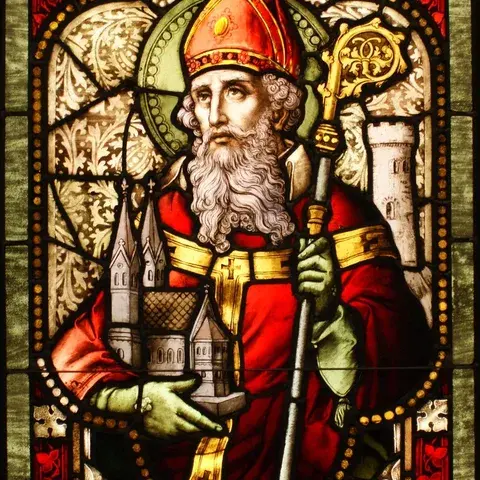
Overview
Patrick was a fifth-century Romano-Briton, son of Calpurnius, a decurion and deacon, and grandson of a priest. In his own Confessio he writes that Irish raiders seized the sixteen-year-old at his home in Britain and carried him to Ireland, where he herded flocks for six years as a slave. In that servitude his faith, previously idle, awoke; he escaped, returned to his family, and after long study - probably in Gaul - was ordained bishop and sent back to the island of his captivity. As a missionary bishop in Ireland he converted thousands, ordained many priests, and organized a native church. Years later, summoned to Britain to answer accusations from fellow churchmen, he composed the long personal defence we know as the Confessio; his other surviving work is a fierce Letter to the soldiers of Coroticus. Almost everything else - the shamrock, the banished snakes, the mountaintop fasts - belongs to the seventh-century Lives of Muirchu and Tirechan and to legend. His feast on 17 March, the traditional date of his death, is a solemnity in Ireland.
The Complete Life
Early Life
Patrick was a fifth-century Romano-Briton, the son of Calpurnius, a decurion and deacon — a local official of the dying imperial administration — and the grandson of a priest named Potitus: a family of the church's minor clergy, settled in the province of Britain at a time when Roman power was withdrawing and the coastal raids were beginning. His birthplace is placed by tradition at several sites, and his dates are uncertain; he tells us his age at the event that changed his life, which is all the chronology his own writings give. In his Confessio, the autobiographical defense he wrote late in life, he says plainly that he and his neighbors ignored the priests among them, and that his own faith, at sixteen, was idle. In that year Irish raiders seized him from his family's property and carried him across the sea, with thousands of others, to be sold in Ireland.
§ Early life and captivity
Conversion and Vocation
Sold to a master in the west of Ireland, Patrick herded flocks for six years — on Slemish, by tradition — and in that servitude the faith he had ignored awoke. His own account is precise: he prayed many times a day, and the love of God and the fear of him grew in him until one night a voice announced that the hour of his return had come, and before long a vessel was made ready for the crossing. He walked some two hundred miles to a port, was refused, prayed, and was taken aboard; after adventures he reached home and his family, who begged him never to leave again. But he had dreamed of a man named Victoricus carrying letters from Ireland, and heard a voice — 'we beg you, holy boy, to come and walk among us again' — and the call he had received in captivity became his vocation to return. Long study followed, probably in Gaul, and ordination as bishop for the Irish mission; he refers to his lack of the education he missed, and to the criticism his irregular training drew, for the rest of his life.
§ Early life and captivity
Mission and Ministry
Patrick's mission in Ireland — traditionally dated from 432, and set against the earlier mission of Palladius, whose work he may have continued — was of a scale no one had attempted in the free Celtic world. Working outside the empire, with no Roman infrastructure of cities and roads, he evangelized by kinship: converting chiefs, and through them their people; paying his own way and refusing gifts, to keep his hands free; and building a native church of churches, priests, and monks rather than a network dependent on continental sees. He says he baptized 'thousands,' ordained many, and traveled to regions 'beyond which no man lived' — the Atlantic rim. His own account of refusing to keep converts' women and gifts shows the standard he set. Whatever the exact relation of his work to Palladius', by his death Ireland had a church that would, within a century, send missionaries back across the collapsing empire.
§ References
Spirituality and Teaching
Patrick's spirituality is documented as few early saints' are, because he wrote it himself, in rough and forceful Latin. The Confessio — the defense of his mission against accusations by fellow churchmen — is the earliest surviving document certainly written in Ireland, and its substance is the theology of the unlearned servant: gratitude for grace, shame at his own education's gaps, and the certainty that God took a slave and made him a bishop to those who had enslaved him. The Letter to the Soldiers of Coroticus, his other surviving work, is fierce: he excommunicates a British chieftain whose men had killed and enslaved newly baptized Irish Christians, and denounces the slave trade itself — one of the earliest Christian condemnations of the traffic in human beings on record. Behind both stands the prayer now called his Breastplate's theology: Christ before me and behind me, the Trinity invoked at every turn of a dangerous day.
§ Introduction
Final Years
The Confessio was written when Patrick was old — he speaks of himself as a fugitive and a failure by the world's measures, worn out, and yet as one who must finish his testimony. The summons to Britain to answer the accusations of his critics (their charge seems to have concerned a confession he made as a youth) was the crisis of his last years; his answer was the document we have, which ends with the hope that he has spent himself well for a people not his own. He died on 17 March by tradition, with the annals giving 461 or 462 (and an alternative tradition 493); the place of his burial was disputed between Armagh and Down from the earliest times, and Downpatrick holds the traditional grave.
§ References
Canonization
Patrick was never canonized by process; he belongs to the great body of pre-congregation saints whose cult is simply the Church's memory. By the seventh century his cult was fixed at Armagh, whose abbots claimed his See and his authority for the primacy of all Ireland; the Lives by Muirchú and Tírechán, written then, gave Ireland its Patrick — the challenger of druids, the faster on Croagh Patrick, the banisher of snakes — a figure as much legend as record, but built on a real man whose own two documents had preserved the fact. His feast on 17 March was a solemnity in Ireland from the early calendar and is now the national day of the Irish everywhere.
§ Introduction
Legacy
Patrick's legacy has three layers. The historical Patrick is the author of the Confessio and the Letter, the missionary bishop of a church without empire, and the man who broke the slave's silence to condemn the trade that had made him one. The legendary Patrick — snakes, shamrock, mountain fasts — is the church's own seventh-century mythmaking, and has carried his name further than the documents ever could. And the national Patrick is the identity of the Irish themselves, at home and through the diaspora, for whom 17 March has become a feast of a people as much as of a saint. The man himself, who wrote that he was 'a sinner, a most simple countryman,' would recognize little of the parade and everything of the text.
§ Introduction
Timeline
- 432
The Irish annals place his arrival in Ireland as missionary in this year, a date chosen to overshadow Palladius
§ Dating
- 445
By tradition he establishes his principal church at Armagh on land given by the chieftain Dáire
§ Patrick and Dáire
- 457
The annals record the death of 'the elder Patrick' this year, possibly meaning Palladius
§ Dating
- 461
The annals note in 461/2 that some record the repose of Patrick
§ Dating
- 17 Mar 492
The annals record in 492/3 the passing of Patrick, arch-apostle of the Scoti, supposedly aged 120
§ Dating
- 553
Colum Cille enshrines his relics, which the annals say was sixty years after his passing
§ Dating
- 632
Cummian, writing on the Easter controversy, calls Patrick 'our papa', meaning father or primate
§ Sainthood and veneration
- 1044
A dispute between two kings over his bell sparks hostage-taking and cattle raids
§ Saint Patrick's Bell
- 1091
King Domnall Ua Lochlainn has his bell encased in a shrine, made sometime before 1105
§ Saint Patrick's Bell
- 9 Mar 2017
The Holy Synod of the Russian Orthodox Church adds his name to its calendar
§ Sainthood and veneration
In Their Own Words
I cannot say that they are my fellow-citizens, nor fellow-citizens of the saints of Rome, but fellow-citizens of demons, because of their evil works
Never before did they know of God except to serve idols and unclean things. But now, they have become the people of the Lord, and are called children of God. The sons and daughters of the leaders of the Irish are seen to be monks and virgins of Christ!
I am Patrick, yes a sinner and indeed untaught; yet I am established here in Ireland where I profess myself bishop.
So I live among barbarous tribes, a stranger and exile for the love of God.
I know for certain, that before I was humbled I was like a stone lying in deep mire, and he that is mighty came and in his mercy raised me up and, indeed, lifted me high up and placed me on top of the wall.
I used to stay out in the forests and on the mountain and I would wake up before daylight to pray in the snow, in icy coldness, in rain, and I used to feel neither ill nor any slothfulness, because, as I now see, the Spirit was burning in me at that time.
From the time when I came to know him in my youth, the love of God and fear of him increased in me, and right up until now, by God's favour, I have kept the faith.
The Record
- Major works
- Confessio (his autobiographical declaration)·Letter to the soldiers of Coroticus (Epistola)
- Patron of
- Ireland (primary patron, with Brigid and Columba)·Nigeria·The Irish diaspora
- Symbols
- Bishop's vestments and crozier·Shamrock (legendary emblem of the Trinity)·Snakes at his feet (legend)
- Canonization
- Pre-congregation (ancient cult); revered as Apostle and primary patron of Ireland since at least the seventh century
Prayer
Bibliography
Show 3 sources
- ↑ Latin : Pātricius
- Irish : Pádraig , Irish pronunciation: [ ˈpˠɑːɾˠɪɟ ] or [ ˈpˠaːd̪ˠɾˠəɟ ]
- Welsh : Padrig , Welsh pronunciation: [ ˈpadrɪɡ ]
Profile text adapted from the Wikipedia article, licensed CC BY-SA 4.0.
Pray with this saint every day
Save St. Patrick to your favorites, read the full profile, and get feast-day reminders in the Saints app.
Get the Saints AppFree on the App Store for iPhone and iPad