
c. 496 – 576·Feast November 18
St. Patroclus of Bourges
Merovingian Hermit and Abbot of Colombier
Overview
Patroclus of Bourges was a Merovingian ascetic who rose from a shepherd boy in the Berry to become a deacon, a solitary, and finally the founding abbot of a monastery at Colombier. Born around 496, he spent his earliest years watching sheep while his elder brother Antonius received the schooling denied to him; only later did his parents consent to his own education, which he carried forward under the teacher Nunnion, a man held in high esteem by King Childebert. Ordained a deacon at Bourges while still young, he became so absorbed in prayer that he neglected the common table of the clergy, drawing the irritation of the archdeacon. Retreating from that friction, he settled at Néris, where he raised a chapel in honor of Martin of Tours, taught children, and cared for the sick who came seeking cures. Desiring deeper solitude, he first established a small community for women, then built himself a cell at a place called Moichant, where he lived on bread, water, and salt, sweetened his drinking water with honey, and won renown for delivering the possessed. He went on to found the monastery of Colombier and governed it as its founding abbot. His death came at La Celle in his eightieth year, and he was buried in his monastery, where his grave became a place of pilgrimage. He is remembered as a patron of cattle.
The Complete Life
A Shepherd Granted His Schooling
Patroclus was born around the year 496 into a family of the Berry, the region of central Gaul around Bourges. His childhood was spent not with books but with flocks: while his older brother Antonius went off to pursue an education, the young Patroclus stayed home and guarded the family's sheep. The arrangement reflected a household that could afford schooling for only one son, and for a time it seemed the future hermit and abbot would remain a country boy with no letters at all. In time, however, his parents relented and allowed him to attend school as well. Once given the chance, he advanced far enough to continue his studies under Nunnion, a master of learning whom King Childebert held in great esteem. The detail, preserved in the tradition of his life, suggests that the shepherd boy's talents became evident quickly enough to place him under instruction of genuine distinction. The contrast between the fields and the schoolroom would shape the man he became: one who never despised humble labor, yet who prized the education of the young so highly that teaching children became part of his later ministry. His earliest formation joined the patience of a shepherd with the discipline of a student, and both would reappear in his work as a deacon, a solitary, and a founder of monasteries.
§ Life
A Deacon Absorbed in Prayer
Gregory of Tours, writing in his Historia Francorum, records that Patroclus was ordained a deacon at Bourges while still a young man. The diaconate placed him among the clergy of an important see, but he proved an unusual member of the cathedral community. So completely was he absorbed in prayer that he failed to appear at the common table when the clergy took their meals together. The archdeacon, charged with the order of the clerical household, took offense at this absence: it seemed to him unseemly that a man should not share bread with those with whom he shared ecclesiastical responsibility. The friction between the contemplative deacon and his supervisor proved decisive. Rather than conform to a rhythm of common life that chafed against his call to ceaseless prayer, Patroclus chose withdrawal. He left the city and retired to Néris, beginning the eremitical life that would define his reputation. The episode is an early window into the character the tradition ascribes to him: a man whose interior devotion was so intense that ordinary community expectations could not contain it, and who was willing to accept criticism rather than curtail his prayer. His path from the cathedral close of Bourges to the solitude of the countryside followed a pattern familiar in Merovingian Gaul, where office and wilderness competed for the same zealous souls.
§ Life
Chapel, Cell, and Monastery
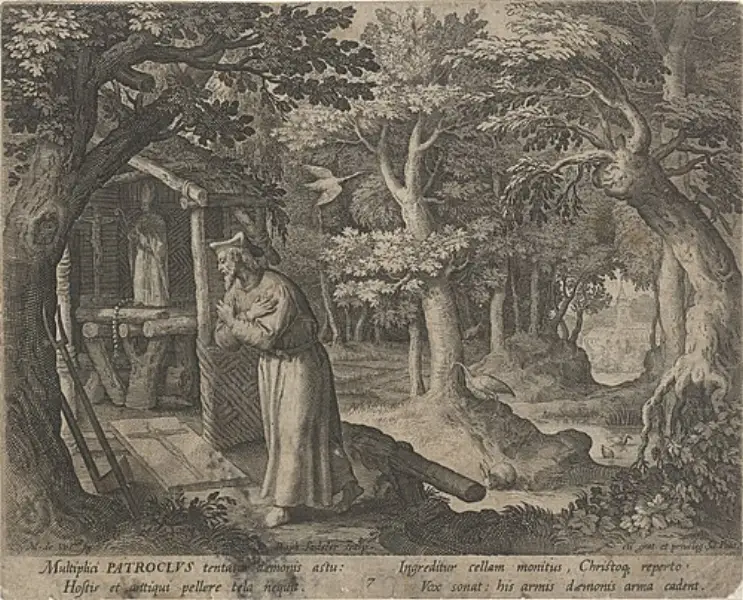
At Néris, Patroclus built a small chapel dedicated to Martin of Tours, the great Wonderworker whose cult shaped much of Frankish monasticism. Around that chapel a ministry quickly gathered: he taught the children of the place, and the sick began to come to him and, the tradition holds, were cured. As his virtue became conspicuous and crowds threatened his peace, he resolved to withdraw into deeper solitude, but not before securing the future of what he had begun. He first established a small monastic community for women, entrusting to it the fruit of his work at Néris. Then he built himself a cell at a spot called Moichant and settled into a severely ascetic regimen: he drank nothing stronger than water sweetened with honey, and his food was bread, water, and salt. Long stretches of the day and night were given to prayer. In that place his reputation for healing reached its height, and an enormous number of people said to be possessed were delivered from their afflictions through the laying on of his hands and the tracing of the cross. His final foundation followed this period of solitary fame: at Colombier he built a monastery and became its first abbot, gathering under a rule the disciples his holiness had attracted.
§ Patroclus at Néris
Death at La Celle
Patroclus lived to an advanced age, dying at a place called La Celle at eighty years old, a span that carried him from the eve of the Frankish settlement of Gaul deep into the Merovingian age. According to the tradition of his life he was buried at the monastery of Colombier, the community he had founded and governed as its first abbot. His grave did not remain a quiet resting place for long: it became a destination for pilgrims, who came to honor the hermit and healer whose fasting, prayer, and gifts of healing had marked his whole career. The pilgrimage traffic at his tomb is the clearest sign of how widely his memory spread beyond the immediate circle of his monasteries. In the centuries that followed, his cult settled into the local calendars of the region. The Roman Catholic Church commemorates him on November 18, while the Orthodox Church keeps his memory a day earlier, on November 17. He is also invoked as a patron saint of cattle, an unlikely but telling patronage for a man whose first occupation was guarding sheep, and whose holiness, in the minds of the farming communities of the Berry and the lands around Colombier, extended its protection to the beasts on which their livelihood depended.
§ Patroclus at Néris
Memory in Berry and Beyond
The chief witness to Patroclus's life is Gregory of Tours, who devoted an account of him to the ninth book of his Life of the Fathers and mentioned his diaconate in the Historia Francorum. That a writer of Gregory's standing included him among the holy men of recent Gaulish memory indicates the esteem his ascetic career commanded within a generation of his death. The institutions he left behind carried his influence forward: the women's community he established at Néris, the chapel of Martin of Tours that anchored his first ministry, and the monastery of Colombier, over which he presided as founding abbot. His tomb became a center of pilgrimage, and the region's faith in his intercession settled into enduring forms, above all the designation of cattle under his patronage, a distinction rooted in his boyhood as a shepherd. His feasts on November 18 in the Roman Catholic Church and November 17 in the Orthodox Church keep his name on both Western and Eastern calendars. Modern scholarship has continued to consult his story: studies of social mobility in late antique Gaul cite his passage from shepherd's hut to cathedral school, and hagiographical reference works preserve the details of his foundations, making the shepherd of the Berry one of the better-attested ascetics of sixth-century France.
§ References
Timeline
- 496
Born around this year into a family of the Berry, and raised guarding his family's sheep
§ Introduction
- 576
Dies at La Celle at the age of eighty and is buried at the monastery of Colombier
§ Patroclus at Néris
The Record
- Major works
- Foundation of a women's monastic community at Néris·Chapel dedicated to Martin of Tours at Néris·Founding of the monastery of Colombier
- Patron of
- patron of cattle
- Symbols
- shepherd's crook·abbot's habit·cattle
- Canonization
- Pre-congregation; venerated from antiquity, his tomb drawing medieval pilgrimages
Prayer
Bibliography
Show 6 sources
- Gregory of Tours, Life of the Fathers, Book 9 (Life of Patroclus), OUP
- "Patroclus from Bourges", The Presbyters Project
- Jones, Allen E., Social Mobility in Late Antique Gaul, Cambridge University Press, 2009 ISBN 9780521762397 p. 325
- Akker s.j., A. van den. "Patroclus van Colombier", Heiligen.net
- Goyau, Georges. "Moulins." The Catholic Encyclopedia Vol. 10. New York: Robert Appleton Company, 1911
- Schäfer, Joachim. "Patroclus von Colombier", Ökumenischen Heiligenlexikon
Profile text adapted from the Wikipedia article, licensed CC BY-SA 4.0.
Pray with this saint every day
Save St. Patroclus of Bourges to your favorites, read the full profile, and get feast-day reminders in the Saints app.
Get the Saints AppFree on the App Store for iPhone and iPad