
died c. 259·Feast January 21
St. Patroclus of Troyes
Aristocrat Martyr of Gaul, Patron of Soest
Overview
Patroclus of Troyes was a Christian martyr who died around the year 259 in the Gallic city of Tricassinum, the modern Troyes. Born into wealth, he inherited from his parents a substantial estate just outside the city and lived on it as a devout Christian, becoming known above all for his generosity to the poor. His charity was considered so pleasing to God that he was believed to have received the gift of working wonders, and the tradition credits him with the conversion of Sabinian of Troyes. He was probably beheaded in the persecution of Emperor Valerian, though the later passion story that bears his name places his death under Emperor Aurelian and elaborates it with dramatic detail: condemned for refusing to worship the Roman gods, he was ordered taken to water and beheaded there so that his body would find no rest on dry land; the guards escorting him to the Seine were struck with blurred vision and he briefly escaped across the river before being retaken and beheaded at Troyes. Two beggars who had often received his alms recovered his body, and it was buried at night by Eusebius, the local archpriest, and the deacon Liberius. Gregory of Tours records a chapel raised over his grave at Saint-Parres-aux-Tertres. In 962 Bruno, Archbishop of Cologne, carried his relics to Cologne, and two years later to Soest in Westphalia, where he became patron saint and his relics rest in the church of St. Patrokli.
The Complete Life
An Heir of Tricassinum
Patroclus belonged to the aristocracy of Tricassinum, the Gallic city known today as Troyes, in the third century. His parents died leaving him a substantial estate situated just outside the city walls, and it was on this property that he made his home as an adult. Unlike many landowners of his rank, he did not treat his inheritance as a means to leisure or advancement; the tradition of his life presents him as a man who led a genuinely pious Christian existence on his own land. In an age when the church of Gaul was still young and persecution periodically threatened its members, a wealthy Christian was a conspicuous figure, and Patroclus's faith was expressed less in words than in the steady practice of almsgiving. His generosity toward the poor of the city and countryside around his estate became his defining trait, so much so that later writers described charity as the distinguishing mark of his life. It was on account of this liberality, the account insists, that God bestowed upon him the gift of wonderworking: the wonders attributed to him were not sought as signs of personal holiness but flowed from a life ordered toward the relief of others. The beggars who would one day recover his body were among the poor who had learned to rely on his table and his purse.
§ Life
Charity and the Gift of Wonders
The spirituality the tradition ascribes to Patroclus was one of practical mercy rather than speculation. Wealth, in his hands, became an instrument of the gospel: the estate outside Troyes supported a life of almsgiving that made his house a refuge for the destitute. The hagiographical account draws a direct line between this charity and his reputation as a wonderworker, presenting the miracle-working power as heaven's response to his liberality rather than as a separate charismatic endowment. His influence extended to conversion as well: he is said to have brought Sabinian of Troyes to the faith, and Sabinian's own later veneration as a saint of the city stands as part of Patroclus's spiritual legacy. The passio that recounts his death, while freely borrowing its literary shape from the passion of Symphorianus of Autun, preserves the central conviction of his cult: that a man of charity could not be made to betray his God. When commanded to worship the Roman gods, he refused, and the refusal cost him his life. In the memory of the church of Troyes, the aristocrat who fed the poor and the martyr who faced the executioner were the same figure, his death the seal on a life whose whole logic had been the giving away of self and substance for the sake of Christ and his needy ones.
§ Passio
Trial at the River
The Passio sancti Patrocli Trecensis gives the fullest account of his martyrdom, though it is in many respects a literary adoption of the passion of Symphorianus of Autun and it places the event under Emperor Aurelian rather than in the Valerianic persecution to which his death is probably to be dated. According to this narrative, the emperor condemned Patroclus for refusing to worship the Roman gods and ordered that he be taken to water and beheaded there, so that his corpse might never repose on dry ground. The soldiers conducting him toward the River Seine, however, found their eyes clouded, and in the confusion the prisoner briefly escaped across the water. The guards fell to arguing among themselves over the meaning of what had happened, some concluding that his god had delivered him and others that he had escaped through magic. The respite was short. Patroclus was recaptured and beheaded at Troyes, and in this way the sentence that had meant to deny him burial on dry land was carried out in the city itself. Whatever the historical complications of the story, its core is a martyr's death by the sword around the year 259, endured rather than avoided, and remembered at Troyes as the cost of fidelity to the Christian faith.
§ Passio
Burial by Night
The first mourners at the martyr's body were, fittingly, the poor. Two aged beggars who had often received alms from Patroclus went to the place of execution, took charge of his remains, and kept watch over them until evening. Under cover of darkness two clergy came to join them: Eusebius, the archpriest of the place, and Liberius, a deacon. Together they enfolded the remains in linen cloth and laid them quietly in the earth, a caution easy to understand in the aftermath of a judicial execution, and then remained watching through the night beside the two aged men who had first kept guard. The scene, preserved in the passion narrative, set the pattern for the cult that followed: the saint's grave became the center of Christian memory at Troyes. Gregory of Tours, writing three centuries later, recounts that a modest chapel had been raised above the martyr's tomb at Saint-Parres-aux-Tertres, the spot on the edge of the city where his body rested. For the early medieval church of Gaul, the tomb of Patroclus joined the growing map of martyrs' shrines that structured local devotion, and the memory of the destitute men and the nighttime burial remained attached to it, a permanent reminder that the martyr's charity had outlived him in the gratitude of those he had fed.
§ Passio
From Troyes to Soest
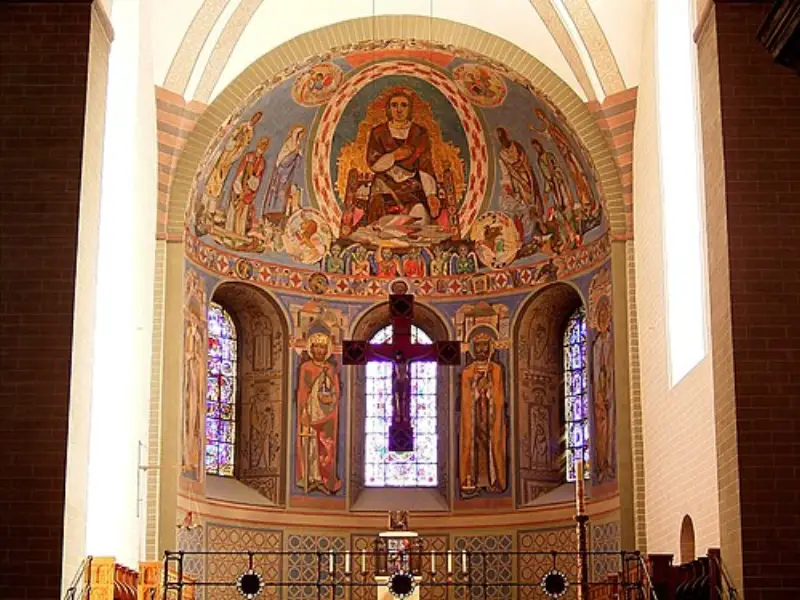
Patroclus's cult traveled far from the Gallic city of his birth and death. Gregory of Tours attests the chapel at Saint-Parres-aux-Tertres, and in the tenth century his relics undertook the journey that fixed his name in Germany. In 962 Bruno I, Archbishop of Cologne, transported the remains from Troyes to Cologne, and in 964 transferred them to Soest in Westphalia. There they were enshrined in the church of St. Patrokli, dedicated in the martyr's honor, and Patroclus became the patron saint of the town, which still displays a polychrome statue of him on the central part of the town hall's facade. In Christian art he appears as a warrior gesturing toward a fish that bears a pearl within its mouth, an emblem whose imagery links him to the waters of his attempted escape and the treasure of faith. The faithful invoke him particularly against demons and fever. His feast is kept on January 21 in the Roman Catholic Church, while the Eastern Orthodox Church commemorates him on August 17. Few saints of third-century Gaul can claim so wide a geographic arc: born and martyred at Troyes, mourned by beggars, chronicled by Gregory of Tours, and finally enthroned in the Westphalian town that took him for its heavenly patron.
§ Veneration
Timeline
- 259
Suffered martyrdom by beheading at Troyes, probably in the persecution of Emperor Valerian
§ Introduction
- 962
Bruno I, Archbishop of Cologne, transports the relics from Troyes to Cologne
§ Veneration
- 964
The relics are transferred to Soest in Westphalia and enshrined in the church of St. Patrokli
§ Veneration
The Record
- Patron of
- patron saint of Soest·invoked against demons·invoked against fever
- Symbols
- depicted as a warrior pointing to a fish with a pearl in its mouth
- Canonization
- Pre-congregation; venerated as a martyr from antiquity by the Roman Catholic and Orthodox Churches
Prayer
Bibliography
Show 5 sources
- "Martyr Patroclus of Troyes", Orthodox Church in America
- Philip Beagon (Datum); David Lambert (Discussion), "Passio sancti Patrocli Trecensis", Cult of Saints, E06480
- Akker S.J., Dries van den. "Patroclus van Troyes", Heiligen
- "Saint Parres aux Tertres", Troyes La Champagne Tourisme
- "Den hellige Patroclus", Den katolske kirke
Profile text adapted from the Wikipedia article, licensed CC BY-SA 4.0.
Pray with this saint every day
Save St. Patroclus of Troyes to your favorites, read the full profile, and get feast-day reminders in the Saints app.
Get the Saints AppFree on the App Store for iPhone and iPad