
c. 435 – 575·Feast March 12
St. Paul Aurelian
First Bishop of Léon, Founder Saint of Brittany
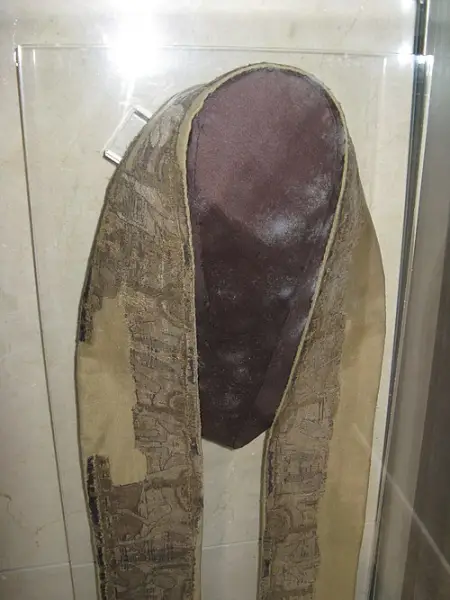
Overview
Paul Aurelian, whom the Bretons name Paol Aorelian and honor as Saint Pol de Léon, called Paulinus Aurelianus in Latin writings, was a sixth-century Welshman who became the first bishop of the see of Léon, numbered among the seven founder saints of Brittany. The hagiographic Life composed in 884 by the Breton monk Wrmonoc of Landévennec Abbey, makes him the son of Perphirius, a chieftain of Penychen in Glamorgan, and gives him as sisters three holy martyrs, Juthwara, Sidwell, and Wulvela. His studies began under Saint Illtud at Llantwit Major and later on Caldey Island alongside Samson of Dol and Gildas, he crossed to Armorica as part of the Brythonic migration that accompanied the Saxon raids on Britain. In Finistère he established monasteries on the island of Ushant, another on Batz, and a third at Ocsimor, today's Saint-Pol-de-Léon, where he founded a community within an abandoned fort. His consecration as bishop took place there under the authority of Childebert, the Frankish king, and he became the see of Léon's first occupant. He maintained a strictly vegetarian diet of simple foods, bread and water. Tradition reports that he died on the island of Batz in 575, rumored to have reached the improbable age of 140 after being aided by three successive coadjutors, a detail that has led scholars to suspect several men named Paul were conflated. He was buried first at Saint-Pol-de-Léon; his relics were later moved to Fleury Abbey.
The Complete Life
A Chieftain's Son of Glamorgan
Nearly everything known of Paul Aurelian's origins comes from the hagiographic Life completed in 884 by Wrmonoc, a monk of Landévennec Abbey, more than three centuries after the saint's death. According to this account, Paul was born around 435 in Glamorgan, Wales, the son of a chieftain named Perphirius or Porphyrius, a name meaning clad in purple, who ruled in Penychen. The Life would later supply him with three holy sister-martyrs, Juthwara, Sidwell, and Wulvela, binding him into the fabric of Cornish and Welsh sanctity. Medieval genealogical traditions connected his family circle with the princely house of the region: the Life of Cadoc reckons the founder of Llancarfan as the son of Gwynllyw, and some sources give Gwynllyw a brother called Pawl, chief of the neighboring Penychen. It has even been suggested that Paul was related to Ambrosius Aurelianus, with whom he shares the Aurelian name and a possible sojourn in Brittany. These family traditions belong to a wider historical moment: in the era of Saxon raiding across the British Isles, they reinforce the picture of an organized migration of the Brythonic population, led by clergy and nobility carrying their faith across the Channel. Scholars have suspected that several men named Paul were blended into this single biography, and G. H. Doble even proposed identifying him with Paulinus of Wales.
§ Family
Schools of the Celtic Masters
Paul's formation followed the great schools of Celtic Christianity. His first teacher was Saint Illtud, whose monastery at Llantwit Major in Glamorgan was the most celebrated center of learning in the Brittonic world, training a generation of saints. From there Paul moved to Caldey Island, off the coast of Pembrokeshire, where he studied in the company of two other towering figures of the age, Samson of Dol and Gildas. This sequence of education places him squarely within the clerical aristocracy of fifth- and sixth-century Britain, whose members moved between island monasteries as students and teachers before carrying their vocation abroad. The Caldey years associated him with the monastic reforming currents that would soon flow into Brittany and Ireland. His subsequent departure for Armorica was not the act of a solitary wanderer but part of the organized migration of Brittonic peoples under clerical and noble leadership during the age of Saxon raids. In crossing to Finistère, Paul took the skills of the Welsh schools with him, and the monasteries he planted on Ushant, on Batz, and at Ocsimor transplanted to Breton soil the learning and discipline he had absorbed at Llantwit Major and Caldey, preparing the way for his consecration as a bishop under Frankish authority.
§ Career
Foundations in Finistère
In Brittany Paul's work centered on the northwest coast and its islands. He established monasteries across Finistère: one at Lampaul on the island of Ushant, the exposed outlier at the edge of the Channel; another on the island of Batz, lying off the coast near Léon; and a third at Ocsimor, today's city of Saint-Pol-de-Léon, where tradition holds that he planted a monastery within the walls of an abandoned fort, turning a decayed Roman stronghold into a Christian settlement. The choice of islands and fortifications reflects the character of early Breton monasticism, which sought out liminal and defensible places at the margin of the inhabited world. His standing among the colonists was confirmed when his episcopal consecration followed at Ocsimor by command of Childebert, the Frankish king; it made him the first bishop of the see of Léon and binding the new Brittonic church to the Frankish political order. As bishop he presided over the young see while the monastic network he had planted continued to grow around him. The tradition records that three successive coadjutors assisted him in his labors across a life of extraordinary length, and he was eventually succeeded in the episcopate by his companion Saint Joavan, who carried the church of Léon forward after him.
§ Career
Bread, Water, and the Ascetic Table
The tradition preserves a distinctive note of Paul's asceticism: he was a vegetarian whose staple fare was of the plainest vegetable kind, bread and water. Such discipline placed him with the Desert tradition carried into the Celtic world, in which the monk's table was a battlefield of self-mastery and a daily testimony that the kingdom of God did not depend on the bounty of this world. It also harmonized with the island setting of his foundations, where Ushant and Batz offered meager fare and demanded self-sufficiency from the communities that settled them. Paul's long life, rumored to have extended to the improbable age of 140, was understood in the hagiographic tradition as a kind of ascetic achievement sustained by three successive coadjutors who shared the burden of his episcopal labors. Whatever the historical reality behind the figure, the image the tradition intended is clear: a bishop whose authority rested on holiness of life rather than rank, whose food was the plainest the land afforded, and whose endurance outstripped ordinary human measure. The survival of his bell at Saint-Pol-de-Léon, among the handful of early medieval hand-bells associated with the founder saints of Brittany, gives tangible witness to the veneration his disciplined, prayerful life inspired among the generations that followed him.
§ Career
Death on Batz and Relics at Fleury
One account records that Paul died on the island of Batz, the site of one of his own monastic foundations, in the year 575, allegedly at the age of 140. The fantastic figure has persuaded modern scholars that the biography compresses several men named Paul into one, their careers joined end to end and their coadjutors read as stages in a single impossibly long episcopate. His first burial came at Saint-Pol-de-Léon, the city that still bears his name, and his grave there became the center of his cult in the Léon region. In time his relics were transferred to Fleury Abbey, the great Burgundian house that guarded the remains of Saint Benedict and drew the relics of many saints into its keeping; the abbey stands as his major shrine in the tradition. The memory of the saint took other tangible forms as well: his bell was preserved at Saint-Pol, a relic of the founder's own ministry, and his feast was fixed on March 12. He is venerated across the Anglican Communion, the Eastern Orthodox Church, and the Roman Catholic Church, and his name heads the roll of the seven founder saints of Brittany, the missionary bishops and abbots to whom the peninsula's earliest Christian settlements traced their origin.
§ Career
Founder Saint and Scholarly Puzzle
Paul Aurelian's legacy has two faces: the saint honored across Brittany and the scholarly puzzle surrounding his identity. As Saint Pol de Léon he ranks among the seven founder saints of Brittany, and the city of Saint-Pol-de-Léon preserves his name, his cathedral's tradition, and his bell. The account of his life by Wrmonoc of Landévennec, written in 884, made him a fixed point of Breton hagiography, and his feast on March 12 has kept his memory in Western and Eastern calendars alike. At the same time, the implausible chronology of his life has invited critical scrutiny. G. H. Doble proposed that Paul Aurelian might be the same person as Paulinus of Wales, the hermit and teacher revered in Carmarthenshire at a place usually identified as Whitland, remembered as the teacher of Saint Teilo and as the one who put forward Saint David to address the Synod of Llanddewi Brefi around 545. Rhigyfarch's Life of David describes that Paulinus as a scribe and disciple of Saint Germanus, and credits David with miraculously restoring his sight when he went blind. Hywel David Emanuel considered the identification doubtful. An inscribed sixth-century stone found at Caeo, honoring a preserver of the faith and champion of righteousness, may belong to that other Paulinus, whose separate feast falls on November 23.
§ Paulinus of Wales
Timeline
- 435
Born, according to tradition, in Glamorgan, Wales, son of the chieftain Perphirius of Penychen
§ Introduction
- 575
Dies on the island of Batz, reportedly at the legendary age of 140, after three successive coadjutors assisted his labors
§ Introduction
- 884
Wrmonoc, a monk of Landévennec Abbey, completes the hagiographic Life recounting Paul's family and career
§ Family
The Record
- Major works
- Monastery on the island of Ushant (Ouessant)·Monastery on the island of Batz·Monastery at Ocsimor (Saint-Pol-de-Léon), founded in an abandoned fort·Establishment of the See of Léon
- Canonization
- Pre-congregation; venerated since antiquity as one of the seven founder saints of Brittany
Prayer
Bibliography
Show 7 sources
- Monks of Ramsgate. "Paul de Leon". Book of Saints, 1921. CatholicSaints.Info. 23 August 2016. Web.
- Roberts, Holly Harlayne (2004-09-01). Vegetarian Christian Saints: Mystics, Ascetics & Monks. New York: Anjeli Press. p. 182. ISBN 978-0-9754844-0-1. Retrieved 2010-12-09.
- "Paul Aurelian", The Oxford Dictionary of Saints 5th rev ed. (David Farmer, ed.) OUP, 2011 ISBN 9780199596607
- St. Augustine's Abbey, Ramsgate (1921). The Book of saints: a dictionary of servants of God canonized by the Catholic Church. London: A. & C. Black, ltd. p. 147. Retrieved 2021-07-26.
- G. H. Doble (1971), Lives of the Welsh Saints
- Emanuel, Hywel David. "Paulinus". Dictionary of Welsh Biography. National Library of Wales.
- Baring-Gould, Sabine; Fisher, John (1913). "S. PAULINUS, or PEULIN, Bishop, Confessor". The Lives of the British Saints. Vol. IV. London: The Honourable Society of Cymmrodorion. pp. 72–75.
Profile text adapted from the Wikipedia article, licensed CC BY-SA 4.0.
Pray with this saint every day
Save St. Paul Aurelian to your favorites, read the full profile, and get feast-day reminders in the Saints app.
Get the Saints AppFree on the App Store for iPhone and iPad