
died c. 350·Feast November 6
St. Paul I of Constantinople
Thrice-Deposed Nicene Archbishop and Confessor
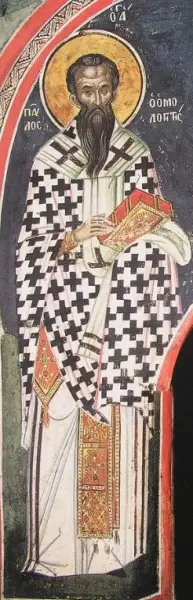
Overview
Paul I of Constantinople, honored as Paul the Confessor, was the sixth bishop of Constantinople and one of the most afflicted defenders of the Nicene faith in the generation after the Council of Nicaea. A native of Thessalonica, he served the Constantinopolitan church as a presbyter and as secretary to Bishop Alexander in his old age, succeeding him in 337 when the Orthodox party elected and consecrated him in the Church of Peace, near the site of the future Hagia Sophia. His episcopate unfolded under the shadow of the Arian controversy and the hostility of Emperor Constantius II, who protected the Arian party in the East. Paul was installed and deposed three times between 337 and 350. Banished around 339, he sheltered in the West, where at Rome he joined Athanasius of Alexandria, Marcellus of Ancyra, and Asclepas of Gaza before Pope Julius I, who found them all steadfast to the creed of Nicaea and espoused their cause. Restored after the death of Eusebius of Nicomedia in 341, he was expelled again amid riots in which the imperial general Hermogenes was killed. He returned in 344 backed by letters from the western emperor Constans, but after Constans died in 350, Constantius had him seized at the baths of Zeuxippus and shipped to Thessalonica. Loaded with chains, he was moved to Singara in Mesopotamia, then Emesa, and finally Cucusus in Cappadocia, where, having survived six days without food in a dark cell, he was strangled. His remains reached Constantinople in 381 and Venice in 1226.
The Complete Life
A Presbyter of the New Capital
Paul came from Thessalonica, the great port city of Macedonia, and made his way to Constantinople, the new Christian capital that Constantine had raised on the Bosporus. There he served as a presbyter of the city's church and as secretary to Bishop Alexander, the aged occupant of the see who had defended its faith against the spreading teachings of Arius. The position placed him at the center of the storm that was gathering over Eastern Christendom: both the city and its inhabitants, the tradition records, suffered much during the Arian controversies, and Constantinople, as the imperial residence, attracted the ambitions of every party. When Alexander lay dying or had died, the question of succession became immediately political. The Arian and Orthodox parties came into open conflict the moment Alexander was gone, each determined to control the pulpit of the capital. Paul represented the Orthodox succession: shaped in the household of Alexander, entrusted with his correspondence and his confidence, and known to the clergy and people as a man of the Nicene conviction his bishop had upheld. From Thessalonica to the imperial city, his whole formation belonged to the generation that had received the Council of Nicaea as the church's charter, and he would be asked to pay for that inheritance with three exiles and his life.
§ Biography
Election in the Church of Peace
No sooner had Alexander died than the two parties moved. The Orthodox party prevailed, and in 337 Paul was elected and consecrated bishop of Constantinople by the bishops who happened to be in the city, the ceremony taking place in the Church of Peace, which stood close to what would afterward be the site of the Hagia Sophia. The choice of that church, with its name speaking of the peace the world could not give, marked the hopes with which the Orthodox party installed their candidate. His vocation as bishop, however, was defined from the outset by opposition from the throne. Emperor Constantius II had been absent while the election took place, and coming back he was angered that his consultation had been omitted in matters touching the capital's church. Summoning a synod of Arian bishops, he pronounced Paul altogether unfit for the bishopric, sent him into banishment, and brought Eusebius of Nicomedia, that shrewd leader of the Arian party, to Constantinople in his place. Thus within two years of his consecration Paul learned the terms of his ministry: he would hold the see only as long as the faithfulness of his confession outlasted the displeasure of emperors, and the validity of his office would rest not on imperial favor but on the faith of the church that had chosen him.
§ First exile
Three Exiles and Two Restorations
Paul's episcopate became a long contest of banishment and return. Judging himself of no further use to his flock while the East's Arianism flourished under Constantius's patronage, he withdrew to the West, found refuge in the dominions of Constans, and made his way to Rome. There he met Athanasius of Alexandria, himself expelled from his see, together with Marcellus of Ancyra and Asclepas of Gaza. The exiles laid their cases before Pope Julius I, who heard each case separately, judged them all firm in the creed of Nicaea, welcomed them into communion, took up their cause, and sent a strong letter to the bishops of the East; the latter answered, refusing outright to follow his counsel. Athanasius and Paul nonetheless recovered their sees. Eusebius died in 341 and Paul was reinstated, but the Arians made the most of the moment: Theognis of Nicaea, Theodorus of Heraclea, and fellow bishops of the heterodox party consecrated Macedonius in opposition as bishop in the church of Saint Paul, and the city became the prey of civil war. Constantius, at Antioch, ordered his cavalry general Hermogenes to expel Paul, but the people rushed the general's house, burned it, and killed him, dragging his body in triumph through the streets. When the emperor rode at full speed to punish the revolt, the populace met him on their knees; he contented himself with halving their allowance of corn but ordered Paul driven from the city.
§ Second exile
Steadfast to the Creed of Nicaea
The spirituality that emerges from Paul's troubled episcopate is one of unyielding fidelity to the creed of Nicaea, maintained at the cost of office, home, and finally life. The judgment pronounced over him and his fellow exiles by Pope Julius I, that they were all staunch to the creed of Nicaea, stands as the summary of his inner life: he measured the faith in the formulas that confessed the Son as God from God, and he would not purchase peace by diluting them. His steadfastness was not solitary. By joining Athanasius of Alexandria, Marcellus of Ancyra, and Asclepas of Gaza in their appeal to Rome, he practiced the communion of confessing bishops, standing with the witnesses of the Nicene faith across the whole East and West. He accepted that the price of this fidelity was repeated displacement: three times installed, three times driven out, each exile endured rather than provoked, for he left Constantinople the first time only when he saw himself rendered useless to his flock. Even the loyalty of his people he received with restraint, refusing to make their love an occasion of bloodshed beyond what force compelled. In the hagiography of the church he is remembered as a confessor, the title given to those who suffered for the faith short of, or in this case at the point of, martyrdom, and his feast on November 6 keeps that witness alive.
§ First exile
From Zeuxippus to Cucusus
The death of Constans in 350 stripped Paul of his last imperial protection. Constantius II, who was then staying at Antioch, commanded Philippus, the Eastern prefect, to drive Paul out yet again and to install Macedonius in his place. Philippus proceeded with theatrical caution: in the public baths named for Zeuxippus, next to a palace standing on the Bosporus shore, he invited the bishop to meet him as if to discuss public business. When Paul arrived, the prefect showed him the emperor's letter and had him quietly led through the palace to the waterside, put on board a ship, and carried off toward Thessalonica, his native town. Leave was granted him to visit Illyricum and the far provinces, but he was never again allowed to set foot in Eastern lands. The measures then hardened. Paul was loaded with chains and taken to Singara in Mesopotamia, then to Emesa, and finally to Cucusus in Cappadocia, the harsh frontier village that would later also receive the exiled John Chrysostom. There they shut him in a narrow, unlit cell and abandoned him to starvation. Six days passed without food before his enemies, to their great disappointment, found him still alive; whereupon they strangled him and reported that he had died after a short sickness. Thus the archbishop who had occupied the first see of the East ended his life as a starved and strangled prisoner around the year 350.
§ Third exile
Confessor and Martyr of the Nicene Faith
The church honored Paul from the first as a confessor and martyr of the orthodox faith, numbered among the victims of the Arian struggle whose sufferings the historians Socrates Scholasticus and Sozomen recorded and whose cause Athanasius himself had championed. His liturgical memory was fixed on November 6, and he is venerated in both the Catholic Church and the Eastern Orthodox Church, which keep him among the early archbishops of Constantinople whose witness sealed the Nicene settlement. The honor began with his body. Brought after his death to Ancyra in Galatia, his remains were translated by the order of Emperor Theodosius I to Constantinople in 381, the very year the emperor summoned the Second Ecumenical Council that would confirm the Nicene faith Paul had died defending, and lay buried in the great church built by his old rival Macedonius. That church was ever afterward called by the single name of Saint Paul, a quiet triumph of the martyred bishop over the adversary who had taken his throne. In the Western church his cult traveled with his relics to Venice, and the menologion miniatures of the Byzantine tradition preserve his portrait among the saints, frescoed and illuminated, a bishop whose crown was won in prison rather than in the cathedral he three times governed.
§ Third exile
A Relic's Road to Venice
Paul's legacy was carried across the centuries by the movements of his own remains. After his murder at Cucusus, his body was brought to Ancyra in Galatia, where it rested for a generation until Theodosius I, the emperor who would make Nicene Christianity the faith of the empire, ordered it translated to Constantinople in 381. There it was buried in the great church that had been built by Macedonius, his Arian rival and successor, and the building was thenceforth called by no other name than that of Saint Paul, so that the confession of the martyred archbishop was preached daily from the very walls his opponents had raised. In 1226 his remains were carried off to Venice, where the church of St. Laurence preserves them with deep reverence, carrying his memory into the Latin West. His historical witness rests on the account of the church historians of the fourth and fifth centuries, above all Socrates Scholasticus and Sozomenus, and on the history of the Arian troubles recorded by Athanasius, materials gathered in the standard dictionaries of Christian biography. In the registers of the church he appears three times over in the list of the archbishops of Constantinople, deposed and restored in 337, again in 341, and again from 346, an episcopate broken by exile yet never resigned, a pattern remembered wherever bishops weigh the demands of empires against the creed they swore to keep.
§ Notes and references
Timeline
- 337
Elected and consecrated bishop of Constantinople in the Church of Peace immediately after the death of Bishop Alexander
§ Biography
- 339
Banished by Emperor Constantius II through an Arian synod, and Eusebius of Nicomedia is installed in his place
§ First exile
- 341
Restored to the see after the death of Eusebius of Nicomedia
§ Second exile
- 342
Expelled again after the Arians consecrate Macedonius and rioters kill the imperial general Hermogenes
§ Second exile
- 344
Returns to Constantinople with letters of recommendation from the western emperor Constans
§ Third exile
- 350
Seized by the prefect Philippus at the baths of Zeuxippus and shipped away to his native Thessalonica
§ Third exile
- 350
Dies at Cucusus in Cappadocia, strangled by his jailers after surviving six days without food in a dark cell
§ Third exile
- 381
His body is translated from Ancyra to Constantinople by order of Emperor Theodosius I
§ Third exile
- 1226
His remains are carried to Venice, where the church of St. Laurence honors them with great reverence
§ Third exile
The Record
- Major works
- Defense of the Nicene creed as archbishop of Constantinople·Alliance with Athanasius of Alexandria and the exiled Nicene bishops before Pope Julius I
- Canonization
- Pre-congregation; venerated as a confessor and martyr from antiquity by the Catholic and Eastern Orthodox Churches
Prayer
Bibliography
Show 7 sources
- Sinclair, W. M. (1911). "Paulus I, bishop of Constantinople". In Wace, Henry; Piercy, William C. (eds.). Dictionary of Christian Biography and Literature to the End of the Sixth Century (3rd ed.). London: John Murray.
- "Paul I", The Ecumenical Patriarchate of Constantinople
- Butler, Alban; The Lives of the Saints, Vol. VI, (1886)
- Socrates Scholasticus, H. E., ii, 6, etc.
- Sozomenus, H. E., iii, 3, etc.
- Athanasius of Alexandria, Hist. Arian. ad Monach, 275
- Mansi, Giovanni Domenico, Concil, i, 1275
Profile text adapted from the Wikipedia article, licensed CC BY-SA 4.0.
Pray with this saint every day
Save St. Paul I of Constantinople to your favorites, read the full profile, and get feast-day reminders in the Saints app.
Get the Saints AppFree on the App Store for iPhone and iPad