
c. 1562-1597·Feast February 6
St. Paul Miki
Jesuit Priest and Martyr of Japan
Overview
Paulo Miki was born around 1562 into a prosperous Japanese household and received his schooling from the Jesuits at Azuchi and Takatsuki. Drawn to the Society of Jesus, he entered the order and grew into one of its most effective preachers, winning many Japanese to the Christian faith. His success unfolded against a darkening political sky: the ruler Toyotomi Hideyoshi, uneasy about foreign religious influence and the European presence in his islands, turned on the Catholic community. Miki was seized and imprisoned with other Christians, and the whole company was then compelled to walk some nine hundred and sixty-six kilometres from Kyoto down to Nagasaki, keeping their spirits up by singing the Te Deum on the road. At Nagasaki, on 5 February 1597, he was tied to a cross and put to death by a lance thrust through his chest. From that cross he preached a final sermon, and tradition holds that he pardoned the very men killing him. With him died the Jesuits John Soan de Goto and James Kisai and twenty-three other clergy and lay believers, a company Pius IX raised to the altar together in 1862.
The Complete Life
Early Life
Paul Miki was born around 1562 into a wealthy Japanese family, at the moment when Japan was first encountering Christianity. Francis Xavier and his companions had landed a dozen years earlier, and the mission was expanding with a speed unmatched anywhere in Asia: within a generation there were hundreds of thousands of Japanese Christians, Jesuit colleges, and Christian daimyō. Miki's education was entrusted to the Jesuits, at Azuchi, the castle town built by Oda Nobunaga, and at Takatsuki and at Takatsuki, a Christian-run castle town that was one of the mission's centers. The faith of his youth was thus not a marginal curiosity but part of the confident, cultivated Catholicism of Japan's brief Christian century, and he absorbed it alongside the classical learning of his own civilization.
§ Introduction
Conversion and Vocation
Miki joined the Society of Jesus, becoming a Jesuit brother on the path to what his superiors clearly intended for the native Japanese clergy. He was never ordained — at his death he was still a religious brother of the Society — but he became the most effective kind of evangelist Japan had produced: a Japanese preacher of Christianity to the Japanese, eloquent in the language, at home in the culture, and successful in gaining converts in a way no European could match. His vocation answered the mission's deepest need, for the Japanese church of the 1580s was growing too fast for its foreign priests, and men like Miki were its future. That future closed in 1587, when Toyotomi Hideyoshi, the ruler who had completed Japan's unification, turned against the Christians — fearing, the sources say, the influence and intentions of the Jesuits and of European power in general.
§ Biography
Mission and Ministry
Miki's ministry was preaching. The sources describe him as well known and successful, gaining numerous converts — which in the Japan of the 1580s meant public disputations, the instruction of households and villages, and the steady catechesis of a church expanding faster than its structures. He worked in the years when Hideyoshi's tolerance was souring into prohibition, when the crosses that had stood in public were coming down and the missionaries were working under watch. It was in this closing window that Miki did his work; the decree of persecution and the arrest that followed ended both the ministry and the world it had addressed.
§ Biography
Trial and Final Years
In late 1596 Hideyoshi ordered the arrest of Christians who would become an example. Miki was seized and jailed with his fellow Catholics, and in January 1597 the twenty-six were forced to march from Kyoto toward Nagasaki — a distance of some nine hundred and sixty-six kilometers — through the winter, publicly exposed as criminals, said by tradition to have sung the Te Deum on the way. In Nagasaki, on 5 February 1597, they were raised on crosses on the hillside and killed: Miki, tied to his cross, had his chest pierced with a lance. From the cross he preached his last sermon, and tradition holds that he forgave the men who killed him. With him died the Jesuits John Soan de Goto and James Kisai, Franciscan friars, and laymen — twenty-six clergy and laity in all, Japanese and foreign together, the first martyrs of the Japanese church.
§ Biography
Canonization
The twenty-six were beatified by Pope Urban VIII on 14 September 1627 — an act of defiance, in liturgical time, against the ferocious persecution then destroying the Japanese church. Pope Pius IX canonized them on 8 June 1862, at the very moment Japan was reopening to the world after two centuries of seclusion. Miki, as the preacher of the group and the first Japanese to be canonized, stands first among them in popular devotion; he is honored as patron of Japan, with feast on 6 February. The hill at Nagasaki where the twenty-six died, Nishizaka, is now the site of the Martyrs' monument and museum, and the place remains the spiritual center of Japanese Catholicism.
§ Introduction
Legacy
Miki's legacy is the Japanese church in miniature: native-born, eloquent, and executed young, before it could become what it was meant to be. The hill of the twenty-six at Nagasaki became the sacred ground of Japanese Catholicism, and the city that killed him became the heart of Japanese Christianity — today the largest Catholic population in Japan. His forgiveness of his executioners, preached from the cross, fixed the manner of his memory: the man whose last sermon was pardon. He is also honored outside the Catholic Church, in the Anglican and Lutheran calendars, as a witness whose death belongs to the whole Christian story.
§ Introduction
Timeline
- 1562
Born into a wealthy Japanese family around this time
§ Introduction
- 1597
With his fellow Catholics he is forced to march some 966 kilometers from Kyoto to Nagasaki, singing the Te Deum
§ Biography
- 5 Feb 1597
Tied to a cross at Nagasaki, he has his chest pierced with a lance and preaches a final sermon of forgiveness
§ Biography
- 14 Sep 1627
Beatified by Pope Urban VIII
§ Introduction
- 8 Jun 1862
Canonized by Pope Pius IX together with the other Twenty-six Martyrs of Japan
§ Introduction
In Their Own Words
The only reason for my being killed is that I have taught the doctrine of Christ. ... I thank God it is for this reason I die.
After Christ's example I forgive my persecutors. I do not hate them.
I therefore declare to you that there is no better way of salvation than that followed by Christians.
The Record
- Patron of
- Japan
- Symbols
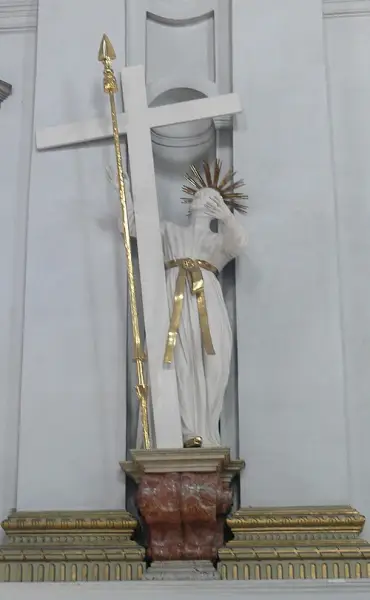
- Martyr's palm·Cross·Spear
- Canonization
- Beatified by Pope Urban VIII on 14 September 1627; canonized by Pope Pius IX on 8 June 1862 among the Twenty-six Martyrs of Japan
Prayer
Bibliography
Show 3 sources
- 1 2 日本人名大辞典+Plus,日本大百科全書(ニッポニカ), デジタル版. パウロ三木(パウロ みき)とは - コトバンク . コトバンク (in Japanese) . Retrieved 2018-08-24 .
- ↑ "カトリック住吉教会 | 聖パウロ三木について" . www.sumiyoshi.catholic.ne.jp . Archived from the original on 2020-02-18 . Retrieved 2018-08-24 .
- ↑ Paul Miki and two companion Martyrs of Japan at Hagiography Circle
Profile text adapted from the Wikipedia article, licensed CC BY-SA 4.0.
Pray with this saint every day
Save St. Paul Miki to your favorites, read the full profile, and get feast-day reminders in the Saints app.
Get the Saints AppFree on the App Store for iPhone and iPad