
c. 227 - c. 341·Feast January 15
St. Paul of Thebes
First Christian hermit of the Egyptian desert
Overview
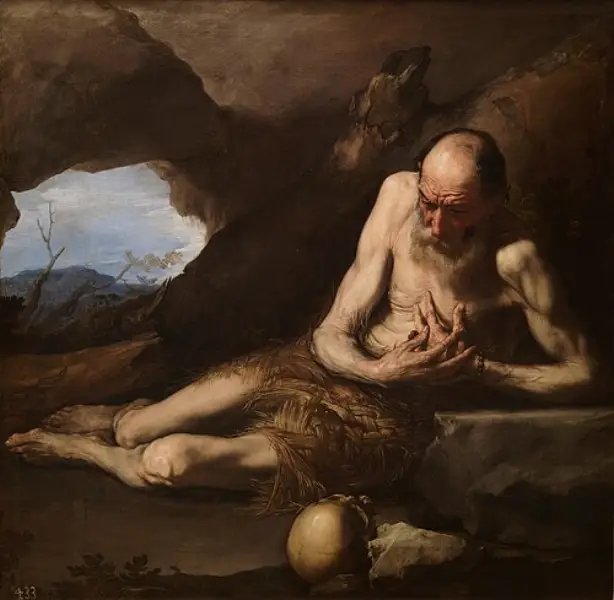
Paul of Thebes, honored in East and West as the First Hermit, is remembered as the first Christian to flee the world and live alone for God in the Egyptian desert. Born around 227 in the Thebaid, he was left an orphan young, and when a covetous brother-in-law threatened to betray him to the persecutors, Paul escaped into the Theban mountains around the year 250, in the days of Decius and Valerian. There he found a cave beside a clear spring and a palm tree, whose leaves clothed him and whose fruit fed him, until a raven began to bring him half a loaf each day. He stayed in that cave for nearly a century, and the world learned of him only at the end: around 342 Anthony the Great was told in a dream of his hidden elder, sought him out, and the two kept a day and a night in holy converse. When Anthony returned, Paul had died at about 113, and two lions came to help dig his grave. Jerome told his story in Latin about 375, Pope Gelasius I enrolled him among the saints in 491, and a monastery by the Red Sea still guards his cave.
The Complete Life
Orphan and Fugitive
Paul was born about the year 227 in the Thebaid, the stretch of upper Egypt along the Nile where the mountains press close to the river. His parents died while he and his married sister were still young, and the orphan's inheritance proved a dangerous treasure. His sister's husband, coveting the estate, resolved to betray the boy to the persecutors and so be rid of him. The persecution he feared belonged to the era of Decius and Valerian, around the year 250, when the Roman state demanded sacrifice and the Church's confessors were hunted. Rather than face betrayal and tribunal, Paul chose disappearance. He went into the Theban desert, that sea of rock and ravine west of the Nile, and did not come back. What he lost in property and family he counted as gain, for the flight that was meant to destroy him became the beginning of a life the desert fathers would retell for centuries. Anthony's later testimony that Paul was a pattern for monks begins with this boyhood decision to lose everything rather than lose the faith.
§ Legend
The Cave by the Spring
In the mountain Paul found a cave near a clear spring, and beside it grew a single palm tree, and there he made his home for the rest of his days. The palm served him as house and table and wardrobe: its leaves clothed him, and until his forty-third year its dates were his only food. Then the desert showed its own economy of grace. A raven began to visit him daily, carrying half a loaf of bread, and the birds' delivery continued for the decades that followed. He stayed in that cave, the tradition says, nearly a hundred years, from youth to extreme old age, unseen by any human being. The Life written by Jerome in Latin, probably in 375 or 376, fixed these details for the whole Christian world and made the cave beside the spring the very image of eremitical life. Later Coptic tradition came to locate the spot in the eastern desert near the Red Sea, where the Monastery of Saint Paul the Anchorite stands today and where pilgrims venerate the cave that Anthony's footsteps would one day find.
§ Legend
A Century of Hidden Prayer
Paul's sanctity was of the silent kind. He founded no monastery and wrote no rule; his whole achievement was presence, a human being living before God alone in the wilderness for the better part of a century. The desert fathers called him a grazer, one who took his food as the wild things do, and his dependence on the palm and the raven made his life a standing parable of providence. Anthony himself described him as the first monk, and the title endured. What his hiddenness taught the desert world was that holiness does not require an audience. When Anthony, at the ends of his own long ascetic life, was told in a dream that a better servant than he lived in the desert, the vision was the world's discovery of what God had been watching all along. The meeting of the two old men became a favorite scene of Christian art, from Velazquez to Ribera: two monks, one bread, and the courtesy of saints, each inviting the other to bless the loaf that broke evenly between them.
§ Legend
Anthony Comes to the Cave
Around the year 342, when Paul was about 113, Anthony the Great was shown in a dream that an elder more perfect than himself lived deep in the desert, and he set out to find him. The two hermits met, conversed for a day and a night, and shared the sign of hospitality the Synaxarion preserves: each urged the other to pronounce the blessing over the loaf; Paul took one end and put the other into Anthony's hands, the loaf parted through its middle, a share falling to each. Anthony went back for the tunic Athanasius had given him, and on his return found Paul kneeling, his soul already departed. He wrapped the body in the tunic, and as he wondered how to dig a grave in the iron ground, two lions came out of the inner desert and dug the pit with their paws. Anthony buried him there, rejoicing, and kept the palm-woven robe of Athanasius for the rest of his life, wearing it only at Easter and Pentecost. The relics were carried in later centuries, some to Ravenna's church of Santa Maria in Porto, while the cave itself became a shrine of the Coptic Church.
§ Legend
Enrolled by Pope Gelasius
Paul's cult passed quickly from the desert to the universal Church. Jerome's Latin Life circulated widely and fixed his feast in the calendars of both East and West. In 491 Pope Gelasius I formally enrolled him among the saints, an early act in the age when the Roman see began to add its authority to the devotion of the people. The Roman Martyrology keeps his memory on January 15, recalling in its entry the solitary who kept the wilderness from his sixteenth year to his one hundred thirteenth; following the calendar reform, the 2004 edition lists the feast on January 10. The Orthodox Churches celebrate him on January 15, and the Coptic Orthodox Church on 2 Meshir, corresponding to February 9. In the thirteenth century the Order of Saint Paul the First Hermit was founded in Hungary in his honor, carrying his name through Europe's colleges and hermitages. He is usually represented in art with his three quiet witnesses: the palm tree that clothed him, the raven that fed him, and the two lions that buried him.
§ Veneration
The Monastery by the Red Sea
The place of Paul's hiding became one of the great shrines of Egyptian Christianity. The Monastery of Saint Paul the Anchorite, known to Copts as Deir Anba Bola, stands in the eastern desert mountains near the Red Sea, on the spot tradition identifies as the site of his cave, where his remains are kept. Its Cave Church of Saint Paul marks the place where Anthony and Paul are said to have met and shared their bread, and pilgrims descend into the rock to pray where the first hermit prayed for nearly a century. From Egypt his memory traveled wherever monks went. Jerome's Life made him a model for the hermits of the Latin West; frescoes of him shine in the monasteries of Mount Athos, including the refectory of Stavronikita; and a colossal statue faces St. Peter's Square in Rome. In the Philippines he is titular of the cathedral of the Diocese of San Pablo and its patron. Thirteen centuries after his death, and fifteen after his flight, the first hermit is still the Christian name for solitude embraced for the love of God.
§ Veneration
Timeline
- 227
Born in the Thebaid of Roman Egypt, in a Christian family that soon lost its parents
§ Paul of Thebes
- 250
Fled a brother-in-law's betrayal into the Theban desert during the persecutions of Decius and Valerian
§ Legend
- 341
Died in his cave at about the age of 113, found dead by Anthony on his second visit
§ Legend
- 342
Anthony the Great, warned in a dream, found the hidden hermit and spent a day and night with him
§ Legend
- 375
Jerome composed the Latin Life of Saint Paul the First Hermit, probably in 375-376
§ Legend
- 491
Enrolled among the saints by Pope Gelasius I
§ Paul of Thebes
The Record
- Patron of
- patron of the Roman Catholic Diocese of San Pablo, Philippines
- Symbols
- two lions·palm tree·raven
- Canonization
- Canonized in 491 by Pope Gelasius I
Prayer
Bibliography
Show 7 sources
- Great Synaxaristes, "Ho Hosios Paulos ho Thbaios", 15 January, MEgas Synaxaristes
- Bacchus, Francis Joseph. "St. Paul the First Hermit." The Catholic Encyclopedia, Vol. 11. New York: Robert Appleton Company, 1911
- "Venerable Paul of Thebes", Orthodox Church in America
- "Paul of Thebes, Saint", Guillaumont, Antoine and Kuhn, K. H., The Coptic Encyclopedia, vol. 6, Macmillan
- "St. Paul of Thebes, Church's first hermit, honored Jan. 15", Catholic News Agency, retrieved 2018-03-17
- The Roman Martyrology, trans. Archbishop of Baltimore, Baltimore: John Murphy Company, 1916, p. 11
- Agaiby, Elizabeth (2018). The Arabic Life of Antony Attributed to Serapion of Thmuis. BRILL
Profile text adapted from the Wikipedia article, licensed CC BY-SA 4.0.
Pray with this saint every day
Save St. Paul of Thebes to your favorites, read the full profile, and get feast-day reminders in the Saints app.
Get the Saints AppFree on the App Store for iPhone and iPad