
9th - 10th century·Feast July 28
St. Paul of Xeropotamou
Athonite ascetic and founder of monasteries
Overview
Paul of Xeropotamou was a Byzantine ascetic of the ninth and tenth centuries who left the imperial palace for the Holy Mountain and founded two of its monasteries. Born Procopius, according to tradition the son of a Byzantine emperor whom some sources name as Michael I Rangabe, he received the finest education of his age and wrote celebrated canons and hymns on the Presentation of Mary, the Forty Martyrs, and the Holy Cross. Learning and rank did not hold him. He exchanged rich garments for beggar's rags, went to Mount Athos, raised his dwelling amid the wreckage of a house founded by the empress Pulcheria at the place called Xeropotamou, and was tonsured there under the name Paul, hiding his erudition out of humility. When his kinsman Romanos took the throne, Paul came to Constantinople only to heal the sick emperor and ask one favor: the restoration of Xeropotamou. Around 980 he obtained from the emperor a second monastery, that of Saint George, later renamed Agiou Pavlou in his honor. He reposed after bidding his fathers farewell, and his relics, carried by the waves to Constantinople, were laid in Hagia Sophia.
The Complete Life
The Emperor's Learned Son
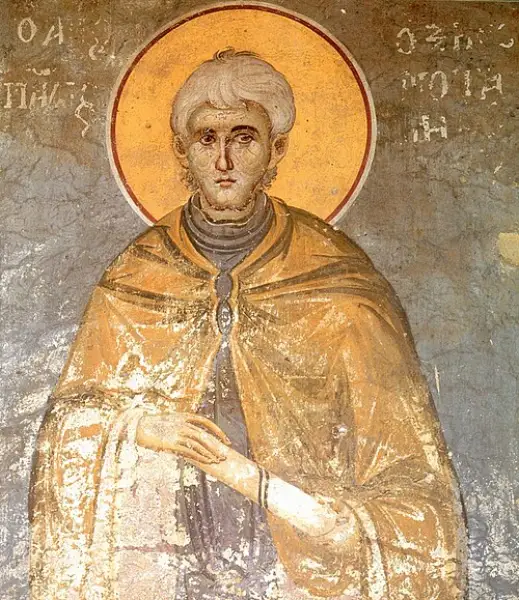
The monk Paul began life as Procopius, and tradition asserts that he was the son of a Byzantine emperor, whom certain sources anachronistically identify as Michael I Rangabe. Whatever the exact pedigree, the boy received an education so complete that he stood among the finest scholars of his age. His pen earned lasting fame: compositions on the Presentation of Mary, a canon of the Forty Martyrs, a canon of the Holy Cross, and other works circulated under his name. Yet scholarship and an honorable position in the world did not entice him. Some scholars describe him as a eunuch, and his iconography supports the surmise, showing a white-haired old man without beard, in contrast with the deep-rooted monastic custom of beards. Castration before or about puberty was the usual lot of eunuchs, and of the sons of deposed emperors: when Michael I Rangabe lost the throne, Leo V the Armenian allowed his sons to live in monasteries only after castrating them. If the saint bore such a mark of palace politics, it made his renunciation only the more complete.
§ Life
To the Holy Mountain
Procopius left everything worldly in a single gesture, exchanging his rich clothing for a beggar's rags and setting out for Mount Athos, the Holy Mountain of the Aegean. At the place called Xeropotamou, the dry river, he walled himself a dwelling amid the wreckage of a house the empress Pulcheria had once founded in honor of the Forty Martyrs. There a hermit named Cosmas tonsured him, and the imperial son took the name Paul. His humility was as deliberate as his asceticism: he never disclosed his erudition to anyone on the mountain, letting his strict life speak instead of his learning. It spoke quickly. Word of his discipline spread through the Holy Mountain, and he became known simply as Paul of Xeropotamou, the name the monastery he served still carries. The learned courtier who had renounced letters found a new authorship in example, and the ruined chapel of a fifth-century empress became again a house of monks through the labor of a man who wanted nothing back from the world he had left.
§ Xeropotamou Monastery
Two Monasteries and a Cross
When the Emperor Romanos, a kinsman of the saint, came to the throne, he sent through the Protos of the Holy Mountain urging Paul to come to Constantinople, and prepared a magnificent reception. The humble monk kept his monastic habit even in the courtly splendor, carrying only a cross, dressed in his ragged habit. He sealed his standing before God by laying his hands on the gravely ill emperor and healing him, and when the grateful sovereign offered the allurements of court, Paul asked a single favor: the restoration of the Xeropotamou monastery. At the consecration of its cathedral after the restoration, a portion of the True Cross was set upon the holy altar, the emperor's gift to the saint. The restored house soon filled with monks, and Paul, handing its direction to one of the fathers, withdrew to a remote hermitage. His silence was broken again by disciples who would not leave their elder, and around 980 he asked the emperor for a new monastery, that of Saint George, first led by Paul himself, who brought to it particles of the True Cross.
§ Agiou Pavlou Monastery
Repose and Relics
Paul was the leading figure of the hermits of Mount Athos, and he marshaled the desert dwellers against the organized monasticism of his day, standing as the chief opponent of Athanasius and his proposals, which he charged with bringing worldly ways to Athos and exploiting the hermits. Warned in advance of his death, he summoned the monks of Xeropotamou and of the younger house of Saint George and gave them their final instruction. On the day of his repose he put on his mantle, recited the prayer of St. Ioannikios the Great that he constantly repeated, and communicated of the Holy Mysteries of Christ. He had directed that his body be buried on the peninsula of Longos across from the Holy Mountain, but God willed otherwise: the sea carried the vessel as far as the Constantinopolitan shore. The emperor and the patriarch received the saint's body with reverence and laid it solemnly in Hagia Sophia. After the Crusaders sacked the imperial city, his relics were carried to Venice, where they remain venerable among the treasures of the Latin churches.
§ Agiou Pavlou Monastery
Two Houses That Bear His Memory
Mount Athos still carries the double imprint of Paul's life. The monastery of Xeropotamou, which he served and restored, keeps the ancient name of the dry river where he built his first cell, and its cathedral altar received the relic of the True Cross his imperial kinsman gave him. The second house he founded, dedicated to Saint George and renamed Agiou Pavlou for its founder, grew into one of the twenty ruling monasteries of the Holy Mountain, and Paul himself was its first abbot, bringing to it particles of the Cross he had obtained. His fame rests not on writings, though his canons earned him deserved celebrity, nor on office, which he abandoned twice, but on the shape of his vocation: the most learned man of his generation hiding his learning, the emperor's kinsman healing emperors and asking nothing for himself, the hermit leading hermits against the very institutionalization of Athos that others praised. Orthodox Christians commemorate him on July 28, and icons show him as tradition remembers him, a white-haired elder without beard, the emperor's son made wholly a monk.
§ Agiou Pavlou Monastery
In Their Own Words
O Holy Trinity, glory to Thee
The Record
- Major works
- Canons on the Presentation of Mary·Canon of the Forty Martyrs·Canon of the Holy Cross
- Symbols
- beardless white-haired elder
- Canonization
- Pre-congregation; glorified in the Eastern Orthodox Church
Prayer
Bibliography
Show 7 sources
- Enev, Mikhail. Mount Athos: Zograph Monastery. Kibela Publishing, 1994, p. 239
- "Venerable Paul the Founder of the Xeropotamou Monastery on Mt Athos", Orthodox Church in America
- Crostini, Barbara and Murzaku, Ines Angeli (2017). Greek Monasticism in Southern Italy: The Life of Neilos in Context. Routledge
- Luttwak, Edward N. (2009). The Grand Strategy of the Byzantine Empire. Harvard University Press, p. 182
- "The Holy Monastery of Agiou Pavlou (St Paul)", Pemptousia, November 5, 2011
- Greenfield, Richard P. H. and Talbot, Alice-Mary (2016). Holy Men of Mount Athos. Harvard University Press, p. 677
- Palairet, Michael (2015). Macedonia: A Voyage through History, Vol. 1. Cambridge Scholars Publishing, p. 387
Profile text adapted from the Wikipedia article, licensed CC BY-SA 4.0.
Pray with this saint every day
Save St. Paul of Xeropotamou to your favorites, read the full profile, and get feast-day reminders in the Saints app.
Get the Saints AppFree on the App Store for iPhone and iPad