
c. 5 - c. 64/65·Feast June 29
St. Paul the Apostle
Apostle to the Gentiles and martyr of Rome
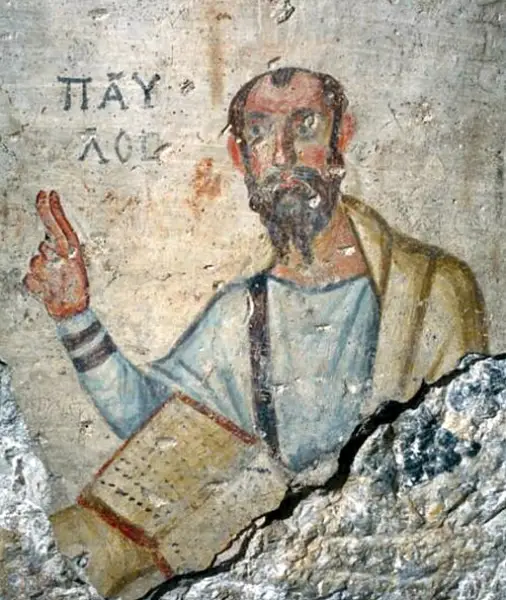
Overview
Paul the Apostle, born Saul of Tarsus around the year 5, towered over the first generation of Christianity as missionary, theologian, and letter writer. Raised in a devout Jewish family in the Cilician city of Tarsus and educated in Jerusalem at the school of Gamaliel, he was a Pharisee who persecuted the young Church until the risen Christ stopped him on the road to Damascus. Blinded, baptized, and filled with the Holy Spirit, he spent the rest of his life carrying the Gospel to the Gentiles. Three great journeys took him across Cyprus, Asia Minor, Macedonia, Greece, and finally to Jerusalem and Rome; he founded churches from Philippi to Corinth, debated the terms of Gentile welcome at the Council of Jerusalem, and wrote letters that became the earliest documents of the New Testament. Arrested in the temple in 57 and held at Caesarea, he appealed to Caesar and was shipwrecked on Malta on the way to trial. He reached Rome about 60 and preached there two years under house arrest. After the great fire of 64, he was beheaded in Nero's persecution, and the basilica on the Ostian Way guards the sarcophagus the Church has venerated ever since.
The Complete Life
Saul of Tarsus
The man the nations would call Paul entered the world as Saul, born between 5 BC and AD 5, probably in Tarsus, the busy trading city of Roman Cilicia renowned for its academy. The Acts of the Apostles presents him as a Roman citizen by birth, a claim scholars largely accept, and some have conjectured that his ancestors were among the Jews Pompey enslaved in 63 BC, freedmen whose descendants inherited citizenship. His family was devout, attached for generations to Pharisaic observance, and he could describe himself as an Israelite in stock, a Benjaminite in tribe, a Hebrew in speech. The trade he learned shaped his future as much as his schooling: Acts shows him as an artisan of leather and tents, a craft that later bound him to Priscilla and Aquila and kept him self-supporting through the missions. Sent as a young man to Jerusalem, he studied at the school of Gamaliel, one of the most celebrated teachers of the Law, though he was not training to be a scholar. His first appearance in the story of the Church is grim: a zealous participant in the death of Stephen, the Hellenist deacon whose martyrdom scattered the Jerusalem believers.
§ Early life
The Road to Damascus
The persecutor became the apostle in a single day on the road to Damascus. Saul had gone north breathing threats against the disciples, intent on hunting down the Hellenist Christians whose outlook he despised, when a light from heaven threw him to the ground and a voice asked why he was persecuting its Lord. Blinded by the vision, he was led by the hand into the city, where for three days he took no food or water and gave himself to prayer. The disciple Ananias came to him at the Lord's command, laid hands on him, restored his sight, and baptized him. Paul himself, writing years later, dated the encounter between AD 31 and 36 and insisted that the Gospel he preached came not from men but by revelation of Jesus Christ. Within days he was proclaiming Jesus in the Damascus synagogues as the Son of God, and when the city's opposition grew murderous he escaped by night in a basket lowered through the wall. After retreat in Arabia he returned to Damascus, then journeyed to Jerusalem, where Barnabas vouched for him before the apostles who still remembered him as their enemy.
§ Conversion
Three Journeys to the Ends of the Earth
From Antioch, where believers were first called Christians, Paul launched the journeys that carried the Gospel across the Roman world. Commissioned with Barnabas, he preached through Cyprus and the cities of southern Galatia, founding churches and teaching that the message of salvation belonged to Gentiles as well as Jews. A second journey brought him across Asia Minor to the Macedonian shore: Philippi, where a jailer's household was baptized after an earthquake opened the prison, Thessalonica, Berea, Athens, where he argued before the Areopagus, and Corinth, where he stayed eighteen months with Aquila and Priscilla. A third took him back through Galatia and Phrygia to Ephesus, where he taught for nearly three years and wrote letters to the church he had founded, leaving only when a silversmith's riot over the goddess Artemis made the city too dangerous. He spent the winter of 56-57 in Greece, probably Corinth, where he dictated the letter to the Romans, then traveled north through Macedonia toward Jerusalem with the collection for the poor. By land and sea he covered many thousands of kilometers, planting the churches that would carry his name and his doctrine long after his death.
§ First missionary journey
The Gospel in Letters
Paul's spiritual genius reached the world through his pen. Seven letters in the New Testament are his beyond reasonable dispute: Romans, First and Second Corinthians, Galatians, Philippians, First Thessalonians, and the brief, tender note to Philemon; three more stand in his name though scholars debate their authorship. Written to churches he had founded or hoped to found, they form the earliest Christian documents we possess and reveal a man of remarkable character, devoted and compassionate, sometimes harsh and angry, supple in argument, and driven by a passionate commitment to God and Christ. His theology centered on the crucified and risen Jesus: justification by faith, the Law fulfilled in Christ, the Spirit poured out on Gentiles without the yoke of circumcision, the one body in which Greek and Jew, slave and free, were made one. He drew on his rabbinic training and Stoic vocabulary alike, coining phrases that Christian thought has never exhausted. His letters show a mystic too, a man who spoke of being caught up to the third heaven and who could say that he lived no longer but Christ lived in him. Tradition has honored him as an apostle and martyr rather than a writer of books, yet his letters remain his monument.
§ Writings
Prisoner for the Gospel
Paul's last journey to Jerusalem in 57 ended in chains. Warned by James that he was rumored to teach Jews abroad to forsake Moses, he submitted to a purification rite in the temple, but when the seven days were nearly complete, Asian Jews accused him of defiling the sanctuary by bringing Gentiles in. The mob dragged him from the temple; Roman soldiers rescued him, and he spoke to the crowd from the barracks steps until their shouts drowned him. Before the Sanhedrin he divided his judges; in Caesarea he defended himself before Felix and Festus, and when a second plot threatened to drag him back to Jerusalem, he appealed to Caesar as a Roman citizen. The voyage to Rome became an ordeal of storm and shipwreck: off Malta the soldiers' ship broke apart, and the islanders, first suspecting the shipwrecked prisoner of murder when a viper fastened on his hand, ended by honoring him when no harm followed. He reached the capital about the year 60 and preached there two years at his own expense, receiving all who came. The Acts end there; his death the tradition supplies, beheaded in the Neronian terror after the great fire of July 64.
§ Last visit to Jerusalem and arrest
The Apostle on the Ostian Way
The Church that scattered Paul's bones could not forget him. Clement of Rome, writing within a generation, held up his endurance as a pattern; Ignatius called him the martyred apostle; Eusebius recorded that he was beheaded in Nero's reign, on the same day as Peter according to Dionysius of Corinth. The Liber Pontificalis records his grave outside Rome's walls along the Ostian Way, on the estate of the Christian matron Lucina, where Constantine built the first church and the emperors of the fourth and fifth centuries raised a greater one. When the sarcophagus beneath the Basilica of Saint Paul Outside the Walls was excavated in 2002, a marble slab bore the inscription Paul apostle and martyr, and in 2009 Pope Benedict announced that bone fragments dated to the first or second century. His feast with Peter on June 29 has been kept at Rome from earliest times, and his conversion is celebrated on January 25. Patron of missionaries, theologians, and evangelists, he remains the traveling apostle whose thought, in the judgment of one historian, forms among the most extraordinary personal gifts religious thought has ever received.
§ Remains
Timeline
- 35
Visited Jerusalem about three years after his conversion and stayed fifteen days with Simon Peter
§ Conversion
- 45
Traveled from Antioch to Jerusalem with Barnabas carrying famine relief for the Judean church
§ First missionary journey
- 46
Set out with Barnabas on the first missionary journey to Cyprus and southern Asia Minor
§ First missionary journey
- 49
Won acceptance of his Gentile mission at the Council of Jerusalem
§ Council of Jerusalem
- 49
Left Jerusalem in late autumn with Silas on the second missionary journey, crossing into Macedonia
§ Second missionary journey
- 50
Reached Corinth, founded its church, and stayed eighteen months, working as a tentmaker
§ Interval in Corinth
- 52
Sailed from Cenchreae with Priscilla and Aquila for Ephesus and home to Antioch
§ Interval in Corinth
- 57
Arrived in Jerusalem with the collection, was seized in the temple, and was held at Caesarea
§ Last visit to Jerusalem and arrest
- 60
Reached Rome as a prisoner and preached there for two years under house arrest
§ Two years in Rome
- 64
Was beheaded in Rome during the Neronian persecution after the great fire of July 64
§ Death
In Their Own Words
Saul, Saul, why do you persecute me?
The Record
- Major works
- Epistle to the Romans·First Epistle to the Corinthians·Second Epistle to the Corinthians·Epistle to the Galatians·Epistle to the Philippians·First Epistle to the Thessalonians·Epistle to Philemon
- Patron of
- patron of missionaries·patron of theologians·patron of evangelists·patron of Gentile Christians·patron of Malta and of London
- Symbols
- sword·book·martyr's palm
- Canonization
- Pre-congregation; venerated as a saint from the apostolic age
Prayer
Bibliography
Show 7 sources
- Aageson, James W. (2008). Paul, the Pastoral Epistles, and the Early Church. Hendrickson
- Brown, Raymond Edward (1997). An Introduction to the New Testament. Doubleday
- Bruce, Frederick Fyvie (2000). Paul: Apostle of the Heart Set Free. Eerdmans
- Dunn, James D. G., ed. (2003). The Cambridge Companion to St. Paul. Cambridge University Press
- Ehrman, Bart D (2006). Peter, Paul and Mary Magdalene: The Followers of Jesus in History and Legend. Oxford University Press
- Fitzmyer, Joseph (1998). The Acts of the Apostles. Yale University Press
- Harris, Stephen L. (2003). Understanding the Bible. McGraw-Hill
Profile text adapted from the Wikipedia article, licensed CC BY-SA 4.0.
Pray with this saint every day
Save St. Paul the Apostle to your favorites, read the full profile, and get feast-day reminders in the Saints app.
Get the Saints AppFree on the App Store for iPhone and iPad