
225 - 339·Feast March 7
St. Paul the Simple
Farmer turned hermit, disciple of St. Anthony
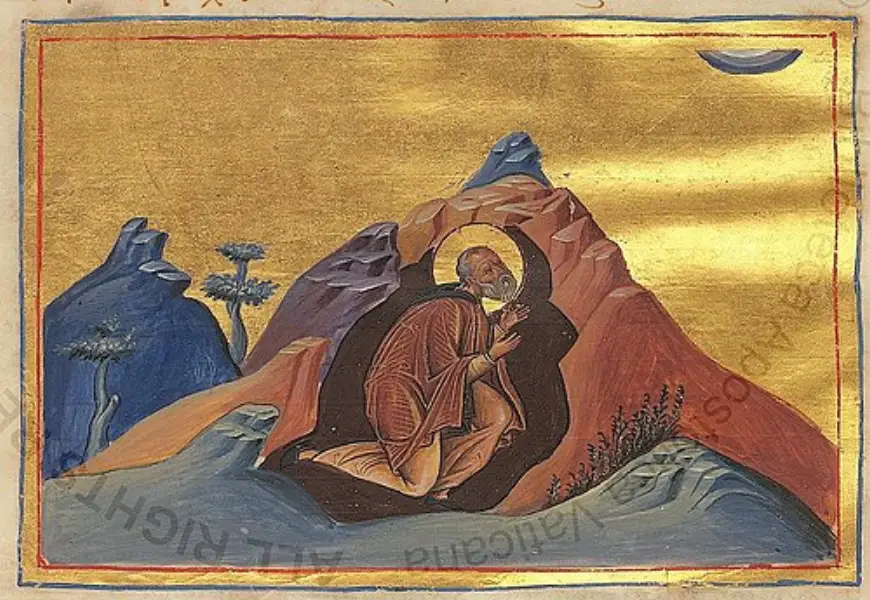
Overview
Paul the Simple of Egypt, born in 225 and dead in 339, began his Christian life at the age of sixty, when most men settle their accounts. He was a farmer, and a hard one, until the day he discovered that his beautiful wife was unfaithful. He left her, walked to the desert, and put himself at the door of Anthony the Great, asking to become a monk. Anthony told him it was impossible at his age and counselled him to be a thankful labourer instead; Paul refused to go away. The old abbot tested him with door shut against him, ropes woven and unwoven, hunger measured out crust by crust, nights of vigil, psalmody, and prostration, and found in the stubborn farmer a simplicity that outlasted every trial. John, Abbot of Sinai, called him the very exemplar of blessed simplicity. Anthony eventually gave him a cell of his own, and God gave him a power his master said he himself had not received: Paul cast out demons, even the powers Anthony said were beyond him. His life was recorded by Palladius and Rufinus, and the Church keeps his feast on March 7.
The Complete Life
A Late Beginning
Paul's road to the desert ran through a broken house. He was an Egyptian farmer, born in 225, who worked his land for six decades before his life cracked open. At the age of sixty he learned that his beautiful wife was unfaithful to him, and his answer was not bitterness but a radical departure: he left her and set out to become a hermit. It was an old man's vocation, undertaken when the desert fathers expected novices to be young and teachable. Yet the sources that preserved his memory, Palladius of Helenopolis in his Lausiac History and Tyrannius Rufinus in his History of the Egyptian Monks, found his story worth telling precisely because of its lateness. Nothing in Paul's first sixty years had prepared him for the ascetic life except endurance, and endurance proved to be the one lesson that could not be taught too late. A broken marriage, a changed road, and a stubborn will carried him out of the fields of Egypt and up to the door of the greatest monk of the age.
§ Life
At the Door of Anthony
When Paul reached Anthony the Great and begged to become a monk, the abbot gave him the honest answer: a man of sixty could not take up so radical a life. Let him be content, Anthony said, to remain a thankful and pious labourer. Paul would not accept the refusal and pleaded to be taught. Anthony sent him instead to a cenobium, a community monastery, and shut the door in his face. Paul remained outside. He stayed there through the days until the fourth, when Anthony, fearing the old man would die at his threshold, took him in. The training began at once, and it was a training in unmaking. Anthony set Paul to weave a rope of palm leaves, then made him undo his work and weave it again, hour after hour. At the evening meal the abbot took three crusts of bread and gave them to him. When each had eaten one, Anthony told Paul to eat a second. Paul answered that he would eat if Anthony ate, but not otherwise; and when the abbot said that one crust was enough for a monk, Paul replied that one was enough for him too, for he wanted to be a monk.
§ Life
The School of Simplicity
Anthony kept testing his aged novice, and the tests grew into a way of life. He drove Paul through hard labour, severe fasting, vigils without end, the constant singing of the Psalms, and waves of prostrations, watching to see whether sixty years of habit would crack. What cracked instead was every claim of self-will. Paul obeyed without argument, ate little and only as permitted, prayed through the nights, and treated each command of the old man as the word of God himself. The monks who told his story saw in this uncalculating obedience the meaning of his name: he was not simple because he was dull, but because he had no second agenda, no private profit, no reserve. Anthony, impressed by a dedication he had rarely matched, at last granted Paul a dwelling of his own, some miles distant, releasing him into the solitary life he had begged for at the farm gate. John, the Abbot of Sinai, later held him before his own monks as a clear example, the rule and type of blessed simplicity, a man whose whole spirituality was one uncomplicated act of yes.
§ Life
Power Given to the Simple
The desert's verdict on Paul the Simple was that God had given him gifts that outran even his master's. Monastic tradition records that in time he was able to cast out demons, and the stories preserve Anthony's own testimony to it. Passing a possessed youth, Anthony is remembered saying that he could not help the boy, for the authority over the demons' prince had not been given him, but that Paul the Simple did have that gift. The saying fixed Paul's place in the memory of the desert: the farmer who came too old to learn was granted an authority the great abbot disclaimed for himself. His life was written down early, by Palladius of Helenopolis among the lives of the fathers and by Tyrannius Rufinus in his history of the Egyptian monks, and the Churches of East and West enrolled him among the saints. Though a contemporary of Paul of Thebes, the first hermit, he is not to be confused with him; his glory was different, the glory of the man who wanted only to be a monk, and was.
§ Paul the Simple
Timeline
- 225
Born in Egypt, a farmer who would not taste monastic life until his sixtieth year
§ Paul the Simple
- 339
Died in Egypt after decades as a hermit and renowned exorcist
§ Paul the Simple
In Their Own Words
the rule and type of blessed simplicity
The Record
- Canonization
- Pre-congregation; venerated in the Catholic, Orthodox, and Anglican churches
Prayer
Bibliography
Show 3 sources
Profile text adapted from the Wikipedia article, licensed CC BY-SA 4.0.
Pray with this saint every day
Save St. Paul the Simple to your favorites, read the full profile, and get feast-day reminders in the Saints app.
Get the Saints AppFree on the App Store for iPhone and iPad