
347 – 404·Feast January 26
St. Paula of Rome
Roman Matron, Desert Mother and Companion of Jerome
Overview
Paula of Rome was a senatorial matron who abandoned one of the greatest fortunes in the city to become an ascetic, pilgrim and abbess in Bethlehem. Born into the clan of the Furii Camilli, a family that claimed descent from Agamemnon, she married the nobleman Toxotius at sixteen and bore five children. Widowed at thirty-two, she fell under the influence of the ascetic circle gathered around Marcella, and in 382 her path crossed Jerome's, arrived in the city in company with Epiphanius and Paulinus of Antioch. After a pilgrimage through the Holy Land and Egypt in the company of Jerome and her daughter Eustochium, she settled in Bethlehem, where she founded a monastery for men under Jerome's direction, a convent for herself and her nuns, and a hostel for pilgrims. Her hospitality and alms consumed her entire fortune. She studied Scripture under Jerome's guidance, practiced severe fasting, and ruled her nuns until her death on January 26, 404. Jerome commemorated her in Letter 108, and her grave beside his in the Church of the Nativity became a center of pilgrimage.
The Complete Life
A Senatorial Childhood
Paula was born in Rome on May 5, 347, a daughter of Blesilla and Rogatus of the noble clan of the Furii Camilli, a family whose lineage was traced, with suitable grandeur, to Agamemnon himself. What is known of her early life comes almost entirely from Jerome, who records in Letter 108 that she had led a luxurious existence and enjoyed great standing in the city. She dressed in silks and was carried through the streets by eunuch slaves, the ordinary privileges of an heiress of the Roman senatorial order. At sixteen she was married to the nobleman Toxotius, and the union produced five children: four daughters, Blaesilla, Paulina, Eustochium and Rufina, and a son, Toxotius, named for his father. The family home was a great town house in Rome; the site is now occupied by the Church of Saint Jerome of the Charity, and tradition identifies it as the house where Jerome, while secretary to Pope Damasus and at work on his Latin translation of the Bible, was hosted by the matron of the household. Such was the world of rank and comfort from which Paula would one day walk away.
§ Early life
Widowhood and the Call to Ascetic Life
Paula was thirty-two when Toxotius died, leaving her a wealthy widow with five children. She continued to devote herself to her family, but religion drew her increasingly as the years passed. Through the influence of Saint Marcella and the group of noblewomen gathered around her, Paula became an enthusiastic member of that semi-monastic circle of Roman women, where the ascetic ideas of the East were first tasted by the aristocracy of the West. The turning point came in 382, when she met Jerome, who had arrived in Rome in the company of Epiphanius of Salamis and Paulinus of Antioch. Jerome - Dalmatian by birth, schooled in Rome as a youth, a traveler in Germany and Aquileia, long a dweller in the East where ascetic study had shaped him - was already engaged, as secretary to Pope Damasus, on the Latin Scriptures. Paula had earlier met and learned from Paulinus of Antioch and Epiphanius, and in Jerome she found a teacher whose learning matched her hunger. From this meeting grew a spiritual partnership that would shape the rest of her life, drawing her from the salons of the Marcella circle toward a radical renunciation of the wealth and station into which she had been born.
§ Entering the religious life
Pilgrimage and Foundation at Bethlehem
After her husband's death Paula resolved to tour the holy places, traveling with large entourages of men and women, among them her daughter Eustochium and Jerome himself. Her widowhood left her a considerable fortune, and with a male heir provided for and two daughters married to aristocrats, she possessed what one scholar has called an ascetic freedom to dispose of her life and goods as she wished. Jerome later described the journey in writing addressed to Eustochium, telling how Paula entered into each place with an intimate, emotional grasp of the biblical events that had occurred there, seeing them with vivid immediacy. On the way she and her companions visited monks and ascetics including Paulinus of Nola, Melania the Elder, Rufinus of Aquileia and Isidore the Confessor, and in Egypt she traveled to Nitria, where the renowned monks received her with honor. The journey ended not in Rome but at Bethlehem. There Paula determined to remain, and out of her own purse she built a double monastery, a convent for herself and her nuns and a monastery for Jerome and his monks, together with a roadside hostel whose generous hospitality to aristocratic pilgrims eventually exhausted her entire fortune.
§ Pilgrimage
The Ascetic Discipline of Bethlehem
Jerome's letter to Eustochium is the richest witness to Paula's life at the monastery she built. Her asceticism was intellectual as well as bodily: she studied the Old and New Testaments intensively, often under Jerome's own instruction, and paired her learning with strict fasting, abstinence and a destitute manner of life undertaken, as Jerome said, to preserve a singular attachment to God. Withdrawn as she was, she did not cut herself off from the Church; she conversed with local clergy and bishops and gave careful attention to the teaching of the nuns under her authority. The monastery itself reflected a disciplined order: during manual labor and meals the men's and women's houses were strictly segregated, though they prayed in the same locale, and within Paula's convent the women were divided by social rank into three communities with separate living quarters, a hierarchy of the great transposed into a spiritual key. Pilgrims and visitors came in crowds from Ethiopia, Persia and India, drawn by Jerome's network and by the reputation of the houses. A letter of 404 records Paula's contact with relics of the passion of Christ, shown the pillar stained with the Lord's blood at his scourging, an encounter she received with her characteristically vivid devotion.
§ Ascetic life
Last Years and Death
The final years of Paula's life were shadowed by diminishing resources and by the losses of her family. Her generosity had strained the finances of the holy places she maintained; to recover costs, Jerome sold the property of his own family in Italy and Dalmatia, and at Paula's death her daughter inherited debts rather than treasure. Around her, the family whose affairs had once filled the great house in Rome was being gathered by death: Blaesilla had died in 384, Rufina in 386, Paulina in 395. Eustochium remained at her side in Bethlehem, ready to continue what her mother had built. Paula died on January 26, 404. Jerome records that the crowds who came to her funeral took in a large share of the population of Palestine, a public tribute to the Roman widow who had made Bethlehem her city. She was buried in the Church of the Nativity, and Jerome, dying in late 419 or early 420, was buried nearby, under the north aisle of that same church, near the graves of Paula and Eustochium, the three companions in death as they had been in the long labor over the Scriptures.
§ Relationship with Jerome
Veneration Through the Centuries
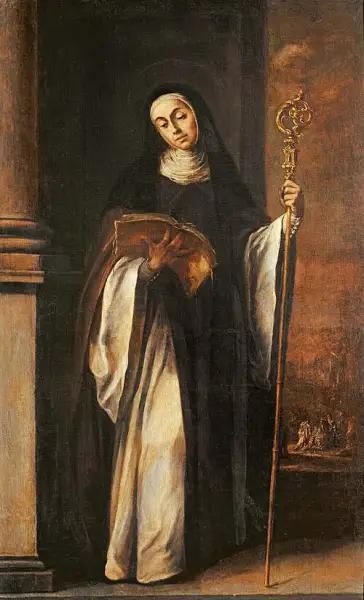
Paula was honored as a saint by the Latin Church essentially from the moment of her death; no formal canonization process existed in her age, and she belongs to the great company of pre-congregation saints. A year after she died she was named a saint, with her feast assigned to January 26, the date of her death, kept in the Catholic Church as the day of a saint's entrance into Heaven. Veneration has continued unbroken in East and West: she is venerated by the Roman Catholic Church and the Eastern Orthodox Church alike, and her memory was carried into the Anglican Communion as well. In 2022 the Episcopal Church officially added her to its liturgical calendar, giving her a feast on September 28 together with her daughter Eustochium, a late but eloquent recognition of her standing among the pioneers of Christian monastic life. Her principal shrines are the Church of Saint Jerome of the Charity and the church of Santa Paola Romana in Rome. Medieval iconography depicts her as a Hieronymite abbess with a book, as a pilgrim, prostrate before the cave at Bethlehem, or holding the scroll of Jerome's epistle that bears her name.
§ Veneration
Legacy: Patron of a Translation
Paula's legacy is inseparable from the Latin Bible. What is certain is that she financed Jerome's translation of the Scriptures into Latin, the Vulgate, and that volumes of his commentary and translation came to her bearing dedications: Job, Isaiah, Samuel and Kings, Esther, Galatians, Philemon, Titus and the minor prophets, with Esther inscribed jointly to Paula and Eustochium. Feminist scholars of the late nineteenth and early twentieth centuries went further, crediting Paula with first suggesting the translation, assisting in the work itself, correcting Jerome's manuscripts, funding the purchase of the necessary texts and circulating the finished copies; one of them described a mind of fine quality, trained and versed in Hebrew, to which Jerome's drafts owed their correction. More cautious voices, such as W. H. Fremantle in the Nicene and Post-Nicene Fathers, pass over her contributions in silence, and Jerome's own letter at her death dwells on her ascetic virtues rather than their collaboration. The argument has never been settled, but her influence traveled even into English literature: Chaucer's Wife of Bath visits the same pilgrimage sites Paula visited and cites Jerome against his own book, a comic echo of the partnership at Bethlehem. She is co-patroness of the Hieronymites, the Order of Saint Jerome.
§ Modern interpretations
Timeline
- 5 May 347
Born in Rome into the senatorial clan of the Furii Camilli
§ Introduction
- 382
Met Jerome, newly arrived in Rome with Epiphanius and Paulinus of Antioch
§ Entering the religious life
- 384
Her daughter Blaesilla, left a widow soon after her marriage, died
§ Family
- 385
Her son Toxotius, at first not a Christian, received baptism
§ Family
- 386
Her daughter Rufina died
§ Family
- 389
Her son Toxotius married Laeta, daughter of the pagan priest Albinus
§ Family
- 395
Her daughter Paulina, wife of the senator Pammachius, died
§ Family
- 26 Jan 404
Died at Bethlehem; a large part of the population of Palestine attended her funeral
§ Ascetic life
- 419
Her daughter Eustochium, who had succeeded her as abbess in Bethlehem, died
§ Family
- 28 Sep 2022
Entered on the calendar of the Episcopal Church, with a feast kept jointly with her daughter Eustochium
§ Veneration
In Their Own Words
For though she was able to surpass all, having great abilities, he hindered her by his jealousy, having induced her to serve his own plan.
I have built a monument more lasting than bronze.
She was shown the pillar of the church which supports the colonnade and is stained with the Lord's blood. He is said to have been tied to it when he was scourged.
The Record
- Major works
- Double monastery at Bethlehem, with a convent for nuns and a monastery for monks·Roadside hostel for pilgrims at Bethlehem·Financial support of Jerome's translation of the Bible into Latin, the Vulgate
- Patron of
- Widows·Order of Saint Jerome monks and nuns
- Symbols
- Depicted as a Hieronymite abbess with a book·Depicted as a pilgrim, often with Jerome and Eustochium·Depicted prostrate before the cave at Bethlehem·Depicted embarking in a ship while a child calls from the shore·Holding a scroll with Saint Jerome's epistle Cogite me Paula·A book and a black veil fringed with gold·A sponge in her hand
- Canonization
- Pre-congregation; named a saint by the Latin Church shortly after her death and venerated since 404
Prayer
Bibliography
Show 7 sources
- John J. Delaney, Dictionary of Saints, ISBN 0-385-13594-7, p. 623
- Cain, Andrew (2010). "Jerome's Epitaphium Paulae: Hagiography, Pilgrimage, and the Cult of Saint Paula". Journal of Early Christian Studies. 18: 105–139. doi: 10.1353/earl.0.0310
- Whiting, Marlena (2011–2012). "Asceticism and Hospitality as Patronage in the Late Antique Holy Land: the Examples of Paula and Melania the Elder". Wiener Jahrbuch für Kunstgeschichte. Vol. LX / LXI. Vienna, Cologne & Weimar: Böhlau Verlag. pp. 74–83
- Yarbrough, Anne (1976). "Christianization in the Fourth Century: The Example of Roman Women". Church History. 45 (2): 149–165. doi: 10.2307/3163714
- Lamprecht, Johanna C. (2017). "Jerome's letter 108 to Eustochium: Contemporary biography in service of ascetic ideology?". HTS Theological Studies. 73 (3). doi: 10.4102/hts.v73i3.4503
- David Farmer, ed., Oxford Dictionary of Saints, ISBN 0-19-860629-X, p. 416
- Herbermann, Charles, ed. (1913). "St. Paula". Catholic Encyclopedia. New York: Robert Appleton Company
Profile text adapted from the Wikipedia article, licensed CC BY-SA 4.0.
Pray with this saint every day
Save St. Paula of Rome to your favorites, read the full profile, and get feast-day reminders in the Saints app.
Get the Saints AppFree on the App Store for iPhone and iPad