
died c. 302·Feast June 6
St. Paulina of Rome
Roman Martyr, Daughter of Martyrs, Patroness of Olomouc
Overview
Paulina was a Roman martyr of the age of persecution, remembered as the daughter of Saints Artemius and Candida of Rome. Peter the Exorcist brought her to the Christian faith, and Saint Marcellinus gave her baptism, both men belonging to the Roman church of the last great persecutions. According to tradition she died around the year 302, killed beneath a heap of stones piled upon her while she yet lived, a manner of martyrdom that made her memory especially vivid among the faithful of the city. Her feast is kept on June 6. Her cult outlived the ancient world by many centuries in a remarkable way: in 1622 Gregory XV presented to the Jesuit Mutio Vitelleschi relics said to be hers, and in the following year they were carried to Olomouc in Moravia, a town then suffering a plague pandemic. The archbishop, Franz von Dietrichstein, proclaimed Paulina patron saint of the city and of the local archdiocese, invoking her against the pestilence. Ancient martyr and baroque patroness thus meet in one history: a Roman woman who died under stones, and the intercessor to whom a Central European city turned in its mortal terror.
The Complete Life
A Household of the Roman Church
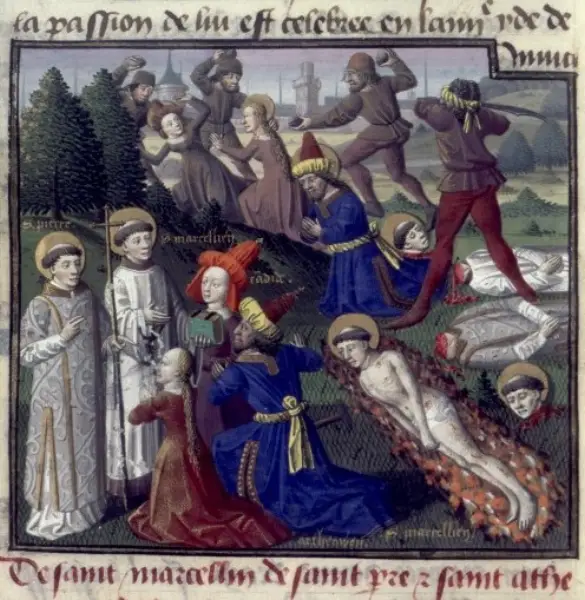
Paulina belonged to a family of the early Roman Church whose members would all be honored as saints. Her father and mother were Artemius and Candida of Rome, remembered together with their daughter in early Christian memory, and ancient illustration later gathered them in a single image, showing Artemius, Candida and Paulina standing before Saints Marcellinus and Peter. Into this household the faith was brought, so the tradition relates, by Saint Peter the Exorcist, one of the clergy of the Roman church whose ministry included the preparation of converts, and it was he who converted Paulina to Christianity. She received baptism from Saint Marcellinus, who with Peter would himself win the martyr's crown in the persecution of Diocletian. The spiritual lineage thus traced in Paulina's life, converts made and baptized by men who were soon to die for the faith, places her squarely in the generation of Roman Christians tested by the last and fiercest of the imperial persecutions. She died, according to tradition, around the year 302, at the height of that storm, and the manner of her execution, burial alive under a heap of stones, was remembered as her special witness to Christ.
§ Introduction
From Rome to Olomouc
Paulina's cult traveled far from the city of her martyrdom and found an unexpected second home in Central Europe. In 1622 Gregory XV gave over to Mutio Vitelleschi, General of the Society of Jesus, remains credited to the martyr, and in the following year his subordinate Mikołaj Łęczycki carried them to Olomouc in Moravia. The city had been struck by a plague pandemic, and the arrival of the martyr's remains came as an answer to desperate need. Archbishop Franz von Dietrichstein named Paulina patron saint of Olomouc and of the local archdiocese, committing the city to her protection against the pestilence. Thereafter she was venerated in Moravia as a patroness against plague, and baroque Olomouc developed an iconography around her intercession, summed up in the plea contra pestem nobis fave, favor us against the plague. The feast of June 6, kept for the Roman martyr since ancient times, thus acquired a second layer of meaning in a city a thousand miles from her own. Her story illustrates the long life of the early martyrs in the memory of the Church: a woman of the persecuted Roman community becoming, centuries later, the hope of a plague-stricken town.
§ Introduction
Timeline
- 302
Martyred, by tradition, beneath a heap of stones piled upon her
§ Introduction
- 1622
Pope Gregory XV donated remains attributed to Paulina to the Jesuit Mutio Vitelleschi
§ Introduction
- 1623
Mikołaj Łęczycki transported the remains to plague-stricken Olomouc in Moravia
§ Introduction
The Record
- Patron of
- Against plague·Patron saint of Olomouc and its archdiocese
- Symbols
- Depicted with Saints Artemius, Candida, Marcellinus and Peter
- Canonization
- Pre-congregation; honored as a martyr of the early Roman Church since antiquity
Prayer
Bibliography
Show 3 sources
- "Santi Marcellino e Pietro Martiri". Santi e Beati (in Italian). Archived from the original on 2023-08-17. Retrieved 2023-08-23
- "Saint Paulina of Rome". CatholicSaints.Info. Archived from the original on 2023-04-10. Retrieved 2023-08-23
- Zelenková, Petra (2005). "'Contra pestem nobis fave': příspěvek k ikonografii svaté Pavlíny, patronky proti moru v barokní Olomouci". Sborník prací Filozofické fakulty brněnské univerzity. F, Řada uměnovědná. pp. [27]–45. Archived from the original on 14 March 2024
Profile text adapted from the Wikipedia article, licensed CC BY-SA 4.0.
Pray with this saint every day
Save St. Paulina of Rome to your favorites, read the full profile, and get feast-day reminders in the Saints app.
Get the Saints AppFree on the App Store for iPhone and iPad