
c. 726 – 802/804·Feast January 11
St. Paulinus II of Aquileia
Patriarch, Theologian and Poet of the Carolingian Renaissance
Overview
Paulinus II of Aquileia was a priest, theologian and poet, a leading light of the Carolingian Renaissance, who governed the ancient see of Aquileia from 787 until his death around 802 or 804. Born at Premariacco near Cividale in Friuli in the last days of Lombard rule, he was educated in the patriarchal school at Cividale, where he later taught as master after his ordination. His learning brought him to the attention of Charlemagne, who summoned him about 776 to the palace court as royal master of grammar. There he joined the circle of Alcuin of York, Peter of Pisa and the other luminaries of the age, forming with Alcuin an enduring friendship. As patriarch he obtained privileges for his church, presided over the condemnation of Spanish Adoptionism at the councils of Ratisbon, Frankfurt and Cividale, and defended the Filioque in the Creed as a safeguard of orthodox faith in Christ. In 796 he presided over a synod in Pepin's camp on the Danube that planned the peaceful evangelization of the Avars and the Slavs, work for which Slovenes honor him as their apostle. He died revered as a saint, and his relics rest in the crypt of the basilica of Cividale del Friuli.
The Complete Life
A Friulian Education
Paulinus was born around 726 at Premariacco, near Cividale, the ancient Roman Forum Iulii, in the Friuli region of northeastern Italy, during the last decades of Lombard dominion. His formation took place in the patriarchal school at Cividale, the intellectual center of the church of Aquileia in its Lombard lands, and there he rose from pupil to master: after ordination to the priesthood he became head of the same school in which he had been taught. The education he received and then transmitted was unusually complete for the age. He acquired a thorough Latin culture grounded in both pagan and Christian classics, a solid grasp of legal science, and broad formation in Scripture, doctrine and the fathers. Such a combination of eloquence, law and doctrine was precisely what the new Carolingian order would demand of its bishops and counselors, and Paulinus carried it with him all his life. The world of his childhood, Lombard Italy on the eve of its fall, passed away when the Frankish armies crossed the Alps, but the school at Cividale had already given its most gifted son the tools with which he would serve a larger empire and a wider church.
§ Early life
From Cividale to the Palace School
Paulinus' learning first drew royal notice in 774, when Charlemagne conquered Lombard northern Italy and brought the patriarchate's lands within the Frankish orbit. His loyalty during Duke Hrodgaud's rebellion of 776 was rewarded with many favors, among them a diploma of Charlemagne, issued from Ivrea, granting him the property of Waldand, son of Mimo of Lavariano. In the same year the king invited him to the palace court as royal master of grammar, and for about ten years Paulinus taught and studied at the itinerant schola palatina, the intellectual hub of the Carolingian Renaissance. There he made the acquaintance of nearly the whole learned world of his generation: Peter of Pisa and Alcuin of York, then Fardulf and Arno of Salzburg, Albrico with Riculph and Raefgot, Rado and Lullus, Bassinus and Fuldrad, Eginard with Adalard, and Adelbert besides. With Alcuin he formed an enduring friendship attested by numerous surviving letters, a bond between two minds that would later cooperate in shaping both doctrine and mission policy for the Frankish church. The court years completed the transformation of the schoolmaster of Cividale into one of the recognized scholars of the empire, preparing him for the ecclesiastical office that lay ahead.
§ Carolingian Renaissance
Patriarch of Aquileia
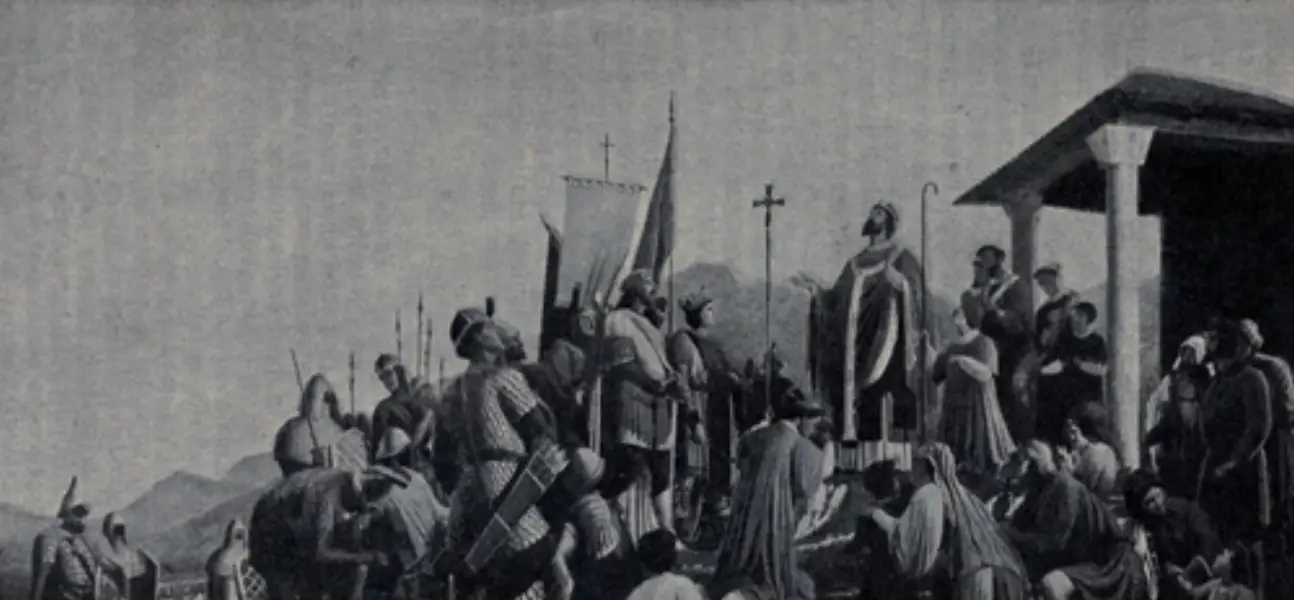
On the death of Patriarch Siguald in 787, Charlemagne appointed Paulinus to be consecrated Patriarch of Aquileia, and the new patriarch returned from court to his see, taking up residence at Cividale, the seat also of the Carolingian count of the March of Friuli. The ancient city of Aquileia itself, destroyed by Attila in 452, had dwindled to a village, though the patriarchal basilica remained. As patriarch, Paulinus took an active part in reforming Christian society. In his dealings with the churches of Istria, and with the Patriarch of Grado who spoke for Byzantine interests nearby, his conduct displayed prudence and pastoral concern. From Charlemagne he obtained diplomas securing to the cathedral chapter of Aquileia the right to choose future patriarchs freely, together with privileges benefiting the Organo monastery of St Mary, the church of St Lawrence at Buja, and the hospitals of St John in Cividale and of St Mary in Verona. His most far-reaching work came after war: in 796 he followed Pepin's campaign against the Avars, and in late summer of that year, with victory won, he presided over a synod of bishops in Pepin's camp on the Danube. There the bishops drew up a plan of evangelization and catechetical instruction for the conquered Avar and Slav lands, resolving, on Alcuin's advice, that the conversion should be carried out nonviolently, and assigning the patriarchate's northernmost territory to the bishop of Salzburg with the border drawn on the Drava River.
§ Patriarch of Aquileia
Guardian of Doctrine
No concern weighed more with Paulinus than the soundness of Catholic teaching. The Council of Ratisbon claimed his presence in 792, and there the Spanish Adoptionism taught by Elipandus of Toledo and Felix of Urgell met condemnation, the doctrine that Christ became God's Son by adoption at the moment the Holy Spirit came upon him in his baptism. In 794 he was a principal figure at the national council of the Franks convened at Frankfurt, where Adoptionism met condemnation once more, and he wrote a book against the error which traveled to Spain under the name of the bishops assembled there. On the road back from Frankfurt he opposed the heresy once more at the Council of Cividale, where fourteen canons on ecclesiastical discipline and the sacrament of marriage were framed and their acts sent to Charlemagne. At that synod he championed the Filioque's place in the Creed, holding that the added word safeguarded the full divinity of Christ against the Adoptionist assumption that his humanity lacked the natural power to send the Holy Spirit; the contemporary Walafrid Strabo noted that the Creed began to be said more widely in the Mass after the deposition of Felix. Paulinus also protested the immunity of the Church from secular interference in his correspondence with the emperor, even while serving him faithfully.
§ Synods
Legate and Servant of Peace
The closing years of Paulinus' patriarchate combined service to the empire with the duties of pastoral office. In 798 he was appointed to act as one of the emperor's missi dominici, the traveling commissioners of Carolingian government, at Pistoia, joining Arno of Salzburg and ten further bishops in the exercise of imperial inspection and justice even while urging in his letters to Charlemagne that the Church must be spared the burdens and meddling of secular power. Afterwards he traveled to Rome as legate to Pope Leo III, an embassy that placed the patriarch of Aquileia in direct contact with the Apostolic See at a momentous period of papal history. The Sponsio Episcoporum addressed to the church of Aquileia gathers up much of what he did as patriarch, recording the undertakings of his bishops toward their see. In 799 he mourned in verse the death of his friend Duke Eric of Friuli, killed at the Siege of Trsat, a personal grief recorded in one of his most famous poems. He died at Cividale, honored already as a saint by the Catholic Church, around 802 or 804, closing a life that had run from a Lombard schoolroom to the councils of an empire, and his remains were at length deposited beneath the crypt altar of the Cividale basilica.
§ Missus dominicus
Saint and Liturgical Cult
Paulinus was never formally canonized; the church of his era revered him as a saint from the time of his death, and his feast entered the liturgical books by custom and use. The first appearance of his name in the liturgy occurs in the Litaniae of Charles the Bald in the ninth century, as well as in the Carolingian litanies, the litanies framed by the holy fathers, and at last the Gertrudian litanies preserved in a tenth-century manuscript. His feast day was recorded on January 11 in manuscripts prior to the Martyrology of Usuard, and in the calendars of the thirteenth, fourteenth and fifteenth centuries used by the churches of Aquileia and Cividale it carried a special rubric. The celebration on January 11, within the privileged octave of the Epiphany, continued until the seventeenth century, when the patriarch Francesco Barbaro translated the feast to February 9; the Church of Cividale keeps it on March 2. The most recent edition of the Roman Martyrology, that of 2004, restores the feast to January 11, the date of his death. After several translations his remains found their resting place at last beneath the crypt altar of the basilica at Cividale del Friuli, where they remain the center of his cult.
§ Feast day
Works and the Apostle of the Slovenes
Paulinus' literary legacy secures his place among the foremost scholars of the Carolingian Renaissance. Against Adoptionism he wrote the Libellus Sacrosyllabus contra Elipandum and the Libri III contra Felicem; for the formation of clergy and laity he composed the Liber Exhortationis; and the protocol of the conference of Pepin and the bishops on the Danube preserves his record of a decisive moment in the history of the Avar expedition. A Commentary on the Letter to the Hebrews remains in manuscript. He was also a poet of real distinction: the Carmen de regula fidei, the Versus de Lazaro, the elegy mourning Duke Eric, a lament for Aquileia's overthrow, and eight hymns written for singing in his own church: for Christmas, Candlemas, Lent, Easter, Saint Mark's day, the solemnity of the apostles Peter and Paul, and the dedication of his cathedral, including the piece known by its incipit Felix per omnes festum mundi cardines. The Carmen de conversione Saxonum may also be his. His letters, preserved in the Monumenta Germaniae Historica and the Patrologia Latina, document the learned world of Charlemagne's court. For the Slovenes he is honored as their apostle, the patriarch who decreed that their conversion should be peaceful, even though full missionary activity in the Aquileian sphere began after his death.
§ Works
Timeline
- 726
Born at Premariacco, near Cividale in the Friuli region, during the latter days of Lombard rule
§ Early life
- 774
First came to the attention of Charlemagne when the Frankish king conquered Lombard northern Italy
§ Carolingian Renaissance
- 776
Rewarded for loyalty during Duke Hrodgaud's rebellion with a diploma of Charlemagne granting him the property of Waldand, son of Mimo of Lavariano
§ Carolingian Renaissance
- 776
Invited by Charlemagne to the palace court as royal master of grammar, where he spent about ten years among the scholars of the schola palatina
§ Carolingian Renaissance
- 787
Appointed by Charlemagne and consecrated Patriarch of Aquileia on the death of Patriarch Siguald, taking up residence at Cividale
§ Patriarch of Aquileia
- 792
Took part in the Council of Ratisbon, which condemned the Spanish Adoptionism of Elipandus of Toledo and Felix of Urgell
§ Synods
- 794
Played a principal role at the national Frankish council of Frankfurt, where he also wrote a book against Adoptionism dispatched to Spain in the bishops' name
§ Synods
- 796
Marched with Pepin, Charlemagne's son, on his campaign against the Avars
§ Synods
- 796
Chaired the bishops' synod convoked in Pepin's camp along the Danube, which planned the evangelization of the newly conquered Avar and Slav territories
§ Synods
- 798
Acted as imperial missus dominicus at Pistoia, appointed alongside Arno of Salzburg and ten more bishops
§ Missus dominicus
- 799
Composed a planctus mourning his friend Duke Eric of Friuli, killed at the Siege of Trsat
§ Works
- 802
Died at Cividale, revered as a saint by the Catholic Church
§ Veneration
In Their Own Words
Began to be repeated in the liturgy of the Mass more widely and frequently after the deposition of Felix the heretic.
The Record
- Major works
- Libellus Sacrosyllabus contra Elipandum·Liber Exhortationis·Libri III contra Felicem·Protocol of the conference of Pepin and the bishops on the Danube·Commentary on the Letter to the Hebrews (unpublished manuscript)·Carmen de regula fidei·Versus de Lazaro·Planctus on the death of Duke Eric of Friuli·Eight liturgical rhythms or hymns, including Felix per omnes festum mundi cardines·Carmen de conversione Saxonum (attributed)
- Patron of
- Revered by the Slovenes as their apostle
- Canonization
- Pre-congregation; revered as a saint from the time of his death, feast assigned to January 11 in the Roman Martyrology
Prayer
Bibliography
Show 8 sources
- Butler, Alban; Hugh Farmer, David (1995). "St Paulinus of Aquileia, Bishop (c. 726–804)". Butler's Lives of the Saints: New Full Edition. Continuum International Publishing Group. pp. 74–75. ISBN 9780860122500
- Štih, Peter; Simoniti, Vasko; Vodopivec, Peter (2008). "The Settlement of the Slavs". A Slovene history: society – politics – culture. Ljubljana: Institute of Modern History. pp. 37–38. ISBN 978-961-6386-19-7
- Herbermann, Charles, ed. (1913). "St. Paulinus II, Patriarch of Aquileia". Catholic Encyclopedia. New York: Robert Appleton Company
- Martyrologium Romanum, Editio Altera, (Citta del Vaticano: Libreria Editrice Vaticana, 2004) 94
- Attwater, Donald and Catherine Rachel John. The Penguin Dictionary of Saints. 3rd edition. New York: Penguin Books, 1993. ISBN 0-14-051312-4
- Nicholas Everett, "Paulinus, the Carolingians and famosissima Aquileia", in Paulino d'Aquileia e il contributo italiano all'Europa carolingia, ed. Paolo Chiesa (Udine, 2003), pp. 115–154
- Carl Giannoni, Paulinus II, Patriarch von Aquileia, (Wien: Verlag, 1896)
- Dag Norberg, L'oeuvre poétique de Paulin d'Aquilée. Stockholm, 1979
Profile text adapted from the Wikipedia article, licensed CC BY-SA 4.0.
Pray with this saint every day
Save St. Paulinus II of Aquileia to your favorites, read the full profile, and get feast-day reminders in the Saints app.
Get the Saints AppFree on the App Store for iPhone and iPad