
c. 354 – 431·Feast June 22
St. Paulinus of Nola
Senator Turned Bishop, Poet and Friend of Augustine
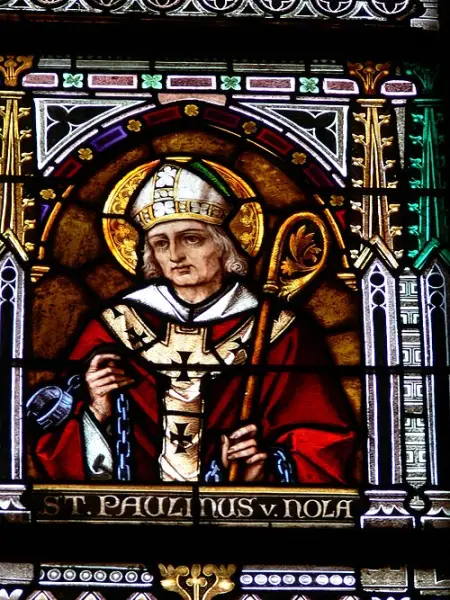
Overview
Paulinus of Nola - in Latin Paulinus Nolanus, baptized Pontius Meropius Anicius Paulinus - joined the careers of poet, senator and Christian bishop, and his surrender of immense wealth became one of the celebrated conversions of late antiquity. Born at Bordeaux around 354 into a senatorial family with estates in Aquitaine, Iberia and southern Italy, and educated by the poet Ausonius, he rose to the rank of suffect consul around 377 and governed Campania around 380. The counsel of his wife Therasia, a Christian of Spain, together with the murder of the emperor Gratian, moved him to lay his career down and receive baptism. The death of their only child sealed the couple's resolve to withdraw from the world; ordained a priest at Barcelona in 393 or 394, Paulinus settled in 395 at Nola in Campania, at the shrine of Saint Felix, where he and Therasia built a great basilica and gathered a monastic community. After Therasia's death he became bishop of Nola around 410 and served for twenty years. His annual poems in honor of Saint Felix and his letters to Augustine, Jerome, Ausonius and Sulpicius Severus made him one of the shaping literary figures of his age. He died at Nola on June 22, 431.
The Complete Life
Heir of Bordeaux
Pontius Meropius Paulinus was born at Bordeaux, the Roman Burdigala, around the year 354, into a notable senatorial family whose estates lay in the Aquitaine province of France, in northern Iberia and in southern Italy. He was a kinsman of Melania the Elder, the aristocratic ascetic whose family would remain entwined with his own spiritual story. His education was entrusted to the best teacher available, the poet Ausonius of Bordeaux, the most celebrated Latin versifier of the age, and from him Paulinus acquired the polished, ornate style that would mark all his later writing. The path laid out for a young man of his class was the standard cursus of senatorial ambition, and at first Paulinus followed it. Once, in his boyhood, he was taken to see the shrine of Saint Felix at Nola by Naples, the third-century martyr's tomb in the necropolis at Cimitile outside the town. The visit passed without recorded consequence, but it planted a connection that would govern the second half of his life. For the present, honors came quickly: in 375 the young emperor Gratian succeeded his father Valentinian, and under the new reign Paulinus was named suffect consul at Rome around 377 and governor of Campania around 380.
§ Life
Conversion and a New Life
As governor of Campania, Paulinus observed the devotion of the Campanians to Saint Felix of Nola, and marked his term of office with gifts to the shrine: a road for pilgrims and a hospice for the poor beside the holy place. The seeds of a different life were already sown. In 383 the emperor Gratian was murdered at Lyon, and Paulinus made his way to Milan and the teaching of Ambrose, western Christendom's most commanding bishop. Around 384 he returned to Bordeaux and married Therasia, a Christian noblewoman from Barcelona. His withdrawal from public life provoked malice: an ugly rumor accused him of his brother's murder, very likely a contrivance aimed at seizing his estates. He was baptized by Bishop Delphinus of Bordeaux, and about 390 he and his wife traveled to Iberia. There the decisive sorrow struck: their only child died eight days after birth, and in their grief the two resolved to renounce secular society for a hidden life of religion. In 393 or 394, after resisting the honor, Paulinus was made a priest by Lampius of Barcelona at the Christmas feast, though the ordination was questioned since he received it at a leap, without the minor orders.
§ Life
Nola and the Cult of Saint Felix
Barcelona could not hold him: in the last weeks of spring 395 he and Therasia crossed from Iberia to Nola in Campania, to the shrine whose pilgrim road he had widened as governor. There they took up residence at Cimitile, beside the martyr's tomb, and Paulinus credited his conversion to Saint Felix, to whom he would write a poem every year for the feast. The great building works of 402 and 403 transformed the site. He restored and improved the ancient basilica raised in the martyr's honor, and with Therasia rebuilt the church commemorating Saint Felix on a grand and lavishly adorned scale, a veritable monument of Christian art whose splendid porticoes and fountains drew their copious water from Avella close by. Pilgrims came in great crowds to the martyr's grave. In January 406, during the peace that followed the defeat of Radagaisus, his house received Melania the Younger with her husband and her mother Albina, together with a band of other guests, among them the Bishop of Beneventum; the whole party remained with him until a date before 408. He also gathered a small monastic community around the shrine. When Therasia died between 408 and 410, Paulinus received episcopal ordination shortly afterwards, and as Bishop of Nola he served the city for twenty years, spending his fortune on his church, his city and its ritual.
§ Influence
Poet of the Martyr, Servant of the Poor
Paulinus' spirituality joined aristocratic generosity to ascetic renunciation, and it found expression above all in his relationship with Saint Felix. Each year he composed a natalicium, a poem for the martyr's feast day when the processions of pilgrims were at their peak, and in these poems the personal bond between bishop and patron in heaven stands openly displayed. His verse shared the ornateness of the early fifth century, and classicists of later centuries dismissed it as cloying and decadent, yet in his own time the poems were highly regarded and used as educational models. His letters, preserved to Augustine, Jerome, Ausonius, Sulpicius Severus, Victricius of Rouen and others, reveal a network of Christian friendship spanning the empire; Paulinus' side of the correspondence with Augustine keeps four letters and Augustine's eight, and it may have been Paulinus' inquiry to Alypius about Augustine's conversion that drew forth the Confessions as Augustine's answer. He decided to invest his money in the poor and the church rather than reject it entirely, a stance deliberately gentler than Jerome's severity. His buildings carried his theology: the apse mosaic and wall inscriptions of the basilica, explained in his long letter to Sulpicius Severus, were designed so that peasants gazing on the painted scenes might be awakened to the faith, art as catechesis for the simple.
§ Influence
Bishop in a Broken World
In later life Paulinus stood as a highly respected church authority and took part in multiple synods investigating the ecclesiastical controversies of the time, including the Pelagian question, an involvement shadowed by his earlier closeness to Pelagius and to the Pelagian writer Julian of Eclanum. His episcopate covered twenty years of mounting crisis for Italy, the age of Gothic armies and Vandal migrations that Gregory the Great's stories would later people with legend: one such tale relates that when the Vandals raided Campania, Paulinus, having exhausted his resources in ransoming captives, offered himself in Africa in exchange for a widow's son, and served as a gardener until the Vandal king, discovering his identity, freed him and all the captive townsmen of Nola. Whatever the truth of the episode, it kept alive the picture of a shepherd whose great heart drew him to his people's side in the calamities of the barbarian invasions. Paulinus died at Nola on June 22, 431, in his late seventies. The following year the presbyter Uranus wrote On the Death of Paulinus, an account of his death and character, a tribute in the tradition that had already honored the deaths of Jerome's friends and Augustine's contemporaries.
§ Legend
Veneration and Relics
Paulinus was venerated as a saint not by formal decree but by the verdict of his own generation: the spectacle of a great lord surrendering riches and rank for a life of ascetic charity drew praise from Augustine, Jerome, Martin and Ambrose alike, and veneration followed naturally. His tomb at Nola became a focus of pilgrimage, and his feast has been kept on June 22, the day of his death, in the Anglican tradition, in Roman Catholicism and in Eastern Orthodoxy, with the Orthodox also commemorating him on January 23 and the Oriental Orthodox Churches on September 8. His relics had a restless history. Around the year 800 Prince Grimoald III of Benevento removed Paulinus's bones; by the eleventh century the remains had been placed in the Roman church of Saint Adalbert, today Saint Bartholomew, on the Tiber island. In 1908 Pius X authorized their return, and on May 15 of the following year the bones were laid once more in the new cathedral of Nola, restoring the saint to the city he had governed and adorned. Sutera, a small town in the Sicilian interior, also cherishes relics of the saint, keeping his feast and walking in procession for him each Easter.
§ Relics
The Lilies of Nola
Paulinus' name is traditionally linked with one of the most familiar elements of Christian worship: the ringing of bells. As bishop of Nola he is credited with introducing bells into church services, and medieval language preserved the tradition, calling a form of handbell a nola and steeple bells campanas from this supposed origin, though the scholar Adolf Buse demonstrated that the invention is not truly his, nor even the town's. His literary legacy has fared better: the letters and verse that survive from his pen, so much of it written for Felix's feast, cast light on his friendships and values, preserve the evolution of Latin literature under Christian influence, and document the emergence of the cult of the saints in the late antique world. The devotion of the people of Nola to their bishop remains vivid. Each year the whole week around his June 22 feast is kept as the Festival of the Lilies, La Festa dei Gigli, in which the gigli, great statues in the saint's honor mounted on towers, are carried on the shoulders of the faithful through the city. Emigrants from Nola and Brusciano carried the tradition to the United States, where their descendants dance the giglio in Brooklyn, on Giglio Way in East Harlem with the Giglio Society of East Harlem, and in West Hempstead on Long Island with the Sons of San Paulino di Nola.
§ Modern devotion to Saint Paulinus
Timeline
- 22 Jun 354
Born at Burdigala (Bordeaux) in Gallia Aquitania into a notable senatorial family
§ Life
- 377
Made suffect consul at Rome by the emperor Gratian
§ Life
- 380
Appointed governor of the province of Campania, where he built a road for pilgrims and a hospice for the poor near the shrine of Saint Felix
§ Life
- 383
After Gratian's murder at Lyon, withdrew to Milan for the teaching of Ambrose
§ Life
- 384
Returned to Bordeaux and married Therasia, a Christian noblewoman from Barcelona
§ Life
- 390
Traveled with his wife to Iberia; after the death of their only child eight days after birth, the couple resolved to withdraw from the world
§ Life
- 25 Dec 393
Ordained priest by Bishop Lampius of Barcelona at the Christmas feast, despite his protests
§ Life
- 395
Moved in late spring from Iberia to Nola in Campania, where he remained until his death
§ Life
- 402
Undertook the great building works of 402–403, restoring the basilica and rebuilding the church of Saint Felix at Cimitile
§ Influence
- Jan 406
Received Melania the Younger, her husband and her mother Albina as guests at Nola
§ Life
- 410
Chosen Bishop of Nola after the death of Therasia, and served the see for twenty years
§ Life
- 22 Jun 431
Died at Nola
§ Life
- 432
The presbyter Uranus wrote On the Death of Paulinus, an account of his death and character
§ Life
- 800
Prince Grimoald III of Benevento removed Paulinus's bones as relics from Nola
§ Relics
- 1908
Pius X authorized the return of the relics to the new cathedral of Nola
§ Relics
- 15 May 1909
The relics were reinterred in the cathedral of Nola
§ Relics
In Their Own Words
It seemed to us useful to portray sacred themes in painting throughout the house of Felix, in the hope that when the peasants see the painted figure, these images will awaken interest in their astonished minds.
Such as I have I give thee
The Record
- Major works
- Annual natalicium poems in honor of Saint Felix of Nola·Letters to Augustine, Jerome, Ausonius, Sulpicius Severus, Victricius of Rouen, Delphinus and Amandus·Building complex at Cimitile: basilicas, porticoes and fountains in honor of Saint Felix·Inscription and apse mosaic program of the basilica, described in his letter to Sulpicius Severus
- Canonization
- Pre-congregation; venerated as a saint from shortly after his death, held up as an example by Augustine, Jerome, Martin and Ambrose
Prayer
Bibliography
Show 7 sources
- Löffler, Klemens "St. Paulinus, Bishop of Nola". The Catholic Encyclopedia Vol. 11. New York: Robert Appleton Company, 1911
- Brown, Peter (1970). "The Patrons of Pelagius: the Roman Aristocracy Between East and West". The Journal of Theological Studies. 21 (1): 56–72. doi: 10.1093/jts/XXI.1.56
- Trout, Dennis E (1999). Paulinus of Nola—Life, Letters, and Poems. Berkeley: University of California Press. ISBN 978-0-520-21709-6
- Pope Benedict XVI (19 December 2007). "St. Paulinus of Nola". L'Osservatore Romano. p. 15
- Schäfer, Joachim (25 May 2022). "Paulinus von Nola". Ökumenisches Heiligenlexikon
- "Bell". Encyclopædia Britannica. Vol. III (9th ed.). New York: Charles Scribner's Sons. 1878. pp. 536–37
- Posen, I. Sheldon; Sciorra, Joseph; Kahn, David M. (1989). The Giglio: Brooklyn's Dancing Tower. Brooklyn, N.Y.: Brooklyn Historical Society
Profile text adapted from the Wikipedia article, licensed CC BY-SA 4.0.
Pray with this saint every day
Save St. Paulinus of Nola to your favorites, read the full profile, and get feast-day reminders in the Saints app.
Get the Saints AppFree on the App Store for iPhone and iPad