
died 358·Feast August 31
St. Paulinus of Trier
Exiled Bishop of Trier and Defender of Athanasius
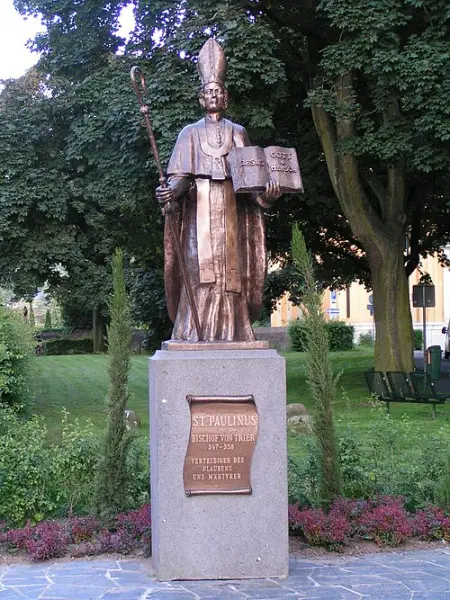
Overview
Paulinus of Trier, who died in 358, shepherded the church of Augusta Treverorum, the modern Trier on the Moselle, during the decades when the Arian controversy tore the Christian world apart. A native of Gascony, he was formed in the cathedral school of Poitiers before travelling north into Germany with Maximin of Trier, whose successor he eventually became in the episcopal chair. His open loyalty to St. Athanasius the Great and to the Nicene faith set him directly against the court party of Emperor Constantius II. At the Synod of Arles in 353 the Arian bishops turned their machinery upon him; singled out by the emperor in person, he was condemned and banished to Phrygia, in what is now Turkey. He endured that exile for the rest of his life and died far from his flock five years later, in 358. The church he had served did not forget him. In 395 his remains were carried back to Trier and laid in the crypt of the city's church, which was afterwards rededicated under his name. He is honored as a saint by the Roman Catholic and Eastern Orthodox Churches, with a shared feast on 31 August.
The Complete Life
From Gascony to the Moselle
Paulinus came from Gascony in the southwest of Gaul, and his gifts marked him out early for the service of the Church. He received his formation in the cathedral school at Poitiers, one of the noted centers of Christian learning in the western empire, where the discipline of scripture and the classical curriculum were studied side by side. From that schooling he carried both a cultivated mind and the Nicene convictions that would define his later life. In time he left his homeland and travelled into Germany in the company of Maximin of Trier, the bishop of one of the great cities of the Roman west. Trier, the Augusta Treverorum of earlier centuries, had served as an imperial residence, and its church stood among the most important of the Gallic provinces. Working beside Maximin, Paulinus learned the government of a demanding urban see, and when Maximin died the succession fell naturally to the educated southerner who had come north to serve. In 335 he took up the bishopric of Trier, and from that position he would be drawn into the widest controversy of his age.
§ Introduction
A Bishop Against the Emperor
The Arian dispute, which had begun over the teaching of Arius about the divinity of Christ, had by the 350s become a struggle for control of the episcopal college, and Emperor Constantius II threw his weight behind the Arian party. Paulinus refused to abandon St. Athanasius the Great, the most famous champion of the Nicene definition, and that loyalty made him a marked man. In 353 a synod convened at Arles gave the court party its instrument: bishops who would not sign against Athanasius faced condemnation and removal. Paulinus was among those singled out, and the emperor's displeasure fell on him personally. He was sentenced to exile and transported to Phrygia, in the interior of Asia Minor, one of the remote destinations to which recalcitrant orthodox bishops were commonly sent. There he remained, deprived of his see and separated from the church he had governed, for the rest of his days. He died in banishment in 358, having held fast to the confession for which he had been condemned, a confessor whose fidelity outlasted the emperor's anger.
§ Introduction
Return and Remembrance
Exile ended only with death, but memory outlived both. Nearly four decades after Paulinus died in Phrygia, his remains were brought back to the city he had served: in 395 his body was returned to Trier and laid to rest in the crypt of the city's church, which was rededicated in his honor and came to be known as St. Paulinus' Church. The translation made the church a center of his cult, and his tomb in the crypt remained the focal point of local devotion through the centuries that followed. The Eastern Orthodox Church and the Roman Catholic Church both number him among the saints, and they keep his memory on a common feast day, 31 August. For the later church his career became an early and enduring example of a recurring drama: a bishop confronted by state power, offered survival at the price of doctrinal compromise, and choosing instead the long obedience of exile. His story is preserved in the records of the Arian controversy, where his name appears among the confessors who suffered for the Nicene faith under Constantius II.
§ Veneration
Timeline
- 335
Assumed the bishopric of Trier, succeeding Maximin
§ Introduction
- 346
His tenure in the see of Trier came to an end, and Bonosus succeeded him
§ Introduction
- 353
Was targeted by the Arians at the Synod of Arles and exiled to Phrygia by Emperor Constantius II
§ Introduction
- 358
Died in exile in Phrygia, five years after his banishment
§ Introduction
- 395
His remains were returned to Trier and buried in the crypt of the church later rededicated to him
§ Introduction
The Record
- Canonization
- Pre-congregation; venerated since antiquity by the Roman Catholic and Eastern Orthodox Churches
Prayer
Bibliography
Show 4 sources
- Carl L. Beckwith, "The Condemnation and Exile of Hilary of Poitiers at the Synod of Beziers (356 C.E.)", Journal of Early Christian Studies 13:1
- NPNF2-09. Philip Schaff, ed. "Hilary of Poitiers, John of Damascus"; Daniel H. Williams, Ambrose of Milan and the End of the Arian-Nicene Conflicts (1995), p. 53.
- Catholic Encyclopedia: "Diocese of Poitiers"
- "Latin Saints of the Orthodox Patriarchate of Rome"
Profile text adapted from the Wikipedia article, licensed CC BY-SA 4.0.
Pray with this saint every day
Save St. Paulinus of Trier to your favorites, read the full profile, and get feast-day reminders in the Saints app.
Get the Saints AppFree on the App Store for iPhone and iPad