
died 10 October 644·Feast October 10
St. Paulinus of York
Missionary Bishop Who Converted Northumbria
Overview
Paulinus, who died on 10 October 644, was a Roman monk of the Gregorian mission and the first Bishop of York, the missionary who brought Christianity to the Northumbrian court and, through it, to much of northern England. Sent from Rome by Pope Gregory I in 601 with the second band of missionaries, he had labored quietly in Kent for some twenty years before his hour came. In 625, newly consecrated a bishop, he escorted the Christian princess Æthelburg of Kent northward to marry King Edwin of Northumbria, and there, over the following years, he achieved the conversion the pope had dreamed of: Edwin himself was baptized at York in 627, thousands of his subjects followed, churches rose on the royal estates, and among those he baptized were the future abbess Hilda of Whitby and the king's daughter Eanflæd. The mission collapsed with Edwin's defeat and death in 633. Paulinus fled south with the widowed queen to Kent, where he accepted the humbler see of Rochester and served it until his death. The pallium naming him Archbishop of York arrived too late to be used, but his stature endured: he was honored as a saint immediately after his death, and his relics were enshrined at Rochester in the 1080s.
The Complete Life
From Rome to Kent
Paulinus was a monk of Rome, probably Italian by birth, when Pope Gregory I chose him in 601 for the reinforcement of the mission he had launched to convert the Anglo-Saxons from their native paganism. He set out with Mellitus and others in the second group of missionaries, and the party reached the Kingdom of Kent by 604. Then follows one of the longest silences in his story: for two decades the sources record nothing of his activities. He remained in Kent while Augustine's successors consolidated the young church of the Canterbury province, and the man who would convert a kingdom served out those years without title or chronicle. The silence ended around 625, when Archbishop Justus of Canterbury consecrated him a bishop on 21 July. Bede, our chief witness, describes him in vivid physical terms: a tall man who stooped a little, dark-haired and thin-faced, with a narrow aquiline nose, and a presence both venerable and awe-inspiring. Historians have debated the exact sequence of the years that followed, since surviving papal letters sit uneasily with Bede's chronology, and some scholars argue the journey north happened a year earlier, or that Paulinus first crossed into Northumbria as a priest and returned for consecration later.
§ Early life
Chaplain of a Marriage Alliance
The turning of Paulinus's life was bound to a royal wedding. Æthelburg, the Christian sister of King Eadbald of Kent, was given in marriage to Edwin, the powerful pagan king of Northumbria, and one condition of the match was that she be allowed to keep her faith and worship as she chose. Paulinus went north with her, and Bede records his double purpose: to serve the new queen's religion and to labor for the conversion of the Northumbrians. Whether he crossed the border as bishop in 625, as Bede has it, or earlier and as a priest, as some historians judge from the papal letters, his assignment was the same. He was planting the church at the very center of a heathen kingdom, dependent first on a queen's private chapel and a king's tolerance. The arrangement must have tested every gift of patience and diplomacy he possessed. For a monk who had waited twenty years in Kent, the journey to Edwin's court was the opening of the work for which Gregory the Great had sent him a generation before, and within two years the entire character of Northumbrian history would begin to change.
§ Early life
The Conversion of Edwin's Kingdom
The door opened in 626. On the very night a West Saxon assassination plot failed against the king, Æthelburg bore a daughter, and Paulinus attributed the safe delivery to his prayers. Edwin promised to convert and to have the child baptized if God granted him victory over the West Saxons; he prevailed but delayed. What decided him was Paulinus's disclosure of a dream from the years of the king's exile at the court of Rædwald of East Anglia: a stranger had promised that power would be his when a man laid a hand on his head, and Paulinus, telling it back to him, stretched out his hand and set it upon Edwin's head. A late seventh-century life of Gregory even identifies the stranger of the vision as Paulinus himself. Politically the ground was prepared as well: the Northumbrian nobles were willing, and Pope Boniface V had written to Edwin urging his baptism. In 627 the king and many of his thegns were baptized at York, where Paulinus now established the church Gregory had intended as England's second metropolitan see. At Yeavering he spent thirty-six days baptizing converts; he preached in Lindsey, built churches on the royal estates, and baptized two women of destiny, Hilda, the future abbess of Whitby, and the infant Eanflæd. As the only Roman bishop in England he also consecrated Honorius archbishop of Canterbury in these years.
§ Bishop of York
Catastrophe and Rochester
The mission stood or fell with its king, and it fell in 633. Edwin was defeated and killed at the Battle of Hatfield Chase by an alliance of the Welsh of Gwynedd and the Mercian Angles, on the date traditionally given as 12 October, though a papal letter of June 634 has led some historians to prefer 634. His kingdom broke apart, his successors reverted to paganism, and Christianity in Northumbria declined sharply. Paulinus took flight with the widowed Æthelburg, escorting her and the royal children back to her brother's Kent; the two boys were afterward carried across the Channel for protection and lodged at the court of King Dagobert I. In Kent the fugitive archbishop-designate was offered the see of Rochester, and he accepted it, serving that modest diocese for the remaining eleven years of his life. From Rome came the final irony: Pope Honorius I had dispatched the pallium, the woolen badge of metropolitan authority, for Paulinus as Archbishop of York, but by the time it reached England he had abandoned the north, and the honor could never be exercised. One of his clergy, James the Deacon, stayed behind in Northumbria to keep the embers of the mission alive.
§ Bishop of Rochester
Death and Cult at Rochester
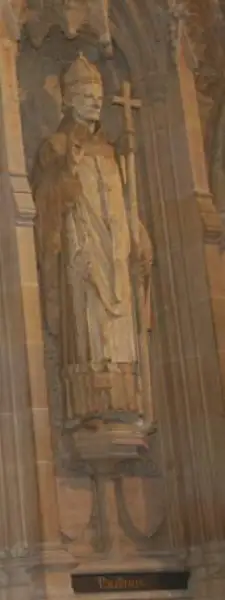
Paulinus died at Rochester on 10 October 644 and was buried in the sacristy of its church. His successor Ithamar became the first Englishman consecrated to one of the Gregorian sees, a quiet testimony to how far the mission had traveled in a single generation. Veneration of Paulinus followed at once: he was revered as a saint, with his feast kept on the day of his death, 10 October. When a new church was built at Rochester in the 1080s, his relics were translated to a fresh shrine, though the full promotion of his cult there seems to have come only after the Norman Conquest of 1066. Canterbury also held shrines in his honor, and at least five English churches came to bear his dedication. He is reckoned a saint by the Roman Catholic Church, the Eastern Orthodox Church, and the Anglican Communion, three communions that rarely name the same confessors with one voice. A millennium and a half after his death his statue stands in Rochester Cathedral, watching over the see that gave him refuge.
§ Death and veneration
A Difficult Harvest
Judging Paulinus's missionary achievement has never been simple. Bede's narrative implies a triumphant conversion of Northumbria, but the supporting evidence is thin, and modern historians suspect his northern mission was less effective than it appeared. The test came quickly: Osric, one of Edwin's successors, had been brought to Christianity by Paulinus, yet after Edwin's death he returned to paganism, and the kingdom's apostasy swept away much of the missionary's work. Northumbria's lasting conversion was accomplished mainly by Irish missionaries, brought in by Oswald, Edwin's eventual successor. Yet the harvest was not nothing. Hilda remained Christian and grew into the abbess who made Whitby one of the decisive monasteries of the English church; Eanflæd followed her; James the Deacon preserved a Roman presence in the north until Irish and Roman currents could merge; and the memory of a bishop who had baptized a king at York never vanished from the northern imagination. Paulinus's career, briefly brilliant and long eclipsed, stands as the first chapter of Christianity in northern England, the sowing for which another generation reaped.
§ Death and veneration
Timeline
- 601
Was sent from Rome by Pope Gregory I with the second Gregorian mission, together with Mellitus and others, to convert the Anglo-Saxons
§ Early life
- 604
Arrived in the Kingdom of Kent with the second group of missionaries
§ Early life
- 21 Jul 625
Was consecrated a bishop by Justus, archbishop of Canterbury
§ Early life
- 625
Accompanied Æthelburg, sister of King Eadbald of Kent, north to Northumbria for her marriage to King Edwin
§ Early life
- 626
Princess Eanflæd was born at Easter even as West Saxon assassins failed against her father, and Paulinus pressed this double providence home
§ Bishop of York
- 627
Baptized King Edwin and many of his followers at York and established his church in what Gregory had planned as England's second metropolitan see
§ Bishop of York
- 12 Oct 633
King Edwin was killed at the Battle of Hatfield Chase; Paulinus and Queen Æthelburg fled Northumbria for Kent
§ Bishop of Rochester
- 633
Accepted the see of Rochester, which he was to hold until his death
§ Bishop of Rochester
- Jun 634
Pope Honorius I sent him the pallium as Archbishop of York, but it arrived after he had left the north and was of no use
§ Bishop of Rochester
- 10 Oct 644
Died at Rochester and was laid to rest in the sacristy of that church
§ Death and veneration
In Their Own Words
A man tall of stature, a little stooping, with black hair and a thin face, a hooked and thin nose, his aspect both venerable and awe-inspiring
The Record
- Major works
- Stone church at York, seat of the planned second metropolitan see of England·Church in Lincoln, identified with the earliest phase of St Paul in the Bail·Churches built on royal estates across Northumbria
- Canonization
- Pre-congregation; revered as a saint soon after his death, venerated by the Roman Catholic, Eastern Orthodox, and Anglican Churches
Prayer
Bibliography
Show 12 sources
- Blair, Peter Hunter (1990). The World of Bede (Reprint of 1970 ed.). Cambridge, UK: Cambridge University Press. ISBN 0-521-39819-3.
- Costambeys, Marios (2004). "Paulinus (St Paulinus) (d. 644)". Oxford Dictionary of National Biography (October 2005 revised ed.). Oxford University Press.
- Farmer, David Hugh (2004). Oxford Dictionary of Saints (Fifth ed.). Oxford, UK: Oxford University Press. ISBN 978-0-19-860949-0.
- Fryde, E. B.; Greenway, D. E.; Porter, S.; Roy, I. (1996). Handbook of British Chronology (Third revised ed.). Cambridge, UK: Cambridge University Press. ISBN 0-521-56350-X.
- Kirby, D. P. (2000). The Earliest English Kings. New York: Routledge. ISBN 0-415-24211-8.
- Lapidge, Michael (2001). "Paulinus". In Lapidge, Blair, Keynes, Scragg (eds.). The Blackwell Encyclopaedia of Anglo-Saxon England. Malden, MA: Blackwell. p. 359. ISBN 978-0-631-22492-1.
- Mayr-Harting, Henry (1991). The Coming of Christianity to Anglo-Saxon England. University Park, PA: Pennsylvania State University Press. ISBN 0-271-00769-9.
- Rollason, David. "The Shrines of Saints in later Anglo-Saxon England: Distribution and Significance". Archaeology Data Services. Department of Archaeology, University of York.
- Sharpe, R. (September 2002). "The Naming of Bishop Ithamar". English Historical Review. 117 (473): 889-894.
- Stenton, F. M. (1971). Anglo-Saxon England (Third ed.). Oxford, UK: Oxford University Press. ISBN 978-0-19-280139-5.
- Walsh, Michael J. (2007). A New Dictionary of Saints: East and West. London: Burns & Oats. ISBN 978-0-86012-438-2.
- Yorke, Barbara (2006). The Conversion of Britain: Religion, Politics and Society in Britain c. 600-800. London: Pearson/Longman. ISBN 0-582-77292-3.
Profile text adapted from the Wikipedia article, licensed CC BY-SA 4.0.
Pray with this saint every day
Save St. Paulinus of York to your favorites, read the full profile, and get feast-day reminders in the Saints app.
Get the Saints AppFree on the App Store for iPhone and iPad