
c. 576 – 648·Feast February 8
St. Paulus of Verdun
Bishop of Verdun and Patron of Bakers
Overview
Paulus of Verdun, born around 576, rose from the old Gallo-Roman aristocracy to become one of the notable churchmen of Merovingian Austrasia. Educated at the court of Chlothar II alongside the future king Dagobert I, the future bishop Desiderius of Cahors, and Eligius, later counselor to Dagobert and bishop of Noyon-Tournai, he chose a harder road than court preferment. He withdrew first to a solitary life on the Paulsberg, across the Moselle from Trier, and then entered the monastery of Tholey in the Saarland, where he directed the school and served as its second abbot from 626. About 630, at the instance of his former pupil Adalgisel Grimo, King Dagobert I named him bishop of Verdun against his own wishes. He found the diocese in severe financial distress and restored it with the help of gifts from Adalgisel and the Frankish king. He built the church of St. Saturninus in Verdun, where he was buried after his death in 647 or 648. A cherished legend of the burning oven at Tholey made him the patron of bakers, and on his feast the bread of Saint Paul was distributed in the streets of Verdun.
The Complete Life
Aristocratic Birth, Courtly Youth
Paulus was born around 576 into a wealthy family whose very name pointed to the old Gallo-Roman aristocracy from which so many Merovingian bishops were drawn. Some sources claim a still closer bond with the ecclesiastical nobility of the age, for the Book of Saints of St. Augustine's Abbey records the tradition that he was brother to St. Germanus of Paris. Whatever the truth of that kinship, his upbringing placed him among the elite of the Frankish kingdoms. In his youth he received his schooling at the court of Chlothar II, joining a tiny but exceptionally well-placed company of aristocratic boys there. His companions there read like a catalogue of the coming generation of church leadership: the future king Dagobert I, Desiderius who would govern the see of Cahors, and Eligius, who would become the trusted adviser of Dagobert and the bishop of Noyon-Tournai. Desiderius of Cahors himself, in one of his surviving letters, bears witness to that shared formation. Few products of the Merovingian court school entered life with better connections, and few used them so deliberately for the service of the Church rather than for personal advancement.
§ Life
Hermit and Abbot of Tholey
Court training did not hold him. Paulus withdrew from the world to live as a hermit on the height known as the Paulsberg, in Latin Mons Cebenna, which rises across the Moselle from Trier amid the Vosges mountains. There he practiced the eremitical discipline of prayer and austerity that shaped the rest of his life. In time he left the solitude for community, entering the monastery of Tholey in the region of the present-day Saarland. His education and aristocratic polish were put to work in the abbey's school, whose direction was entrusted to him. The brethren eventually chose him as their abbot, and he is counted the second abbot of Tholey. His tenure as superior lasted from 626 to somewhere between 643 and 647, a long stewardship during which the monastery on the Saar became a center of learning and monastic observance. Even after his elevation to the episcopate he retained a bond with Tholey, a bond the monks themselves honored generations later when, fearing the Viking raids, they carried his relics to the safety of their abbey in the late ninth century.
§ Life
An Unwilling Bishop Rebuilds Verdun
Around 630 King Dagobert I named Paulus bishop of Verdun. According to his biography the appointment was forced upon him against his will, and the human instrument of his elevation was one of his own former pupils, Adalgisel Grimo, whose influence with the court prevailed over the abbot's reluctance. What Paulus found at Verdun dismayed him: the diocese was in a very poor financial state, its resources dissipated and its works of religion neglected. He set about its restoration with the same practical energy he had shown at Tholey. Gifts from his devoted former student and from the Frankish king of Austrasia supplied the means, and under his government the see recovered its stability. He built the church of St. Saturninus in the city, a foundation that would become inseparable from his memory, for after his death in 647 or 648 he was buried there and the church was later renamed St. Paul's in his honor. The Roman Martyrology records that he was renowned for miracles, a reputation that his people attached to a bishop who had governed them for some seventeen years.
§ Life
The Legend of the Oven
The story his devotees loved best was told by Bertarius of Verdun. One day, according to the legend, Paulus was working in the bakery of the abbey of Tholey when the oven malfunctioned. Alarmed that the loaves would miss the hour when the community sat down to eat, he stepped into the red-hot oven still wearing his complete habit, scrubbed it out with his hood, and set the loaves in order, afterward walking out unscathed with the baking finished. The tale distills the spirituality of the man: a bishop who had begun as a hermit never considered any task in the monastery beneath him, and his trust in God extended to the humblest labor of the kitchen. The legend gave him to the working world. Because of it, Paulus became the patron of the bakers and pastry chefs of Verdun, and each year on his feast, 8 February, the bread of Saint Paul was blessed and distributed through the streets of the city, an enduring link between the episcopal saint and the tradespeople who claimed him.
§ Legend
Cross, Abbey, and Window
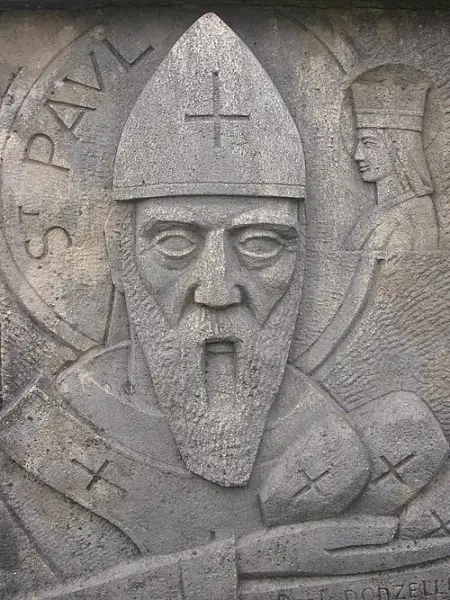
Devotion to Paulus left durable marks on the landscape of Lorraine. In 970 Bishop Viefrid founded a new monastery at Verdun that was dedicated to Paulus and received the translation of his remains; the Abbey of Saint-Paul was occupied first by Benedictines, passed to the Premonstratensians in 1135, and was finally destroyed in 1552. Outside Verdun, a few kilometers away at the spot named Le Rozelier, a stone cross rises, its figure identifiable as the saint by the bread rolls in his hands. Its inscription recounts how the monks of Tholey carried the saint's body to their Saarland abbey in the late ninth century to shield it from the Norman invasion, how they were halted at that spot by a mysterious force, and how the cross raised there came to be called the Pale Cross or Paul Cross; the priory of Saint-Vanne was later established beside it, and the present cross and altar, containing a relic of the saint, were blessed by the bishop of Verdun on 14 August 1963. In the church of Saint Martin at Les Éparges, rebuilt after the First World War, a stained glass window shows him holding three bread rolls upon the Gospel.
§ Monuments
Timeline
- 576
Was born into a wealthy family of the old Gallo-Roman aristocracy
§ Life
- 626
Began a tenure as second abbot of the monastery at Tholey, where he had charge of the school
§ Life
- 630
Was named bishop of Verdun by King Dagobert I, accepting office against his will
§ Life
- 648
Died after some seventeen years as bishop, and was buried in the church of St. Saturninus he had built
§ Life
- 973
His remains were translated to the new Abbey of Saint-Paul at Verdun, founded and dedicated to him by Bishop Viefrid
§ Monuments
The Record
- Major works
- Church of St. Saturninus in Verdun, later renamed St. Paul's
- Patron of
- Bakers and pastry chefs of Verdun
- Symbols
- Depicted holding three bread rolls set upon the Gospel
- Canonization
- Pre-congregation; ancient cult recorded in the Roman Martyrology, venerated by the Roman Catholic and Eastern Orthodox Churches
Prayer
Bibliography
Show 10 sources
- Matthew Bunson and Margaret Bunson. Our Sunday Visitor's Encyclopedia of Saints. Second Edition. Our Sunday Visitor, 2014. p. 651.
- The Benedictine Monks of St Augustine's Abbey, Ramsgate (Comp.). The Book of Saints: A Dictionary of Servants of God Canonised by the Catholic Church. London: A & C Black, 1921. p. 211.
- Abtliste: Paulus (Bischof von Verdun). Benediktinerabtei St. Maritius Tholey. Retrieved: 14 May 2015.
- Smith, William; Wace, Henry (1887). A Dictionary of Christian Biography, Literature, Sects and Doctrines, vol 4. Little, Brown & Company. p. 271.
- Goyau, Georges. "Diocese of Verdun." The Catholic Encyclopedia. Vol. 15. New York: Robert Appleton Company, 1912.
- February. Latin Saints of the Orthodox Patriarchate of Rome.
- Rabenstein, Katherine I. "Paul of Verdun, OSB B (RM)." St. Patrick Catholic Church - Saint of the Day, 1998.
- Bertarius Virdunensis (916). Historia brevis episcoporum Virdunensium.
- The Roman Martyrology. Transl. by the Archbishop of Baltimore. Baltimore: John Murphy Company, 1916. pp. 41-42.
- Eglise paroissiale Saint-Martin a Les Eparges, Meuse. PatrimoineDeFrance.com. Retrieved: 16 May 2015.
Profile text adapted from the Wikipedia article, licensed CC BY-SA 4.0.
Pray with this saint every day
Save St. Paulus of Verdun to your favorites, read the full profile, and get feast-day reminders in the Saints app.
Get the Saints AppFree on the App Store for iPhone and iPad