
died c. 606·Feast May 26
St. Pausicacus of Synada
Healing Ascetic and Bishop of Synada
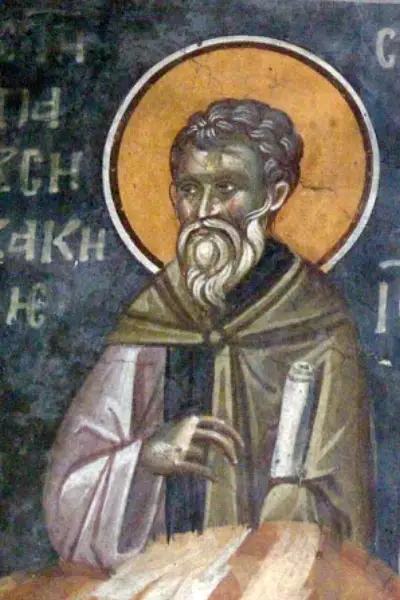
Overview
Pausicacus of Synada was a monk, ascetic, and bishop whose Greek name, from the words for 'cessation' and 'evil,' means 'to stop evil.' He was born in the fifth century at Apamea in southwest Syria, into a noble and devout family, and even as a child gave himself to prayer and the ascetic life. At twenty-five he became a monk, sustaining himself on little more than bread and water. Alongside that severity came a reputation for healing: he was credited with curing ailments of body and mind, delivering the tormented from demons, and restoring sight to the blind. Reports of these marvels eventually reached Constantinople, where Patriarch Cyriacus summoned the monk and ordained him bishop of Synada, a see in Phrygia in Asia Minor. As bishop he proved a stern as well as a tender shepherd, banishing heretics and the persistently immoral from his flock, yet winning fame throughout Phrygia for his care of his people. On a journey to the capital he healed Emperor Maurice of an illness, winning a reward for his province, and on the road home his prayer brought forth a spring of water for his thirsty companions. He died in 606.
The Complete Life
A Noble Child of Apamea
The city of Apamea, set in the southwest of Syria, was the motherland of Pausicacus, and it gave him two inheritances: the nobility of his family and the fervor of its piety. He was born in the fifth century to parents of rank who were also devout, and the combination proved decisive. Even as a small boy he adopted the ascetic manner of life, and prayer claimed nearly every one of his hours — remarkable conduct in a child of the governing class. His very name expressed his parents' hopes and his life's work: in Greek, Pausicacus joins the word for stopping or ceasing with the word for evil or misfortune, so that it means 'to stop evil.' When he reached the age of twenty-five he took the decisive step and became a monk. The discipline he embraced was severe even by the standards of Syrian asceticism; his nourishment was a little water and a little bread, and out of that austerity there flowered the gifts of healing for which the whole East would come to know him.
§ Biography
The Healer Summoned to the Capital
Grace followed the monastic discipline. Pausicacus received, so the accounts relate, a healing power, and sickness of body and mind alike began to yield before his intercession. As the years passed, reports spread that he could expel demons from the possessed, restore vision to those born blind, and work many other marvels. Such reputations travel far, and theirs reached the Patriarch of Constantinople, Cyriacus, who held the patriarchal throne from 592 to 606. The patriarch summoned the Syrian monk to the capital, and there consecrated him a bishop, appointing him to the see of Synada in Phrygia, in the west of Asia Minor. It was a striking translation: a hermit formed in the deserts of Syria, discovered by rumor and raised by the patriarch's own hands to govern a distant flock. Whatever the monk thought of the honor, he obeyed, and the gifts that had marked his hidden years now passed into the public service of the Church, where a whole province would soon feel their effect.
§ Biography
Shepherd of Phrygia
No sooner had Pausicacus taken up the government of Synada than he showed the rigor that a lifetime of asceticism breeds. He began to banish from his congregation the heretics and freethinkers who corrupted doctrine, together with those who persisted in immorality, refusing to let his flock be leavened by corruption. Yet severity was only one side of his episcopate. His care for the people entrusted to him made him famous throughout Phrygia, and that fame, too, traveled. Summoned again to Constantinople, he healed the Emperor Maurice of his illness, and the grateful sovereign granted a reward to the saint's province, so that his gift of healing became a material blessing for the whole region under his charge. The return journey gave the story his biographers cherished most: finding his companions parched with thirst, Pausicacus cried out to the Lord on their behalf, and where he stood a fountain of clean water burst up through the soil. He continued to govern his see until his death in 606. Where he was buried is unknown, but his memory was fixed in the calendars of the Church on 26 May.
§ Biography
Veneration East and West
Pausicacus was never formally canonized, for he belongs to the company of saints whose cult arose in the first ages of devotion and was received by the whole Church without decree. The Eastern Orthodox Churches and the Oriental Orthodox Churches alike honor him, keeping his name day on 26 May. His cult traveled with the Slavic peoples, who received his story among the lives of the saints collected for every day of the year, and the baptismal calendars of the Christian East preserved his name in forms like Pavsikaky. Iconography remembered him simply: a twelfth-century fresco shows the bishop vested as a bishop, without a legend of martyrdom or a spectacular emblem, because his sanctity was written in healed bodies and opened eyes rather than in blood. The absence of any record of his grave has not dimmed that memory; a saint whose burial place is unknown belongs to no single shrine, and every place where the sick pray for deliverance from evil may claim a share in his intercession.
§ Introduction
The Record
- Symbols
- Vested as a bishop
- Canonization
- Pre-congregation; venerated since antiquity in the Eastern Orthodox and Oriental Orthodox Churches
Prayer
Bibliography
Show 6 sources
- Pétridès, Sophrone. "Synnada." The Catholic Encyclopedia Vol. 14. New York: Robert Appleton Company, 1912.
- "Dictionary of Russian names: Pavsikaky". Reference and Information Portal ГРАМОТА.RU. Retrieved 2011-10-24.
- "Lives of the saints for every day: May 26". The Holy Dormition Kiev-Pechersk Lavra. Retrieved 2011-10-19.
- "Saint Pausicacus, Bishop of Synnada", OCA.
- "Venerable Pavsikaky, bishop of Sinad". Christian portal. Retrieved 2011-10-19.
- Lives of the Saints in the presentation of St. Dmitry Tuptalo (Rostov). Volume IX: May. Lviv: Svichado. 496. ISBN 978-966-395-392-2.
Profile text adapted from the Wikipedia article, licensed CC BY-SA 4.0.
Pray with this saint every day
Save St. Pausicacus of Synada to your favorites, read the full profile, and get feast-day reminders in the Saints app.
Get the Saints AppFree on the App Store for iPhone and iPad