
c. 1441 – 17 September 1485·Feast September 17
St. Pedro de Arbués
Canon Regular and Inquisitor Martyred in Zaragoza
Overview
Pedro de Arbués, born around 1441 at Épila in the Kingdom of Aragon, was a priest of the Augustinian canons regular whose assassination in the cathedral of Zaragoza made him the Spanish Inquisition's most famous martyr. Formed at the university of Bologna, where he took his doctorate in 1473 and taught moral philosophy, he returned to Spain to enter the cathedral chapter of La Seo in Zaragoza, making his religious profession in 1474. When Ferdinand and Isabella obtained the papal bull establishing the modern Spanish tribunal against heresy, the Grand Inquisitor Tomás de Torquemada named Arbués Inquisitor Provincial of the Kingdom of Aragon on 4 May 1484. His work was bitterly resisted by many converts and by those who saw the tribunal as a threat to their liberties. On 14 September 1485 he was attacked at the altar of La Seo cathedral as he knelt in prayer; though he wore a helmet and chain mail beneath his tunic, the wounds proved fatal, and he died three days later, on 17 September. Devotion to him arose at once through popular acclaim, and his death greatly strengthened the Inquisition's campaign. He was beatified in 1664 and canonized by Pope Pius IX on 29 June 1867, and his shrine stands in the cathedral where he died.
The Complete Life
A Noble Scholar of Aragon
Pedro de Arbués was born about 1441 at Épila, a town in the region of Zaragoza, into the nobility of the Kingdom of Aragon; his father was the nobleman Antonio de Arbués and his mother Sancia Ruiz. The family's standing gave the boy access to the best education of the age. He studied philosophy, perhaps at Huesca, and then won a scholarship to the Spanish College of Saint Clement at Bologna, one of the great institutions through which young Iberians were formed alongside the learning of Italy. There he rose quickly: he obtained his doctorate in 1473 and served during those years as a professor of moral philosophical studies, that is, of ethics. The combination of noble birth, scholastic distinction, and pastoral purpose marked him for responsibility. On his return to Spain he entered the cathedral chapter of canons regular at La Seo, Zaragoza's cathedral of the Savior, and in 1474 he made his religious profession among them. He was thus both a canon bound by the Augustinian rule and a doctor of theology, a man whose gifts placed him naturally among the counselors and officials of a restless kingdom.
§ Life
Called to the Inquisition
The Spain into which Arbués returned was convulsed by the question of religious conformity. Ferdinand and Isabella had obtained from Pope Sixtus IV the bull establishing a tribunal to search out heretics in their kingdoms, reviving an office that had first appeared in Aragon in the fourteenth century against the Cathar heresy. At its center stood the conversos, Jews who had received baptism, some of whom were suspected of practicing Judaism in secret. In 1483 Torquemada was appointed Grand Inquisitor for Castile, and on 4 May 1484 he named Pedro de Arbués and Pedro Gaspar Juglar Inquisitors Provincial of the Kingdom of Aragon. The office made the canon of La Seo one of the most visible and most exposed men in the kingdom. His work was opposed by converts who dreaded the tribunal, and by many others who saw in it a Castilian intrusion upon Aragonese charters, privileges, and local laws. Arbués knew the risks: he had taken up a charge whose holders were targets, and the last year of his life would be spent in the shadow of that knowledge.
§ Life
Assassination at the Altar
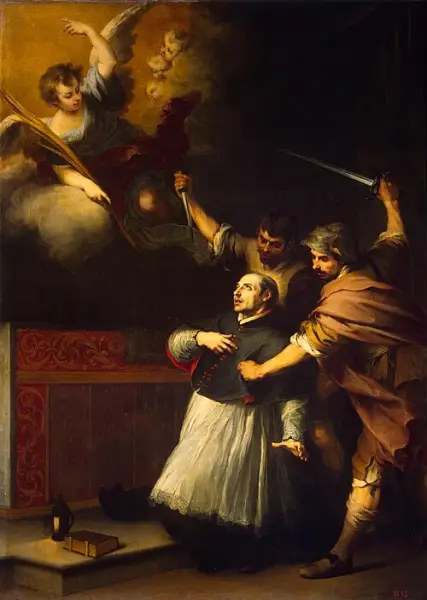
On 14 September 1485 Pedro de Arbués was attacked in the cathedral of Zaragoza as he knelt in prayer before the altar. He had long understood that his office placed his life in danger, and he had worn armor beneath his tunic; on that day he had a helmet and chain mail under his vestments. The assault against him was no chance violence but a plot: the most powerful families among Aragon's converted Jews, the Sánchez, Montesa, Abadía, Paterno, and Santangel families, appear to have funded the conspiracy. The armor did not save him. Wounded at the altar where he had knelt, he lingered three days and died of his injuries on 17 September 1485, at the age of forty-four. His body was laid in a chapel built and named in his honor. Whatever judgment history may render on the tribunal he served, the manner of his death was the death of a priest slain at his prayers, and his contemporaries did not hesitate to number him among the martyrs of the Church.
§ Murder
Reprisals and Their Shadow
The assassination unleashed a ruthless reckoning. Between 30 June and 15 December 1486 — the tally is the chronicler Jerónimo Zurita's — nine of the implicated were put to death, two took their own lives, thirteen were burned in effigy, and four suffered penalties for complicity. Francisco de Santa Fe, grandson of the well-known convert Gerónimo de Santa Fe, killed himself in prison; his body was burned and his ashes thrown into the river. Some converso officeholders got away into Navarre, while those who were taken suffered mutilation before execution; the hands of some were nailed to the cathedral door before they were beheaded and quartered, and Luis de Santangel, a notable official, was beheaded, his head displayed on a pole and his body burned. In 1489 the Inquisition granted Arbués's sister property confiscated from Santangel to fund her marriage. The purge reached beyond the actual conspirators: Juan de la Caballería was tried in 1488 and died in prison. The chronicler Hernando del Pulgar, who knew the converso world of high office, reported that fear of persecution had driven some to violence, doubting the inquisitor's motives, and that old Christians were involved as well, though none of them was tried. Later historians have seen in the trials a chance, beneath the banner of heresy-hunting, to strip prominent converso figures of their influence.
§ Murder
From Acclaim to Canonization
Veneration of the slain inquisitor came swiftly through popular acclaim, without the long processes that later canon law would require. Pope Alexander VII formalized his beatification in Rome on 20 April 1664, and on 29 June 1867 Pope Pius IX celebrated his canonization at Saint Peter's Basilica, confirming it in the document Maiorem caritatem. The canonization belonged to a nineteenth-century papacy that held up the martyrs of earlier centuries as models, and Arbués was enrolled among the martyrs of the Catholic Church. His principal shrine is the Cathedral of the Savior in Zaragoza, where he had been a canon, where he was attacked, and where his tomb became a place of pilgrimage; Murillo's painting of the inquisitor's death, now in the Hermitage, shows how the martyrdom entered the sacred art of the age. His feast is kept on 17 September, the day of his death. In the long memory of the Church he stands as a priest who died at the altar, though the history that surrounds his cult, entangled with the Inquisition and its consequences for the Jews and conversos of Spain, remains among the most somber chapters of early modern Europe.
§ Sainthood
Memory and Reckoning
Few saints carry so heavy a historical shadow. Contemporaries recorded that Arbués's death greatly assisted Torquemada's campaign against heretics and crypto-Jews, and the murders, confiscations, and executions that followed his assassination spread terror through the converso communities of Aragon. The claim, repeated by Leonardo Sciascia, that Arbués was one of only two inquisitors ever assassinated, is erroneous, but it testifies to how singular his case seemed. His cult flourished in Zaragoza, where the chapel of his tomb anchored local devotion, and artists returned to the scene of the cathedral attack for generations; Francesco Cecchini among them painted the martyrdom in the late seventeenth century. Modern historians approach the episode with the sources of both sides: the registers that honor the martyr and the chronicles, like those of Zurita and Pulgar, that show the reprisals' full brutality. The Church keeps his feast, while honest history keeps alongside it the memory of those who perished in his name. That double memory is his legacy: a priest faithful unto death, and an era whose anguish the Church has learned to contemplate without flinching.
§ Sainthood
Timeline
- 1441
Was born at Épila near Zaragoza, child of the nobleman Antonio de Arbués and of Sancia Ruiz
§ Life
- 1473
Obtained his doctorate at the Spanish College of Saint Clement in Bologna, where he also served as a professor of moral philosophy
§ Life
- 1474
Entered the cathedral chapter of canons regular at La Seo, Zaragoza, and made his religious profession
§ Life
- 4 May 1484
Was appointed Inquisitor Provincial of the Kingdom of Aragon by Grand Inquisitor Tomás de Torquemada
§ Life
- 14 Sep 1485
Was attacked while praying at the altar of La Seo cathedral in Zaragoza, despite the armor he wore beneath his tunic
§ Murder
- 17 Sep 1485
Died of his wounds at the age of forty-four, and was entombed in a chapel dedicated to him
§ Murder
- 20 Apr 1664
Was beatified by Pope Alexander VII at Saint Peter's Basilica in Rome
§ Sainthood
- 29 Jun 1867
Was canonized by Pope Pius IX, who formalized the decree in the document Maiorem caritatem
§ Sainthood
The Record
- Canonization
- Canonized 29 June 1867 by Pope Pius IX; beatified 20 April 1664 by Pope Alexander VII
Prayer
Bibliography
Show 8 sources
- "Arbués, Pedro de". Gran Enciclopedia Aragonesa. Retrieved 20 September 2017.
- "Saint Peter Arbues". Saints SQPN. 19 September 2017. Retrieved 20 September 2017.
- Allaria, Anthony (1911). "St. Peter of Arbues". The Catholic Encyclopedia: Vol. 11. New York: Robert Appleton Company. Retrieved 2 May 2015.
- "Saint Peter Arbues". Santi e Beati. Retrieved 20 September 2017.
- Gottheil, Richard; Kayserling, Meyer; Milwitzky, William (1901-1906). "Arbues, Pedro". In Singer, Isidore (ed.). The Jewish Encyclopedia. New York: Funk & Wagnalls.
- Roth, Norman (1995). Conversos, Inquisition, and the expulsion of the Jews from Spain. Madison, WI: University of Wisconsin Press. pp. 258-259. ISBN 978-0-299-14230-8.
- Wills, Garry (23 September 2001). "The Popes Against the Jews: Before the Holocaust". New York Times.
- Whitechapel, Simon. Flesh Inferno: Atrocities of Torquemada and the Spanish Inquisition. Creation Books, 2003. ISBN 1-84068-105-5.
Profile text adapted from the Wikipedia article, licensed CC BY-SA 4.0.
Pray with this saint every day
Save St. Pedro de Arbués to your favorites, read the full profile, and get feast-day reminders in the Saints app.
Get the Saints AppFree on the App Store for iPhone and iPad