
c. 673 – 719·Feast January 8
St. Pega
Anchoress of Peakirk and sister of St Guthlac
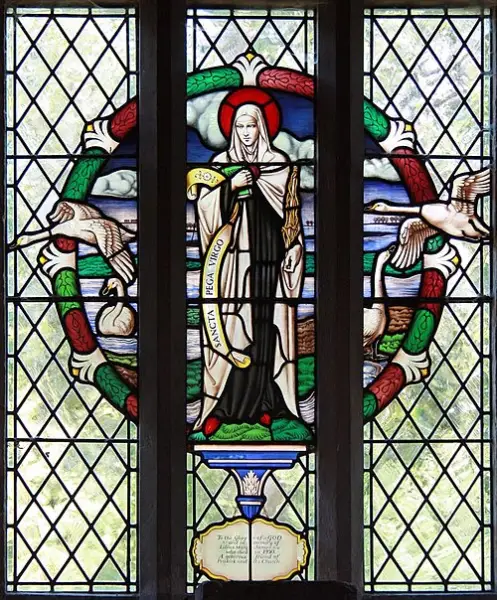
Overview
Pega was an Anglo-Saxon anchoress of the early eighth century, remembered as the sister of the hermit St Guthlac of Crowland. Born into a noble Mercian family around 673, she embraced the enclosed life near the fenland settlement now called Peakirk, a short distance from her brother's hermitage at Crowland. Her story survives chiefly through Felix's Latin life of Guthlac, which names her the holy virgin of Christ and records her presence at the decisive moments of her brother's last days. She buried Guthlac in 714 and a year later presided over the raising of his remains, which were found untouched by decay, an event that fixed her place in English hagiography. According to a twelfth-century account, she then journeyed to Rome on pilgrimage and died there on 8 January 719. Orderic Vitalis writes that a church was raised in her honour in the city and that wonders were worked at her tomb. In England her memory endured in the parish church of Peakirk, the only church dedicated to her, where a relic said to be her heart was long venerated.
The Complete Life
A Noble Daughter of Mercia
Pega belonged to one of the great noble kindreds of the Mercian kingdom. She was the daughter of Penwalh of Mercia, and through her father she was tied to the aristocracy that produced some of Anglo-Saxon England's most striking religious figures. The earliest written witness to her existence is Felix's eighth-century Latin life of her brother Guthlac, where she appears under the title of the holy virgin of Christ. That single phrase is nearly all that the first sources say about her origins, yet it places her within a family of standing whose children chose the ascetic path over wealth and influence. Her brother Guthlac would become the celebrated hermit of Crowland, famed for his warfare against demons in the fenland wilderness. For Pega, membership in this household meant both privilege and a vocation that ran against its worldly expectations. The evidence suggests that she and her brother shared a spiritual temper, each withdrawing from secular life into the demanding discipline of the enclosed and eremitical traditions that flourished in Mercia during the generations after the conversion of the English peoples.
§ Life
The Enclosed Life at Peakirk
Pega lived as an anchoress at the place now known as Peakirk, a name that preserves her own, meaning Pega's church. The site lies near Peterborough, close to the fenland hermitage where Guthlac pursued his ascetic life at Crowland, and the two siblings remained near enough to one another for their stories to intertwine. An anchorite took a solemn commitment to remain within a fixed enclosure for life, devoting the days to prayer and intercession, and Pega's settlement in this lonely corner of the fens marked her as one of the earliest recorded women of the Anglo-Saxon church to follow that demanding path. The precise location of her cell has never been established, though tradition associates it with the site of a chapel at St Pega's Hermitage in Peakirk, where a chancel of about 1300 still stands, later enlarged by a fifteenth-century nave. In 714, when Guthlac understood that his death was approaching, he sent for his sister. She made her way by water through the fens to his oratory and buried him there, fulfilling for her brother the final office of love that no companion at Crowland could supply.
§ Life
The Incorrupt Body and the Healing of the Blind
A year after laying her brother in the earth, Pega returned to Crowland to preside over a ceremony that would shape his cult for centuries. His remains were lifted from the grave for translation into a new sepulchre, and those present found the body incorrupt, untouched by the decay that claims ordinary flesh. Such a discovery was read as heaven's testimony to Guthlac's holiness, and Pega stood at the centre of the rite as the sister who had known him in life and now honoured him in death. On the same occasion she performed an act of healing that the sources record with care. A man blind in both eyes had travelled to Crowland all the way from Wisbech, hoping for a cure. Pega took a piece of glutinous salt that Guthlac had consecrated during his lifetime and applied it, and the man's sight was restored. The episode joined the siblings together in the memory of the church, the hermit's blessing working through his sister's hands, and it gave the new shrine at Crowland a reputation for mercy that drew pilgrims from the surrounding fenland towns and villages.
§ Life
Pilgrimage to Rome and Death
After her brother's death, Pega's course turned away from the fens of her native Mercia toward the papal city. She went on pilgrimage to Rome, joining the stream of Anglo-Saxon men and women who crossed the Alps in the early eighth century to pray at the shrines of the apostles, and some among them, like her, ended their days there. According to a twelfth-century account preserved by Orderic Vitalis, she died in Rome on 8 January 719. Orderic adds that the Christians of the city raised a sanctuary for her, where wonders were reported at her shrine. The claim of a Roman church dedicated to an English anchoress is remarkable, for few women of her generation received such commemoration, and it testifies to the esteem her reputation had won. Later English tradition wove its own memorial: a local legend held that her heart had been brought back from Rome to Peakirk, kept within the parish church enclosed in a heart stone, whose fractured pieces remain visible in the window of the south aisle even now.
§ Death, miracles and legacy
Memory in the Fens
Pega's memory took root most firmly in the small fenland parish whose name she gave it. The Church of England parish church at Peakirk remains uniquely dedicated to her, a distinction held by no other church, and the village itself bears the meaning Pega's church in its very name. Within the building, devotees long venerated a relic believed to be her heart, enshrined in a heart stone whose fractured pieces survive in the south aisle window. Medieval writers enriched her story further. Henry of Avranches, writing in the thirteenth century, recounted that the devil once took on Pega's appearance to tempt Guthlac to break his fast, and that her brother banished her from Crowland in consequence, a tale that shows how deeply her figure was woven into his legend. The fifteenth-century Croyland Chronicle claimed that she inherited Guthlac's psalter and scourge and gave them to Kenulph, the first abbot of Crowland Abbey. Her hermitage chapel at Peakirk, deconsecrated after Anglican nuns departed in 2001, survives as a Grade II listed private residence, while the Eastern Orthodox, Anglican and Catholic traditions continue to keep her feast on 8 January.
§ Death, miracles and legacy
Timeline
- 673
Born around this time into the noble Mercian household of Penwalh.
§ Life
- 714
Travelling by boat, buried her brother Guthlac in his oratory after his death.
§ Life
- 715
Presided over the translation of Guthlac's incorrupt remains into a new sepulchre and cured a blind man from Wisbech with consecrated salt.
§ Life
- 8 Jan 719
Died in Rome while on pilgrimage, according to Orderic Vitalis.
§ Death, miracles and legacy
The Record
- Canonization
- Pre-congregation saint, venerated in the Catholic, Anglican and Eastern Orthodox churches since Anglo-Saxon times
Prayer
Bibliography
Show 6 sources
- Felix (1985). Felix's Life of Saint Guthlac. Ed. Bertram Colgrave. Cambridge: Cambridge University Press, pp. 161–163. ISBN 0-521-30926-3.
- Henry of Avranches (2014). Saints' lives. Ed. David Townsend. Cambridge, Massachusetts. ISBN 978-0-674-05128-7.
- Ingulf; Peter of Blois; Riley, Henry T. (1854). Ingulph's chronicle of the abbey of Croyland with the continuations by Peter of Blois and anonymous writers. London: H. G. Bohn.
- Vitalis, Orderic (1990). The Ecclesiastical History of Orderic Vitalis. Ed. Marjorie Chibnall. Oxford: Clarendon Press. ISBN 0-19-822243-2.
- Lumley Prior, Avril (2008). "Fact and/or Folklore? The Case for St Pega of Peakirk". Northamptonshire Past and Present 61: 7–17.
- Historic England. "Hermitage, Peakirk (Grade II) (1275188)". National Heritage List for England.
Profile text adapted from the Wikipedia article, licensed CC BY-SA 4.0.
Pray with this saint every day
Save St. Pega to your favorites, read the full profile, and get feast-day reminders in the Saints app.
Get the Saints AppFree on the App Store for iPhone and iPad