
6th century·Feast Not recorded
St. Peirio
Sixth-century Welsh founder of Rhosbeirio church
Overview
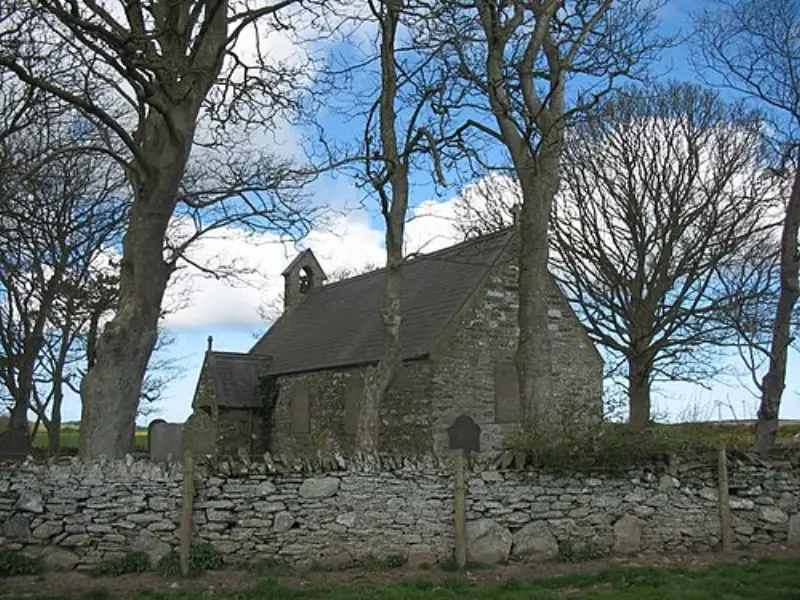
Peirio was a pre-congregational saint of Wales who lived in the sixth century. He was a child of King Caw of Strathclyde. Peirio's own work took root on the island of Anglesey in North Wales, where he established a church at the place still known as Rhosbeirio, a name that preserves his own. The dedication endured through the centuries as a parish church of the island, and it was already standing as an ancient foundation when antiquarians of the nineteenth century came to record it. Almost nothing else is known of his life: no act, no journey, no death date survives in the written record. His commemoration rests on the living witness of his foundation, one of the many modest llannau of Anglesey through which the faith of the early Welsh church was planted and handed on.
The Complete Life
A Prince's Son Who Built a Church
Peirio came from the royal stock of Caw of Strathclyde, a chieftain whose household in the old North became a nursery of saints for the Welsh church. In the pattern of his family, the call of Christ outweighed the inheritance of a throne, and Peirio took his place among the wandering founders of the sixth century. His mission brought him to Anglesey, the sacred island off the coast of Gwynedd where Christian communities were multiplying in the wake of the first British evangelists. There, in the year 605 according to the received chronology, he founded a church at a site that came to bear his name: Rhosbeirio, the moorland of Peirio. The act of foundation was the characteristic labour of the Welsh saints of his era. They did not write treatises or command armies; they chose a field, raised a rough oratory, gathered a small brotherhood, and left behind a living parish that would carry their name down a thousand years and more. Peirio's church at Rhosbeirio stands in exactly that tradition, the fixed point from which his memory has never entirely faded.
§ Biography
A Humble Foundation That Endured
The church Peirio left at Rhosbeirio was never a grand monument. When the antiquary Harry Longueville Jones surveyed it in 1861 for his studies of medieval Anglesey, he judged it one of the humblest ecclesiastical buildings on the island and remarked that it offered no architectural features worthy of delineation. Yet the very plainness of the building is a form of testimony. It shows that the foundation traced its origin to the earliest generation of Welsh Christianity and survived as a working parish through Norman conquest, medieval reorganisation and Anglican establishment, serving a small rural congregation on the island's northwestern coast. The site was recorded by the Royal Commission on Ancient and Historical Monuments in Wales and Monmouthshire in its inventory of Anglesey's ancient monuments, and the antiquarian literature of Wales from Rice Rees onward counted Peirio among the primitive Christians regarded as founders of churches. For a saint whose biography holds a single dated act, that endurance is the whole of his legacy: a name spoken in a place-name, a churchyard kept in use, and a memory preserved on the island where he laboured.
§ Biography
In Their Own Words
one of the humblest ecclesiastical buildings in Anglesey
The Record
- Major works
- The church at Rhosbeirio, Anglesey
- Canonization
- Pre-congregational saint of Wales, venerated since the early medieval period
Prayer
Bibliography
Show 4 sources
- Rees, Rev. Rice. Welsh Saints or Primitive Christians usually considered to be Founders of Churches in Wales. London: Longman, Rees, Orme, Brown and Green, 1836.
- Lewis, Samuel (1849). "Rhôsbeirio, or Rhôs-Peirio (Rhôsbeirio)". A Topographical Dictionary of Wales (1849).
- Royal Commission on Ancient and Historical Monuments in Wales and Monmouthshire (1968) [1937]. "Rhosbeirio". An Inventory of the Ancient Monuments in Anglesey. Her Majesty's Stationery Office, p. 144.
- Longueville Jones, Harry (1861). "Mona Mediaeva No. XXV". Archaeologia Cambrensis, 3rd series VII: 294–295.
Profile text adapted from the Wikipedia article, licensed CC BY-SA 4.0.
Pray with this saint every day
Save St. Peirio to your favorites, read the full profile, and get feast-day reminders in the Saints app.
Get the Saints AppFree on the App Store for iPhone and iPad