
c. 290 – 457·Feast October 8
St. Pelagia
Penitent actress of Antioch turned desert recluse
Overview
Pelagia, honoured as Pelagia the Penitent, is remembered as an actress and courtesan of Antioch who abandoned a life of public luxury to die in hidden penance as a hermit on the Mount of Olives. Her story comes down through an account attributed to James, deacon of the church of Heliopolis, who names her Margarita, the foremost performer of the city and its most notorious harlot. Her path changed when she chanced to pass a gathering of bishops and caught the gaze of Nonnus, who saw in her adornment a rebuke to his own carelessness of soul. His preaching on hell and paradise pierced her, and she sought baptism, receiving her birth name Pelagia with the deaconess Romana as godmother. She gave her fortune to the poor of Antioch, freed her slaves, and slipped away by night dressed in one of the bishop's garments. In Jerusalem she built herself a cell of narrow walls and lived as a male recluse called Pelagius, known only for holiness. Her austerities wasted her body until death came; when her sex was discovered, the report spread and pilgrims came from Jericho and the Jordan valley to her grave. Her feast of 8 October was once kept in common with Pelagia the Virgin and Pelagia of Tarsus.
The Complete Life
The Foremost Actress of Antioch
In the great Syrian metropolis of Antioch, Margarita rose to fame as the city's leading actress and one of its most prominent courtesans. Her name, the pearl, suited a woman whose appearances were staged like theatrical spectacles. The account of her life, preserved by James the Deacon of Heliopolis, describes her riding through the streets on a donkey amid her entourage, wrapped in cloth of gold and heaped with pearls and gems, with strands of jewels descending from her uncovered shoulders as far as her ankles, her head bare and her figure barely veiled by the shimmer of her dress. On one such occasion she passed the fathers of the church as they gathered for a council in the city. Most of the bishops averted their eyes in shame, but Nonnus of Edessa, then sojourning in Antioch, looked at her steadily and declared himself delighted, not with desire but with wonder. Mocking his fellow churchmen, he said that both they and he took less care for their souls than this woman took for her body. The remark was a judgment delivered in her passing presence, and it would become, without her yet knowing it, the first summons of her conversion.
§ Legend
Conversion at the Preaching of Nonnus
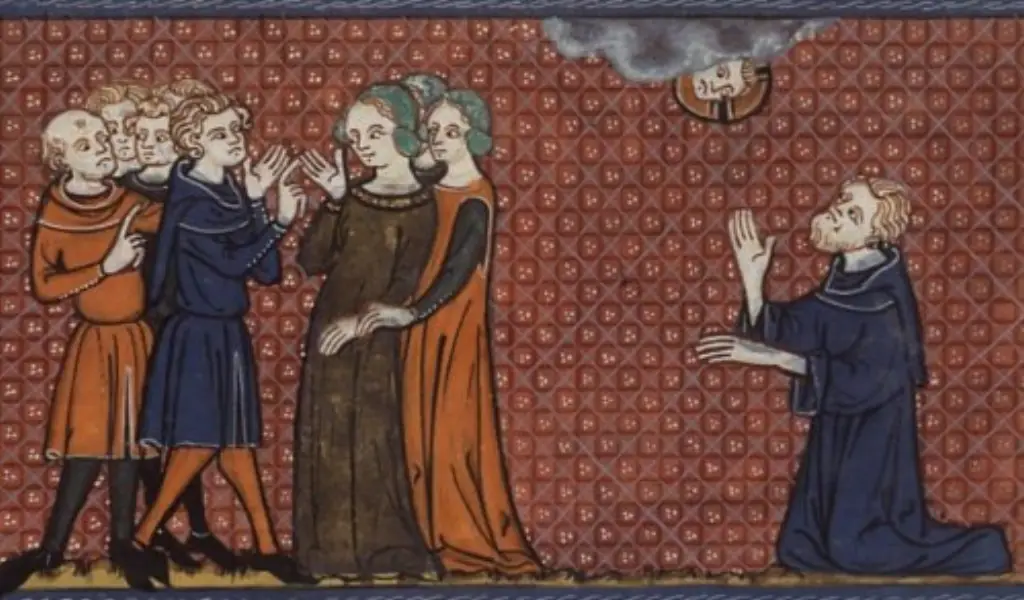
At Nonnus's sermon on the following Sunday, the actress appeared among the hearers, and his words on the terrors of hell and the goodness of paradise broke through her defences. She could not approach him directly: she set two of her slaves to follow the bishop to his lodging, and then sent him a message written on wax tablets. In it she styled herself a sinner and one enslaved to the devil, yet implored pity from the God who had descended to earth to rescue not the just but the guilty. Nonnus answered that God knew both her and her past and would receive her, but only before the other bishops. At the basilica of Saint Julian she presented herself and, pressed for assurance that she would not fall back into her former life, prostrated herself on the ground and warned that if the church refused her, every future sin of hers would be charged against Nonnus at the judgment. The archbishop was told, the deaconess Romana brought her the baptismal gown, and Nonnus received her confession and baptised her under the birth name Pelagia, with Romana standing as her godmother.
§ Legend
Renunciation and the Cell on the Mount of Olives
The new Christian's break with her old world was immediate and total. When the devil came to complain of his lost captive, she drove him off with the Sign of the Cross and her breath; he returned the following night and was repelled the same way. On the third day she ordered her steward to make a full inventory of her possessions, then handed everything over to Nonnus, who distributed the wealth among the widows, orphans and poor of Antioch. Her slaves, men and women alike, she freed with her own hands, taking the golden torcs from their necks as she released them. She then lived for a time with Romana, her godmother, in the discipline of the newly baptised. But greater seclusion was drawing her. On the night before she was to set aside her baptismal gown, she slipped out into the darkness wearing one of Nonnus's chitons and made her way to Jerusalem. On the Mount of Olives she raised a cell that the Latin tradition describes as four walls pierced by a single window. There she passed three or four years, passing herself off as a male solitary and eunuch bearing the name Pelagius, esteemed by the desert fathers only as a monk of exceptional holiness.
§ Legend
Death in Disguise and the Discovery
The rigours of her hidden life consumed the former actress from within. Extreme asceticism emaciated her so far that when death came, her features were those of a stranger, and no one who had known Margarita of Antioch would have recognised her. By Orthodox tradition she was buried in the cell where she had died, on the slope of the Mount of Olives overlooking Jerusalem. Only then did the community of monks learn that the renowned recluse Pelagius had been a woman. The fathers of the monastery at first concealed what they had learned, but word of it got abroad, and the fame of a hidden saint drew pilgrims from as far away as Jericho and the villages of the Jordan valley to pray at her grave. James the Deacon, the narrator of her life, records that in the Latin and Syriac versions of the story he visited her once before her end, encouraged by Nonnus. Knocking at the window of her cell, he was instantly recognised by her, while he himself supposed he was speaking to the monk Pelagius for the first time, never suspecting that the face before him belonged to the woman he had helped to bring to baptism.
§ Legend
Cult, Conflations and Controversy
Pelagia's story entered the Greek Menaea and spread through Latin, Syriac and other versions, becoming one of the classic tales of the desert penitents. Her commemoration on 8 October was originally held in common with Pelagia the Virgin and Pelagia of Tarsus, until the Roman Martyrology distinguished the dates and moved the others to different months. A tomb near Jerusalem has been venerated as hers since Byzantine times, and on Crete the village of Agia Pelagia keeps a local legend of her icon found in a cave. Her tale has long been compared with those of other desert ascetics such as Mary of Egypt and Saint Thaïs, and with the tale of Marina, a young wife who put on a monk's habit to get away from a marriage that had been forced upon her. Scholars note that her origins are unusually obscure: the narrative has been woven from varied strands, including apocryphal material about Mary Magdalene and biblical episodes, and its historical basis remains disputed. An earlier Pelagia of Antioch, an actual virgin martyred under Diocletian, appears in Ambrose and Chrysostom, and some scholars trace the monastic heroine back to her, though the question is not settled.
§ History
Timeline
- 290
Traditionally held to have been born at Antioch.
§ Legend
- 457
Date of her death given by one authority, after years of severe asceticism on the Mount of Olives.
§ Legend
In Their Own Words
came down to earth not for the sake of the righteous but to save sinners
The Record
- Canonization
- Pre-congregation saint, venerated as a confessor in the Catholic, Eastern Orthodox, Syriac Orthodox and Armenian Apostolic churches
Prayer
Bibliography
Show 8 sources
- Bunson, Matthew; et al. (2003). "Nonnus". Our Sunday Visitor's Encyclopedia of Saints, rev. ed. Huntington: Our Sunday Visitor, p. 611. ISBN 1-931709-75-0.
- Butler, Alban (1866). "October 8: Saint Pelagia, Penitent". The Lives of the Fathers, Martyrs, and Other Principal Saints, Vol. X: October. Dublin: James Duffy.
- Cameron, Alan (2016). "The Poet, the Bishop, and the Harlot". Wandering Poets and Other Essays on Late Greek Literature and Philosophy. Oxford: Oxford University Press, pp. 81–90. ISBN 978-0-19-026894-7.
- Coon, Lynda L. (1997). "Pelagia: God's Holy Harlot". Sacred Fictions: Holy Women and Hagiography in Late Antiquity. Philadelphia: University of Pennsylvania Press, pp. 77–84. ISBN 0-8122-3371-9.
- Jacobus Diaconus (1628). "The Life of Saint Pelagia the Harlot, translated into Latin from the Greek by Eustochius". Vitae Patrum, Vol. I. Antwerp.
- Kirsch, Johann Peter (1911). "Pelagia". The Catholic Encyclopedia, Vol. 11. New York: Robert Appleton Co.
- Usener, Hermann (1879). Legenden der heiligen Pelagia. Bonn.
- Ward, Benedicta (1987). Harlots of the Desert: A Study of Repentance in Early Monastic Sources. Cistercian Studies Series. Kalamazoo, Mich.: Cistercian Publications. ISBN 978-0-87907-406-7.
Profile text adapted from the Wikipedia article, licensed CC BY-SA 4.0.
Pray with this saint every day
Save St. Pelagia to your favorites, read the full profile, and get feast-day reminders in the Saints app.
Get the Saints AppFree on the App Store for iPhone and iPad