
died 301–305·Feast May 4 (October 8 in some Eastern calendars)
St. Pelagia of Tarsus
Virgin martyr of the Diocletianic persecution at Rome
Overview
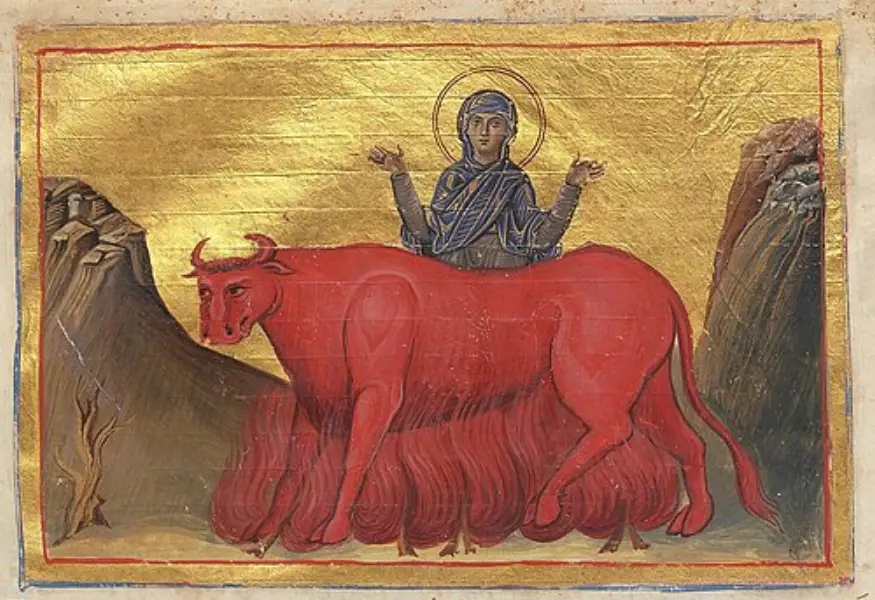
Pelagia of Tarsus, called Pelagia the Martyr, is honoured as a virgin of Cilicia who died at Rome during the persecution of Christians under Emperor Diocletian. She was born at Tarsus in southeastern Asia Minor in the third century, the daughter of a pagan mother, and devoted herself to Christ by a vow of virginity. The legend that carries her memory tells that Diocletian's son, heir to the imperial throne, desired her hand in marriage; when she refused, explaining that she belonged to Christ, the prince took his own life in grief. The maiden was then taken to Rome, where the emperor himself sought to make her his wife. Her scornful refusal so enraged him that she was put to death by fire, in some versions within a brazen bull, and the witnesses marvelled that her burning flesh gave forth the scent of myrrh through the streets of the city. When pagans set four lions to guard her bones, hoping to expose them to scavenging birds, the beasts instead kept the vultures and crows away until a Christian bishop could gather the relics. Her feast was once kept on 8 October together with the two Pelagias of Antioch, and is now observed on 4 May.
The Complete Life
A Vow That Refused a Throne
Pelagia grew up at Tarsus, the celebrated city on the Cilician coast that had given the church its first great missionary, and there she bound herself to Christ by a promise of perpetual virginity. According to the legend, that promise was soon tested at the highest level. Diocletian's son, the heir to the Roman world, fell in love with the maiden and pressed his suit for marriage. Her answer placed heaven above the palace: she could not marry him, for she had sworn her virginity to Christ and considered herself wedded to the Lord. To her, the proposal was not an honour but a temptation, and she would not weigh a vow against a throne. The young prince, unable to bear her refusal, fell into despair and took his own life. The tragedy transformed the suit into a crime in the eyes of the court, and Pelagia's steadfastness, which should have commanded respect, drew the hostility of an imperial household that had lost its heir. Her pagan mother, alarmed by the scandal and unmoved by her daughter's faith, resolved to send the girl away from Tarsus to Rome itself, placing her directly before the emperor.
§ Legend
Martyrdom Before the Emperor
At Rome, the story reaches its climax in the presence of Diocletian. The emperor, having heard of the maiden who had cost him a son, asked Pelagia to become his own wife, an offer that few in the empire would have dared to decline. Her reply was fearlessly direct: she called the emperor insane, refusing to betray her Bridegroom for the master of the world. Such defiance sealed her fate. The persecution of Christians that marked Diocletian's reign supplied the machinery of her punishment, and she was condemned to be burned to death. The legend lingers on the details of her end. As the flames consumed her body, her flesh melted, and a fragrance like myrrh spread through Rome, convincing the onlookers that heaven attended the death of the condemned woman. Some versions of the story place her execution inside a brazen bull, the bronze instrument of torture whose bellows turned the victim's cries into the sound of a bellowing beast. After her death, the pagans stationed four lions around her bones, expecting the beasts to guard the remains for desecration; instead the creatures kept off the vultures and crows until a Christian bishop came at last to recover them.
§ Legend
Cult and the Question of History
The memory of Pelagia the Martyr was honoured by the church from an early period, though modern scholars have found little historical foundation for the tale as it stands. The chronology of the legend collides with a well-attested fact: the imperial family of Diocletian included a daughter, Valeria, but no male heir, a circumstance weighty enough to shape the whole history of his reign, and so the tale of the lovesick prince and the emperor's wooing must be judged later invention. It is thought probable that commemorations of a genuinely historical martyr named Pelagia did take place at Tarsus, and that the tradition was at some point embellished and transferred to Rome, given a setting in the imperial capital that suited the drama of the tale. Whatever the value of the narrative, the cult itself was firm enough that Constantine the Great erected a church over the place reputed to hold her relics, an imperial foundation that gave her memory a permanent home in Christian Rome. In the calendars, her feast was originally joined to that of Pelagia the Virgin and Pelagia the Harlot of Antioch on 8 October; the Roman Martyrology later separated the dates, and her commemoration is now kept on 4 May in the Eastern Orthodox and Roman Catholic churches.
§ History
The Record
- Canonization
- Pre-congregation martyr, venerated since the early church
Prayer
Bibliography
Show 4 sources
- Herbermann, Charles G. (1913). The Catholic Encyclopedia: An International Work of Reference on the Constitution, Doctrine, Discipline, and History of the Catholic Church, vol. 11. New York: The Encyclopedia Press, Inc.
- Kirsch, Johann Peter (1911). "Pelagia". The Catholic Encyclopedia, Vol. 11. New York: Robert Appleton Co.
- "Ἡ Ἁγία Πελαγία ἡ Μάρτυς" (Saint Pelagia the Martyr). 4 Μαΐου. Μέγας Συναξαριστής (Great Synaxaristes), synaxarion.gr.
- "Lives of all saints commemorated on May 4". Retrieved 12 June 2010.
Profile text adapted from the Wikipedia article, licensed CC BY-SA 4.0.
Pray with this saint every day
Save St. Pelagia of Tarsus to your favorites, read the full profile, and get feast-day reminders in the Saints app.
Get the Saints AppFree on the App Store for iPhone and iPad