
died c. 303·Feast October 8 (Eastern Orthodox); June 9 (Roman Catholic)
St. Pelagia the Virgin
Fifteen-year-old virgin martyr of Antioch
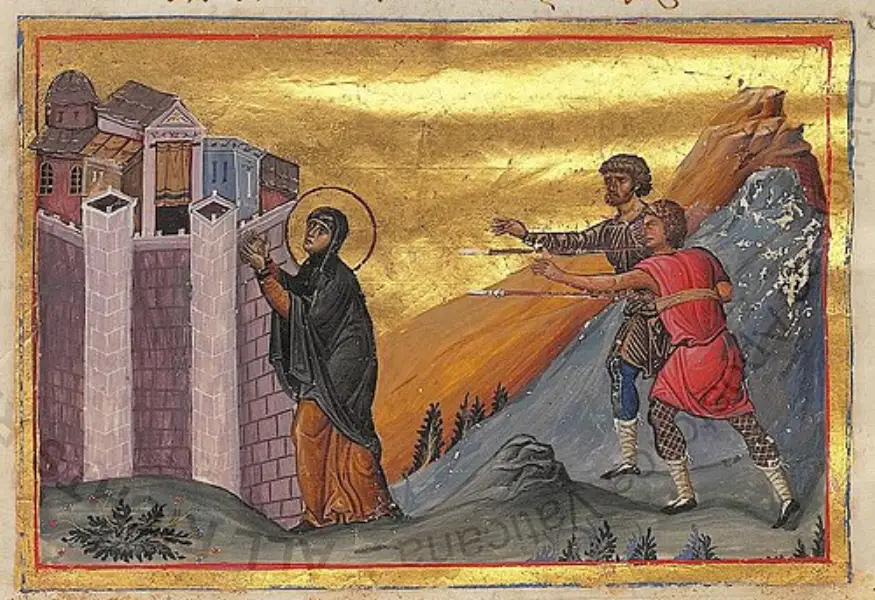
Overview
Pelagia the Virgin, also called Pelagia of Antioch, was a Christian girl of that city who died during the Diocletianic Persecution rather than surrender her faith and her chastity. She was born late in the third century and was only fifteen years old when Roman soldiers came upon her house while she was alone. Learning that they meant to force her to join a public sacrifice to the pagan gods, and fearing an even worse outrage against her virginity, she asked leave to change her clothes, climbed to the roof of her home, and threw herself into the sea. The fathers of the early church did not hesitate about her memory: Ambrose of Milan recorded her fate, and John Chrysostom preached two sermons on her courage, treating her death as a sacred martyrdom. Her feast was once kept by the whole church on 8 October, together with the other saints of her name, and it remains her day in the Orthodox East; after the Great Schism the Roman Catholic Church moved her commemoration to 9 June, while Naples keeps her on 5 October. Her story is thought to have supplied the seed of the later and more embellished legend of Pelagia of Tarsus.
The Complete Life
A Daughter of Antioch
Pelagia grew up in Antioch, the brilliant and turbulent capital of Roman Syria, in a Christian household of the generation that would face the last and fiercest of the imperial persecutions. Of her family and formation almost nothing is recorded, but the church that remembered her counted her among its consecrated virgins, girls who had dedicated themselves to Christ and guarded that dedication as the treasuring of their whole lives. She was born late in the third century, and by the time the Diocletianic Persecution reached Antioch she was a girl of fifteen, at home alone when the officers of the state arrived. The persecutors of that era sought less to kill Christians outright than to break them, compelling a public act of sacrifice to the pagan gods that would make the believer an apostate before the whole city. For a young woman, the menace carried a second horror: the sources speak darkly of an intention to do something unspeakable to her because she was a virgin, an allusion readers have understood as the threat of assault by the soldiers themselves. Alone in the house, the girl understood exactly what was being asked of her.
§ Life
The Leap from the Roof
When the soldiers revealed their purpose, Pelagia did not argue with them and did not flee through the streets. She asked permission for the smallest of favours, to change her clothes, and the request was granted. Going up to the roof of her own house, she cast herself from it into the sea, choosing death at her own hand rather than the sacrifice and violation her captors intended. To modern readers the act is stark and troubling; to the church fathers who transmitted her memory there was no hesitation at all. Ambrose of Milan, the great teacher of virginity, included her in his account of the martyrs, and John Chrysostom, the most famous preacher of Antioch, devoted two sermons to her. In the patristic understanding, the girl's leap was not despair but a final act of sovereignty: unable to preserve her body from the hands of men who meant both apostasy and defilement, she preserved her soul and her consecration in the one way left to her. The fathers treat her death as a sacred martyrdom, ranking the fifteen-year-old among the witnesses of Christ whose blood was the seed of the church.
§ Life
Commemoration Through the Centuries
The veneration of Pelagia the Virgin proved durable on both sides of the later division of Christendom. Originally her feast was celebrated on 8 October by the entire church, a day she shared with Pelagia the Harlot of Antioch and with Pelagia of Tarsus, whose colourful legend probably grew in part from the memory of her martyrdom. That common observance survived the Great Schism only briefly in the West: the Roman Catholic Church eventually moved her commemoration to 9 June, while the Eastern Orthodox Church keeps 8 October to this day. In Naples, where her cult took a local hold, her feast is observed on 5 October. She is conflated in some traditions with other virgin saints of similar name, among them Marina the Monk and Margaret the Virgin, a sign of how widely her story travelled and how readily the tale of a maiden martyr was retold. Her witness entered the devotional literature of the church through Butler's Lives of the Saints and the Catholic Encyclopedia, and the memory of the girl of Antioch who chose the sea over the altar of the gods remains part of the shared inheritance of East and West.
§ Veneration
The Record
- Canonization
- Pre-congregation martyr, venerated since the patristic era
Prayer
Bibliography
Show 4 sources
- Butler, Alban (1866). The Lives of the Saints, Vol. X: October.
- Kirsch, Johann Peter (1911). "Pelagia". The Catholic Encyclopedia, Vol. 11. New York: Robert Appleton Co.
- Amidon, Philip R. Appendix 6.10 to Philostorgius, Church History.
- Ambrose. De Virginitate, III, 7, 33.
Profile text adapted from the Wikipedia article, licensed CC BY-SA 4.0.
Pray with this saint every day
Save St. Pelagia the Virgin to your favorites, read the full profile, and get feast-day reminders in the Saints app.
Get the Saints AppFree on the App Store for iPhone and iPad