
c. 912 – 926·Feast June 26
St. Pelagius of Córdoba
Boy martyr who died refusing the Caliph of Córdoba
Overview
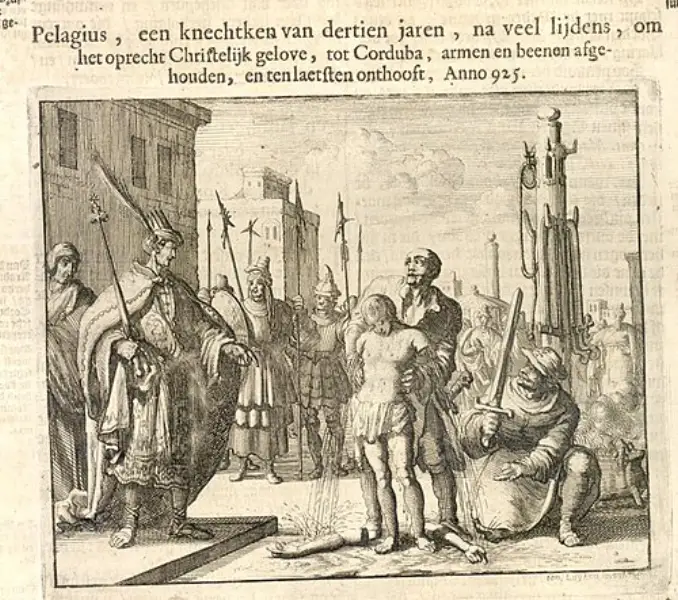
Pelagius of Córdoba, in Spanish San Pelayo Mártir, was a Christian boy from Galicia who died as a martyr at Córdoba around the year 926, at about the age of thirteen. His uncle handed him over, aged ten, to be held as a pledge at the court of Abd-ar-Rahman III of al-Andalus, to bargain for a captured clerical kinsman, and he spent three years in captivity while the exchange never took place. His courage and constancy of faith drew the attention of the caliph, who offered him freedom in return for conversion to Islam; the boy refused. In the earliest account, the caliph's regard turned to desire for the beautiful youth, and when Pelagius repulsed his advances, striking and insulting the monarch, the enraged ruler had him tortured and put to death, by dismemberment in one version and by catapult and beheading in another. His story was told in three early accounts, a prose passion by the priest Raguel of Córdoba, a verse retelling by Hrotsvitha of Gandersheim, and a Mozarabic liturgy written around 967, the year in which the remains were fetched from Córdoba and carried in procession to Toledo. His relics eventually found a resting place in the cathedral of Oviedo, where his shrine drew pilgrims, and his cult fed the spiritual energy of the Reconquista for centuries.
The Complete Life
A Hostage at the Court of the Caliph
Pelagius was born around the year 912 at Crecente, in the Kingdom of Galicia in the northwest of the Iberian peninsula, into a Christian world that lived in uneasy proximity to the Muslim state of al-Andalus. His childhood was ended by diplomacy. His uncle placed him, aged ten, as a pledge in the hands of the court at Córdoba, to ransom the captured kinsman, the bishop Hermoygius. Such exchanges of hostages were a routine instrument of the frontier politics of the age, but the arrangement that brought the boy to Córdoba failed: the trade for which he was pledged never took place, and Pelagius remained a captive in the caliphal capital for three years. He grew from a child of ten to a youth of thirteen in detention, among other Christian prisoners who observed him closely. According to their testimony, which fed the earliest written account of his death, the boy's courage and unbroken faith were remarkable even in those years, so much so that word of the young Galician reached the caliph himself, and the ruler of al-Andalus took a personal interest in the hostage he held.
§ Narrative
Refusal, Torture and Death
The accounts of Pelagius agree on the substance of what followed, though they colour it differently. The caliph, impressed by the thirteen-year-old, offered him his freedom on one condition: that he convert to Islam. The offer placed before the boy everything a captive could want, life, liberty and advancement, against the faith he had been taught in Galicia, and he declined it. In the earliest narrative, written by the priest Raguel of Córdoba, the caliph's interest in the beautiful youth was also bodily: he fell in love with the boy and sought his favours. Pelagius rejected the advances outright, striking the monarch and heaping insults upon him, an act of astonishing audacity from a captive child before the master of al-Andalus. The enraged ruler ordered him tortured, and the torment lasted six hours before he was dismembered. Other versions of the passion describe a different execution: the boy was launched from a catapult beyond the city's ramparts, the ruler anticipating that the boulders beside the river would shatter him on impact., yet he emerged from the ordeal unharmed and was then decapitated. Every version upholds the same core, the refusal of the youth to yield to the caliph's wishes.
§ Narrative
Enshrined Among the Martyrs
The church of the Iberian peninsula received the boy's death as martyrdom without hesitation. He was enshrined among the saints as Saint Pelagius, and his cult was consolidated by three early testimonies: the prose Martyrdom or Passion written by Raguel, the versified retelling by the Saxon canoness Hrotsvitha of Gandersheim, and a Mozarabic liturgy composed around 967, the year his body was recovered from Córdoba and brought to Toledo. From Toledo his relics were eventually deposited in the cathedral of Oviedo in the Asturian kingdom, where his shrine became a goal of pilgrimage and a fixture of the Christian north. He was honoured with a feast on 26 June and named patron of abandoned people and of torture victims, as well as of Castro Urdiales in Spain. Later ages saw his cult in harder political light: for centuries the memory of the boy who died at a Muslim prince's hands supplied spiritual energy to the Reconquista, the Christian reconquest of the peninsula, and some modern scholars read the passion as part of a literary pattern that portrayed Islamic morality as inferior to that of Christendom. Hrotsvitha's own verses give the tone, lamenting the mingling of faithful and unbeliever.
§ Narrative
A Hero Who Refused to Assimilate
Modern historians have found in the passion of Pelagius a document about the anxieties of the Christian minority of al-Andalus as much as about a boy's death. Jeffrey A. Bowman observes that the Martyrdom is not only an attack on Muslim morals but the portrait of a hero who refuses to assimilate. Tenth-century Córdoba was a wealthy and sophisticated city of fine houses, libraries and bath houses, and its dominant culture drew Christians to itself: as Raguel wrote, believers were converting to Islam in growing numbers, and Christian leaders complained that the young cared more for learning Arabic than Latin. The child who would not bend to the caliph, in this reading, embodied the identity the community feared it was losing. Lisa Weston discerns the same theme in Hrotsvitha's poem, which enacts the drawing of boundaries between the saint's community and the unbelieving other upon the textual body of the martyr; the poet deplores the dissolution of one world into the other, and puts upon Pelagius's lips the protest that one who has been washed in the baptism of Christ must never offer his innocent neck to such an embrace. Scholars have also examined the story through the history of sexuality and of Christian-Muslim relations, reading it as a founding text of medieval polemic.
§ Interpretation
Timeline
- 912
Born at Crecente in the Kingdom of Galicia.
§ Narrative
- 926
Refused the caliph's offers of conversion and favour, was tortured for six hours and martyred at Córdoba at about thirteen.
§ Narrative
- 967
His remains were fetched from Córdoba and taken to Toledo, an occasion marked by a Mozarabic liturgy; they later reached Oviedo Cathedral.
§ Narrative
In Their Own Words
It is not right that a man cleansed by the baptism of Christ should submit his chaste neck to a barbaric embrace, nor should a worshipper of Christ, anointed with the sacred chrism, accept the kiss of such a lewd slave of demons
The Record
- Patron of
- Abandoned people·Torture victims·Castro Urdiales, Spain
- Canonization
- Canonized after his martyrdom, honoured as San Pelayo Mártir
Prayer
Bibliography
Show 6 sources
- Bowman, Jeffrey A. (2001). "Raguel, 'The Martyrdom of St. Pelagius'". In Thomas F. Head (ed.). Medieval Hagiography: An Anthology. Psychology Press. ISBN 9780415937535.
- Coope, Jessica (1995). The Martyrs of Córdoba: Community and Family Conflict in an Age of Mass Conversion. Lincoln: University of Nebraska Press. ISBN 0-8032-1471-5.
- Wolf, Kenneth (1988). Christian Martyrs in Muslim Spain. Cambridge: Cambridge University Press. ISBN 0-521-34416-6.
- Jordan, Mark D. (1997). The Invention of Sodomy in Christian Theology. Chicago, pp. 10–28.
- Weston, Lisa (2002). "The Saracen and the Martyr: Embracing the Foreign in Hrotvit's 'Pelagius'". In Albrecht Classen (ed.). Meeting the Foreign in the Middle Ages. Psychology Press. ISBN 9780415930024.
- Fierro, Maribel (2014). "Hostages and the Dangers of Cultural Contact". KOHEPOCU, European Research Council.
Profile text adapted from the Wikipedia article, licensed CC BY-SA 4.0.
Pray with this saint every day
Save St. Pelagius of Córdoba to your favorites, read the full profile, and get feast-day reminders in the Saints app.
Get the Saints AppFree on the App Store for iPhone and iPad