
martyred c. 305–311
St. Peleus
Egyptian Bishop Burned for Serving the Condemned
Overview
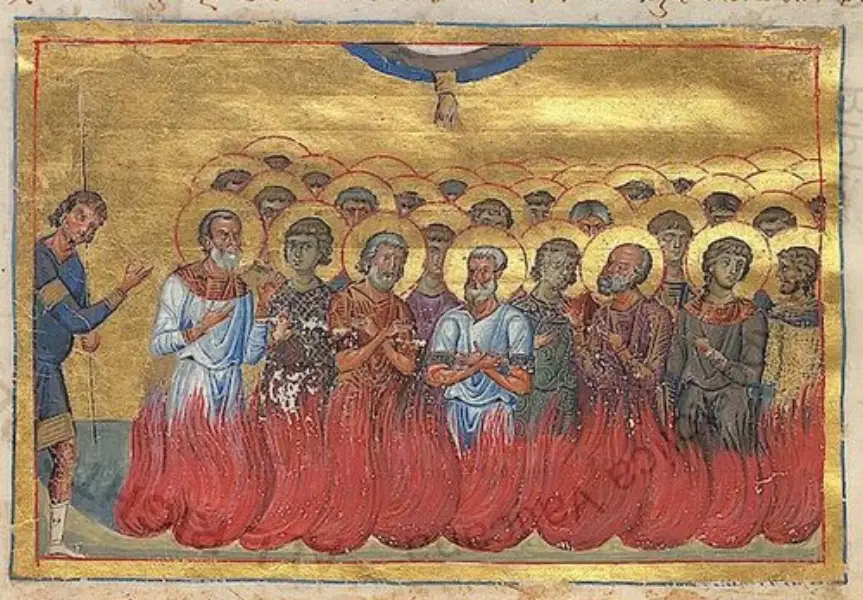
Peleus was an Egyptian bishop martyred in Palestine during the Great Persecution at the start of the fourth century. When the Diocletianic persecution filled the Palestinian quarries with Christians condemned to forced labor, Peleus was one of four leaders — with Nilus, Elias and Patermuthius — who risked everything to minister to them, leading services of worship among the condemned. When the emperor Galerius learned of it, he had the four burned alive and scattered the Christian convicts to the mines of Cyprus and Lebanon. The Egyptian tradition preserves a fuller reckoning of the persecution: the governor of Palestine, Firmilian, arrested 156 Christians, most of them Egyptians with some Palestinians among them; their eyes were gouged out, the tendons of their feet cut, and they were subjected to tortures of every kind before a hundred were beheaded and the rest burned. Peleus is venerated as a saint in the Roman Catholic, Eastern Orthodox and Coptic Orthodox churches, remembered with his companion bishops and the host of Egyptians who died with them.
The Complete Life
A Bishop Among the Condemned
The sources leave almost nothing of Peleus's life before the quarries, except the one fact that matters: he was a bishop in Egypt when the Great Persecution broke over the church. Begun under Diocletian and continued under his colleagues and successors, the persecution reached Egypt with special severity, and its condemned were shipped to Palestine as penal labor. There, in the imperial quarries, the Christian convicts found themselves cut off from the sacraments — and it was precisely there that Peleus acted. Together with Nilus, Elias and Patermuthius, he led worship for the persecuted, celebrating among prisoners whom the law had marked for destruction. To minister openly to the condemned was itself a crime, and the four leaders knew what it would cost. Theirs was the office of a bishop performed in its most exposed form: not governing a see from a cathedral, but carrying the church to the place where its members suffered most. The Egyptian tradition that remembers him counts him among the bishops whose martyrdom sealed their ministry, men who held the flock together precisely by standing where the blows fell.
§ Introduction
Fire in the Quarries
The end came when the emperor Galerius learned that the condemned Christians of the Palestinian quarries were being served by their clergy. His response was summary. Peleus, Nilus, Elias and Patermuthius were condemned to be burned alive, and the sentence was carried out; the Christian laborers were dispersed to the mines of Cyprus and Lebanon, places of exile even harsher than the quarries they left. The Egyptian synaxarion preserves the wider reckoning of the same persecution. Firmilian, governor of Palestine, arrested 156 Christians, the majority Egyptians but with Palestinians among them; the martyrs had their eyes gouged out and the tendons of their feet cut, and were subjected to tortures of every kind. A hundred of them were beheaded; the rest were burned. Whether Peleus died among that company or in the separate sentence pronounced on the four leaders, the traditions agree on the manner of his witness: fire, endured for the sake of the worship he had refused to stop celebrating. He died in the years of Galerius's rule, which ran from 305 to 311, among the last and fiercest of the persecutions.
§ Introduction
Venerated East and West
The church of Egypt kept the memory of its martyred bishops with a tenacity that outlasted the persecution that killed them. Peleus is venerated as a saint in three communions — the Roman Catholic Church, the Eastern Orthodox Church and the Coptic Orthodox Church — a range of honor that shows how the cult of the Palestinian confessors crossed every liturgical frontier. In the synaxaria he stands with his companions Nilus, Elias and Patermuthius, and with the hundred and fifty-six arrested by Firmilian, the beheaded and the burned, a collective memorial of the Egyptian church's costliest generation. Alban Butler's Lives of the Saints preserves his story for the Western reader, and the account of the four clergy who led forbidden services in the quarries has remained one of the emblematic narratives of the Great Persecution: clergy attending to the simplest needs of the faithful — prayer, the word, the sacraments — at the price of their lives. The quarries of Palestine and the mines of Cyprus and Lebanon entered the church's memory as places where the faithful had been broken, and Peleus is among those who sanctified them.
§ Introduction
The Record
- Symbols
- The palm of martyrdom·Fire
- Canonization
- Pre-congregation; ancient martyr cult venerated in the Roman Catholic, Eastern Orthodox and Coptic Orthodox churches
Prayer
Bibliography
Show 1 sources
- Butler, Alban (December 1, 1956). Butler's Lives of the Saints (New Full ed.). Collegeville, Minnesota: Christian Classics. p. 181. ISBN 0-8146-2385-9.
Profile text adapted from the Wikipedia article, licensed CC BY-SA 4.0.
Pray with this saint every day
Save St. Peleus to your favorites, read the full profile, and get feast-day reminders in the Saints app.
Get the Saints AppFree on the App Store for iPhone and iPad