
died c. 30 – 33·Feast March 25
St. Dismas
The Penitent Thief, Crucified at the Right Hand of Christ
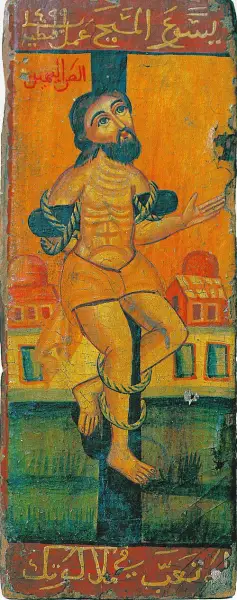
Overview
The penitent thief, known by tradition as Dismas and honored also as the good thief, the wise thief, and the thief on the cross, is one of the two criminals crucified beside Jesus, whose plea for remembrance and whose promise of paradise occupy the heart of Luke's account of the passion. The canonical gospels leave him nameless; the name Dismas was given him in a Greek recension of the Acta Pilati and the Latin Gospel of Nicodemus, texts whose oldest portions may reach back to the late fourth century, while other churches knew him as Demas, Zoatham, Titus, or Rakh. According to Luke, he rebuked his fellow criminal for mocking a man who had done nothing wrong, acknowledged his own guilt, and turned to the dying Jesus with a plea that he be remembered when his kingdom came. The answer became one of the most cherished sentences of Scripture: this day you will be with me in paradise. He is venerated as a saint by the Eastern Orthodox, Catholic, and Oriental Orthodox Churches, which see in him the one person canonized by the mouth of Christ himself. The Roman Martyrology joins his commemoration to March 25, the feast of the Annunciation, honoring the ancient belief that he died on the same date the Word became flesh.
The Complete Life
A Thief Without a Name
The gospels record the thief's crime, his cross, and his conversion, but not his name. Luke calls him one of two criminals; John mentions two others; Matthew and Mark describe robbers crucified with Jesus, and in their accounts both mock him. Only later Christian tradition supplied the missing name. Dismas, the name by which the Catholic Church knows him, derives from a Greek recension of the Acta Pilati and from the Latin Gospel of Nicodemus, documents whose earliest strata may belong to the late fourth century; the name may descend from a Greek word meaning dying. His companion in crime received the name Gestas. Other churches handed down other names: the Coptic Orthodox tradition and the Narrative of Joseph of Arimathea call him Demas, the Codex Colbertinus gives Zoatham or Zoathan, and the Russian Orthodox tradition knows him as Rakh. The Arabic Infancy Gospel names him Titus and tells a childhood tale in which he prevented his fellow robbers from plundering the Holy Family during the flight into Egypt, an early instance of the legendary elaborations that gathered around the figure, including the devotional Life of the Good Thief published in French in 1868. Whatever his baptismal name, the church remembers him by his deed: the thief who believed.
§ Name
The Confession on the Cross
Jesus died between two criminals, one at his right hand and one at his left, a scene Mark's gospel reads as Isaiah's prophecy brought to pass, that the servant of God was numbered with the transgressors. According to Matthew and Mark, both criminals joined the mockery directed at the dying Jesus, but Luke tells the story differently. In his account one criminal reviled the Lord, demanding that if he were the Messiah he save himself and them; the other rebuked him with the most searching words any dying man ever spoke: Have you no fear of God, since you are under the same sentence? We are punished justly, for we are getting what our deeds deserve, but this man has done nothing wrong. Then he turned to the one man present who could not help him and asked to be remembered when that man came into his kingdom. The reply has echoed through every Christian century: this very day, the Lord assured him from his own cross, the two of them would be together in paradise. Tradition has it that the good thief hung on Jesus' right, and for this reason paintings of the crucifixion incline the Lord's head to the right, toward the man who confessed him, while the slanted footrest of the Russian three-bar cross points upward to the thief on the right and downward to the one on the left.
§ Narratives
The Thief and the Theologians
The discrepancy between Luke's penitent criminal and the mocking pair of Matthew and Mark occupied the church's earliest interpreters. Tatian simply dropped the Markan and Matthean tradition in his Diatessaron, and Ephrem the Syrian followed him; Origen, Eustathius of Antioch, and Epiphanius of Salamis read the differences as complementary intentions of different authors; Origen and his successors proposed a chronology in which both thieves reviled Jesus at first and one repented on the spot; while Epiphanius, Ambrose, and Augustine argued that the first two evangelists used the plural for the singular, a figure of speech called syllepsis. More consequential than the harmonizing was the thief's standing in the theology of baptism. Augustine wondered whether he might have been baptized at some earlier point, and in On Baptism, Against the Donatists he took up Cyprian's argument that the thief, promised paradise though unbaptized, shows the difference between the sacrament of baptism and the heart's conversion, which can suffice to save a man when baptism cannot be had. Late medieval preachers held the good thief up as the classic instance of a deathbed turning to God, weighing whether those who repent at the very point of death may yet be saved. Some prayers honor him as the only person the Bible confirms as a saint, known by Christ's own word to be in paradise.
§ Unnamed
Canonized from the Cross
The Catholic Church keeps the memory of the good thief on March 25, and the date is itself a theology: the Roman Martyrology sets his commemoration beside the feast of the Annunciation, honoring the old belief that the Lord died on the very date on which he had become incarnate, and that the thief died with him on that day. The Martyrology's entry states plainly what no other saint can claim, that he owned Christ from the cross and received his canonization from the mouth of Jesus himself at that hour, together with the promise of paradise. He is venerated across the divided communions of Christianity, by the Eastern Orthodox Church, the Catholic Church, and the Oriental Orthodox Church alike. Geography and architecture carry his name: San Dimas, California, is one of a number of towns named for him, and his patronage has raised churches in unlikely places, among them the Church of the Good Thief in Kingston, Ontario, built by convicts of the nearby penitentiary; Saint Dismas Church in Waukegan, Illinois; the Old Catholic Parish of St Dismas in Coseley; and the church of that name standing inside Clinton Correctional Facility at Dannemora, New York, where his patronage of prisoners is honored at the prison gate itself.
§ Sainthood
Hymns, Icons, and a Ministry of Remembrance
No saint of the early church lives more constantly on the lips of the East. The traditional Orthodox prayer said before holy communion puts the thief's confession into every communicant's mouth, contrasting Judas's kiss with the thief's cry of confession, and begging to be remembered in the Lord's kingdom. On Good Friday one of the chief hymns of the Orthodox office, the Wise Thief, tells how Christ made him worthy of paradise in a single moment, and celebrated settings of the hymn, among them Pavel Chesnokov's, are sung at Matins in the Russian Church. Christian art found him early: the wooden doors of Santa Sabina in Rome may hold the oldest depiction, with the thief at Jesus' right as in the Rabbula Gospels, and medieval painters showed him accompanying Christ in the Harrowing of Hell. The twentieth century claimed him in drama and in deeds: Beckett's Vladimir weighed the evangelists' contradictions over his salvation, and in 2000 Dismas Ministry was founded, a national Catholic prison outreach that carries scripture and religious resources to prisoners and the chaplains who serve them throughout the United States. A robber who stole paradise in his last hour has become the patron of everyone the world has locked away.
§ Prayer and music
Timeline
- 33
Crucified at Golgotha outside Jerusalem, on Jesus' right hand, and promised paradise in response to his plea for remembrance; the crucifixion is dated between 30 and 33
§ Narratives
- 1868
The devotional Life of the Good Thief (Histoire du Bon Larron) was published in French, followed by an English translation in 1882
§ Name
- 2000
Dismas Ministry, a national Catholic prison outreach, was founded, bringing scripture and religious resources to prisoners and the chaplains who serve them throughout the United States
§ Missionary work
In Their Own Words
Jesus, remember me, when you come into your kingdom.
Commemoration of the holy thief in Jerusalem who confessed Christ on the cross and was canonized by Jesus himself at that moment, and merited to hear from him: 'Today you will be with me in Paradise.'
Eden's locked gates the Thief has opened wide, By putting in the key, 'Remember me.'
I will not speak of Thy Mystery to Thine enemies, neither like Judas will I give Thee a kiss; but like the thief will I confess Thee: Remember me, O Lord in Thy Kingdom.
The Record
- Patron of
- Prisoners, especially the condemned·Funeral directors·Repentant thieves·Merizo, Guam·San Dimas, Mexico
- Symbols
- Wearing a loincloth·Holding his cross or being crucified·Sometimes depicted in Paradise
- Canonization
- Pre-Congregation; the Roman Martyrology commemorates him as canonized by Jesus himself on the cross
Prayer
Bibliography
Show 8 sources
- Holweck, Frederick George (1907). "Feast of the Annunciation of the Blessed Virgin Mary." In Herbermann, Charles (ed.). Catholic Encyclopedia. Vol. 1. New York: Robert Appleton Company
- Cunningham, Lawrence. A Brief History of Saints (2005), page 32
- Gabra, Gawdat (2009). The A to Z of the Coptic Church. Lanham, MD: Scarecrow Press. p. 120. ISBN 9780810870574
- Metzger, Bruce M.; Ehrman, Bart D. (2005). The Text of the New Testament: Its Transmission, Corruption, and Restoration (4th ed.). Oxford: Oxford University Press. p. 270. ISBN 978-019-516667-5
- Gaume, Msgr. The Life of The Good Thief. Loreto Publications, 1868 (reprint 2003)
- Suciu, Alin (2012). "Ps.-Theophili Alexandrini Sermo de Cruce et Latrone (CPG 2622): Edition of Pierpont Morgan M595 with Parallels and Translation". Zeitschrift für Antikes Christentum. 16 (2): 181–225. doi:10.1515/zac-2012-0014
- Sheckler, Allyson Everingham; Leith, Mary Joan Winn (January 2010). "The Crucifixion Conundrum and the Santa Sabina Doors". Harvard Theological Review. 103 (1): 67–88. doi:10.1017/S0017816009990319
- Merback, Mitchell B. (1999). The Thief, the Cross, and the Wheel: Pain and the Spectacle of Punishment in Medieval and Renaissance Europe. University of Chicago Press. ISBN 978-0-226-52015-5
Profile text adapted from the Wikipedia article, licensed CC BY-SA 4.0.
Pray with this saint every day
Save St. Dismas to your favorites, read the full profile, and get feast-day reminders in the Saints app.
Get the Saints AppFree on the App Store for iPhone and iPad