
fl. possibly 6th century·Feast December 11
St. Peris
Welsh Hermit of the Nant Peris Valley
Overview
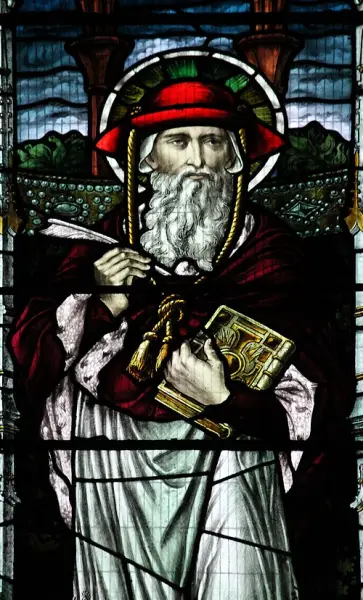
Peris is an obscure holy man of early Christian Wales, perhaps living in the sixth century, whose memory has attached itself firmly to the valleys under Snowdon. The genealogies give two conflicting origins: the Bonedd y Saint styles him a 'Cardinal of Rome', while tradition also counts him among the numerous offspring of Helig ap Glannog, lord of Tyno Helig, the drowned lowland of the north Wales coast. What is sure is the landscape he left behind. He is believed to have sought out the quiet of Nant Peris, that deep valley of the Welsh north, and the church of the village there is dedicated to him. The well called Ffynnon Peris, or Ffynnon y Sant, bears his name and the story that he kept two fish in its waters and drank from the well daily. The nearby village of Llanberis takes its name from him, as does Llyn Peris, the lake that lies between the two. His feast day is 11 December, and he is the patron saint of Llanberis. A companion figure, Saint Cian, a soldier who became his servant and died a hermit in Caernarfonshire, keeps the same feast.
The Complete Life
A Saint of Two Genealogies
Welsh tradition preserves two answers to the question of where Peris came from, and it has never settled between them. The Bonedd y Saint, the medieval genealogy of the Welsh saints, calls him a 'Cardinal of Rome' — a title that in its strict modern sense belongs to a later age, and which in the Welsh lists generally signals a saint of Roman or continental origin, one who brought the faith from the old center of Christendom. The other tradition, genealogical rather than ecclesiastical, numbers him among the numerous children of Helig ap Glannog, that legendary chieftain of Tyno Helig, a fertile lowland said to have been swallowed by the sea off the north Wales coast. The two accounts cannot easily be reconciled, and the sources are too thin to try. What they agree on is the world he belonged to: the age, possibly the sixth century, when the church in Wales was taking shape out of native British Christianity, monastic pioneers, and holy figures remembered as arrivals from afar. Peris belongs to that generation of saints about whom Wales remembered everything except the biography.
§ Introduction
Solitude in Nant Peris
Whatever his origins, Peris's known life belongs to the mountains. He is believed to have withdrawn into the quiet of Nant Peris, a valley that still carries his name under the heights of Snowdon in the Welsh north, and there to have lived as a hermit of the Welsh pattern — a solitary who made a wilderness holy by prayer. The choice of place was characteristic of the early Welsh church, which sought out the remote valley and the stony shore for cells and oratories. In time a church stood in the village of his valley, and it is dedicated to him still, and the settlement grew up around the llan, the sacred enclosure of his foundation. With him tradition pairs Saint Cian, a soldier who laid down his arms to enter Peris's service and finished his days as a solitary in Caernarfonshire; the church of Llangian in Gwynedd is dedicated to Cian, and his feast falls, like his master's, on 11 December. Master, servant and valley together form a single picture of the early Welsh religious landscape: armed men become servants, servants become solitaries, and valleys become parishes.
§ Introduction
The Well, the Lake, the Village
Few British saints have given their name to so much enduring geography. The village of Llanberis at the foot of Snowdon derives its name from his, as does Llyn Peris, the lake that lies between Llanberis and Nant Peris; the spring called Ffynnon Peris, or Ffynnon y Sant — the saint's well — rises in the valley, and tradition tells that Peris kept two fish in it and drank from its water daily. The story of the fish belongs to the oldest stratum of Celtic holy-well lore, and the well kept its repute among the people of the valley for centuries. He is the patron saint of Llanberis, and his feast is kept on 11 December. For a saint of whom almost no biographical fact survives, the density of his commemoration in one small landscape is remarkable: a village, a lake, a well and a parish church all testify to a cult that grew where he actually lived. Antiquarians from Sabine Baring-Gould onward have recorded him in the Lives of the British Saints, and the valley that bears his name remains the fullest monument a hermit could ask.
§ Introduction
The Record
- Patron of
- Llanberis, Wales
- Symbols
- Ffynnon Peris, the well with its two fish
- Canonization
- Pre-congregation; ancient Welsh cult centered at Llanberis
Prayer
Bibliography
Show 6 sources
- Baring-Gould, Sabine (1907). Lives of the British Saints.
- "Historical Information: The Church of Saint Peris". Nantperis.org.uk. Archived from the original on 29 September 2011.
- Maddern, Eric (2015). "Saint Peris". Snowdonia Folk Tales. The History Press. ISBN 9780750966429.
- Hutchison-Hall, John (Ellsworth) (2017). Orthodox Saints of the British Isles. Vol. IV. St. Eadfrith Press. p. 243. ISBN 9781542718226.
- Monks of Ramsgate (1921). "Cian". Book of Saints. CatholicSaints.Info.
- "St Cian, Llangian". The Church in Wales.
Profile text adapted from the Wikipedia article, licensed CC BY-SA 4.0.
Pray with this saint every day
Save St. Peris to your favorites, read the full profile, and get feast-day reminders in the Saints app.
Get the Saints AppFree on the App Store for iPhone and iPad