
c. 182 – c. 203·Feast March 7
St. Perpetua and Felicity
Carthaginian martyrs of the arena, early third century
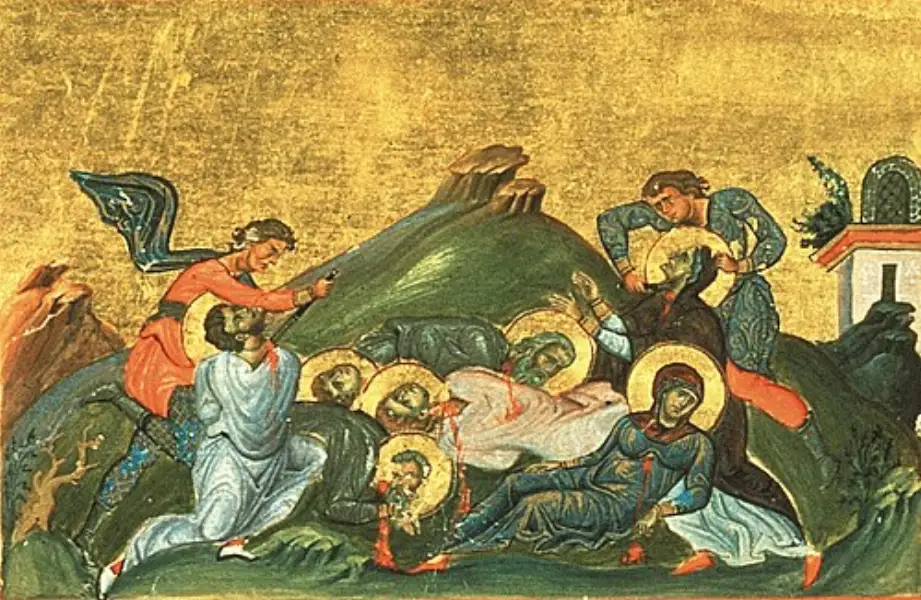
Overview
Perpetua and Felicity were put to death together at Carthage, in Roman Africa, about the year 203. Vibia Perpetua belonged to a good family and had recently married; a well-educated woman of about twenty-two, she was still nursing an infant son when she died. Felicity was an enslaved woman imprisoned at her side, expecting a child when she was arrested. Three companions joined them among the catechumens of the city: the free men Saturninus and Secundulus and the enslaved Revocatus, while a sixth Christian, Saturus, handed himself over to share their fate. Perpetua kept a diary through her imprisonment, and this first-person narrative was published after her death within the Passion of Saints Perpetua and Felicity, a text treasured from antiquity onward. It records her agonized conflict with her father, her baptism, the miseries of the Carthaginian prison, and a series of visions that assured her of the coming contest. The prisoners were put to death in the military games staged for the birthday of Geta, son of the emperor Septimius Severus. Their cult spread at once: a basilica rose over their tomb, their names entered the Roman Canon of the Mass, and their feast appears in the fourth-century Philocalian Calendar of Rome.
The Complete Life
A Noblewoman and a Slave
Perpetua came of a respected household in Carthage, the great city of Roman Africa. The Passion describes her as young, recently wed, and carefully educated, with a small son still at her breast; she is said to have been twenty-two years old when she faced death. Nothing in her early story suggested the arena. She was a catechumen, a convert still under instruction, when the warrant for her arrest was issued in the last years of Septimius Severus's reign. At her side in prison stood Felicity, known in Latin as Felicitas, a slave woman heavy with child. Their circumstances could hardly have differed more: one a noblewoman with an infant son, the other a slave awaiting the birth of her own child, yet the two women shared one faith and one destiny. Around them gathered three others under instruction, Saturninus and Secundulus, who were free, and Revocatus, who was enslaved. These five, with their elder Saturus, would become the most famous company of martyrs that Roman Africa ever produced, their names recited at the altar from the earliest centuries of Christian memory. The Passio remembers them not as abstract emblems of courage but as women with names, families, and bodily needs, and it is precisely this closeness that has kept their story alive for eighteen centuries.
§ Introduction
Baptism and the Cost of Confession
The account opens with a family torn apart by conversion. Perpetua's father, a pagan, begged her to abandon her belief and say the words that would free her; she refused, holding to the faith she had only lately embraced. Soon afterward she received baptism, and the small company of catechumens was moved into custody at Carthage in the days before the games. Baptism, for Perpetua, was no quiet initiation but the seal placed on a decision already being tested by imprisonment. Her resolve was matched by that of Saturus, who had not been seized with the others; he went before the magistrate of his own accord and declared himself a Christian, choosing bondage beside his fellows. The narrative makes clear that this was a vocation embraced rather than endured: Perpetua debated, suffered, and prayed her way into the courage she displayed, leaving her diary as the record of a conscience arriving at maturity. Her father's grief, her infant's need, and the threat of the beasts all pressed upon her, and she wrote through it, giving the church its earliest substantial writing from a Christian woman's own hand.
§ Imprisonment
Visions of the Ladder and the Contest
Perpetua's diary is remarkable for the visions it records. At her brother's urging she asked God for a sign, and in sleep she saw a steep ladder of bronze reaching to heaven, fitted with weapons on every side that would tear anyone climbing carelessly. A serpent lay coiled at its base and struck terror into climbers; Saturus went up first, unharmed, and Perpetua followed, treading on the serpent's head as she had been taught to do, until she reached a broad garden where a white-haired shepherd welcomed her. Waking, she understood that the martyrs were to suffer, and that the vision promised passage through suffering rather than escape from it. On the day before the games she dreamed again, this time of combat: she was stripped, rubbed with oil, and matched against a monstrous Egyptian in the arena, whom she overthrew and trampled, receiving a branch of gold from a towering figure who ruled the contest. She drew the meaning herself. Her struggle would not be against beasts alone; the true adversary was the Devil, and the fight of the following day would be fought, and won, in the spirit.
§ Imprisonment
Prison and the Arena
Perpetua wrote plainly of prison: the heat, the crowding, the rough handling by the soldiers, and above all the agony of a nursing mother separated from her child. Her breasts ached in the alternating cycle of pain and relief she described so precisely. When she managed to bribe her keepers, she and her companions were transferred to a better part of the prison, and her baby was brought to her; bodily torment eased once she could nurse him again. Felicity suffered in her own way, eight months pregnant when arrest came, since the law did not execute pregnant women and she feared to be separated from her companions; tradition holds she gave birth in time to join them. The end came in the military games celebrated for the birthday of Geta, son of Septimius Severus. The catechumens were led into the arena at Carthage and there completed their confession, Perpetua and Felicity dying side by side with Saturninus, Secundulus, Revocatus, and the self-surrendered Saturus, around the year 203. Perpetua's narrative closes at the threshold of that day, completed by another hand within the Passion.
§ Imprisonment
Honour from the First Centuries
No formal process was needed to make Perpetua and Felicity saints; the church of Carthage honoured them from the moment of their death as martyrs of Christ. A basilica, the Basilica Maiorum, was eventually raised over their tomb, and within it archaeologists have found an ancient inscription carrying the names of Perpetua and Felicitas, testimony to a cult unbroken from antiquity. Their standing in the universal church is fixed by two of its oldest documents of worship. The feast of Saints Felicitas and Perpetua on 7 March was observed across the Roman Empire and entered the Philocalian Calendar, the fourth-century register of martyrs venerated publicly at Rome. More solemnly still, the two African women are commemorated by name in the Roman Canon of the Mass, the great eucharistic prayer in use at Rome from the earliest centuries, where they stand in the company of the church's most venerable martyrs. Such recognition, won in the arena and preserved in the church's central prayer, marks them among the saints whose cult belongs to the whole Catholic communion from its beginnings. The closeness with which the Passio portrays them — women with families, infant children, and bodily needs rather than abstract emblems of courage — has kept devotion to them vivid from the third century to the present day.
§ Veneration
A Feast That Would Not Be Moved
Few calendars have been adjusted around two martyrs so often. Their 7 March observance, fixed in the Philocalian Calendar, was overshadowed when the feast of Thomas Aquinas was assigned to the same day, after which the African pair were merely commemorated alongside him. The Tridentine calendar of Pius V kept that arrangement until 1908, when Pius X moved their celebration to 6 March. The 1969 revision of the General Roman Calendar transferred Aquinas elsewhere and gave the martyrs back their ancient 7 March date. Other communions never moved it at all: Lutherans and Anglicans generally, including the Episcopal Church and the Church of England, keep 7 March, while the Anglican Church of Canada long observed 6 March under the Book of Common Prayer of 1962 before returning to the traditional day with the Book of Alternative Services of 1985. The Eastern Orthodox churches commemorate Perpetua and her companions on 1 February. Mosaics such as the sixth-century portrait of Perpetua in the Euphrasian Basilica at Poreč show how widely her face was honoured, and her diary remains one of the most read documents of the early church.
§ Veneration
Timeline
- 182
Perpetua is born at Carthage in Roman Africa, probably in this year.
§ Introduction
- 203
Perpetua, Felicity, Saturninus, Secundulus, and Revocatus are executed in the arena games at Carthage held for the birthday of Caesar Geta; Saturus dies with them.
§ Introduction
- 1908
Pope Pius X moves the joint feast from 7 March to 6 March, leaving Thomas Aquinas in possession of the traditional date.
§ Veneration
- 1962
The Anglican Church of Canada still commemorates the two martyrs on 6 March in its Book of Common Prayer of that year.
§ Veneration
- 1969
The revision of the General Roman Calendar transfers the feast of Aquinas elsewhere and restores Perpetua and Felicity to 7 March.
§ Veneration
- 1985
The Anglican Church of Canada adopts the Book of Alternative Services and returns to the traditional 7 March date.
§ Veneration
In Their Own Words
of good family, recently married, and well educated with an infant son at her breast
The Record
- Major works
- Perpetua's first-person prison diary, preserved in the Passion of Saints Perpetua and Felicity
- Patron of
- Mothers·Expectant mothers·Ranchers·Butchers·Carthage·Catalonia
- Canonization
- Pre-congregation; honoured as martyrs from the earliest centuries
Prayer
Bibliography
Show 6 sources
- Heffernan, Thomas J. (2012). The Passion of Perpetua and Felicity. Oxford: Oxford University Press.
- Gold, Barbara K. (2018). Perpetua: Athlete of God. Oxford: Oxford University Press.
- Dova, Stamatia (2017). "Lactation Cessation and the Realities of Martyrdom in the Passion of Saint Perpetua". Illinois Classical Studies 42 (1): 245-265.
- Salisbury, Joyce Ellen (3 March 2019). "Perpetua: Christian Martyr". Encyclopædia Britannica.
- Farina, William (2009). Perpetua of Carthage: Portrait of a Third-Century Martyr. McFarland and Company.
- Perez, Melissa. Vibia Perpetua's Diary: A Woman's Writing in a Roman Text of Its Own (thesis).
Profile text adapted from the Wikipedia article, licensed CC BY-SA 4.0.
Pray with this saint every day
Save St. Perpetua and Felicity to your favorites, read the full profile, and get feast-day reminders in the Saints app.
Get the Saints AppFree on the App Store for iPhone and iPad