
died 30 December 490·Feast April 8
St. Perpetuus
Sixth Bishop of Tours and Builder of Martin's Basilica
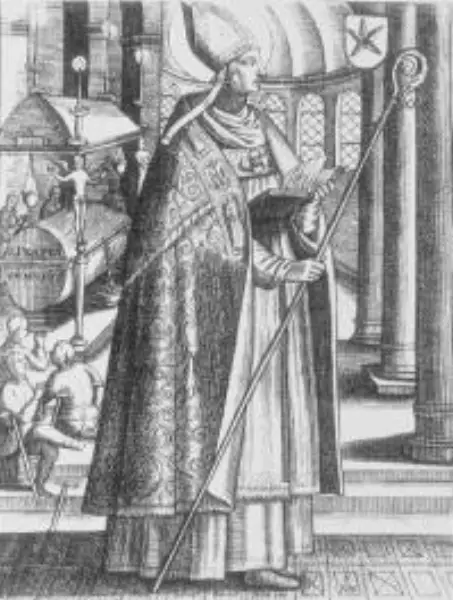
Overview
Perpetuus led the Church of Tours as its sixth bishop from about 460 until his death at the end of 490. Born into a senatorial family of the Auvergne, he belonged to a clerical dynasty: he succeeded his kinsman Eustochius, probably an uncle, and was followed in turn by another relative, Volusian. Educated in the scriptures and numbered among the friends of the poet Sidonius Apollinaris, he poured out his large fortune on behalf of the needy. Across three decades he developed and consolidated Christianity in Touraine, presiding over a council of eight bishops at Tours in 461 and over the Council of Vannes in 465, and removing clergy who proved unworthy of office. His most visible monument was the great basilica he raised over the tomb of Martin of Tours, adorned with murals, explanatory inscriptions, and a poem for the apse by Sidonius; the saint's body was translated into it with ceremony in 473. Perpetuus also shaped daily piety, decreeing fasts on Wednesdays and Fridays that were still observed in the seventh century. He died on 30 December 490 and was buried in the basilica he had built, leaving his vineyards, gold, and houses to the poor.
The Complete Life
Birth into the Senatorial Aristocracy
Perpetuus came of age in the fading Roman aristocracy of Gaul. His family was senatorial, rooted in the Auvergne, one of those great landholding houses whose wealth and learning still carried weight in a countryside increasingly contested by new powers. That standing mattered for his career: the episcopal thrones of fifth-century Gaul were routinely filled by men of exactly this class, and Tours proved no exception. When Eustochius died around 460, his own relative — most accounts call him an uncle — stepped into the see. The family's hold on the diocese did not end with Perpetuus either, for another close kinsman, Volusian, followed him as bishop. Contemporaries described him as a student of sacred literature, a man of books as well as birth, and his friendship with the poet and bishop Sidonius Apollinaris placed him among the literary circles of the age. Sidonius corresponded with the great men of Gaul, and that Perpetuus counted among them says much about the world into which he was born: a Christian aristocracy in which family, culture, and church office were woven tightly together, and in which a bishop could be at once landowner, statesman, and pastor.
§ Life
Shepherd of Touraine
Perpetuus became bishop of Tours around 460 and guided the church of that city for thirty years. The sources credit him with developing and consolidating Christianity throughout Touraine, the rural diocese that radiated outward from the shrine of its great patron. He took the pastoral office seriously in its administrative dimensions: he kept careful surveillance over the conduct of his clergy, and the record notes that priests who proved unworthy were removed from their office. In 461 he presided over an assembly at Tours in which eight bishops gathered on the feast of Saint Martin; the council promulgated an important rule touching ecclesiastical discipline. Four years later, in 465, he presided at the Council of Vannes, which condemned the Sortes Sanctorum — the practice of divining the future by opening the writings of the saints at random — a verdict that shows a bishop concerned to distinguish Christian hope from fortune-telling. The picture that emerges is of a disciplined, energetic ordinary: a prelate who combined aristocratic authority with genuine pastoral vigilance, and who understood that the faith of a diocese depends on the worthiness of those who serve it.
§ Life
A Great Basilica for Saint Martin
No work of Perpetuus mattered more than his promotion of devotion to Martin of Tours. Around 470 he replaced the modest chapel of Saints Peter and Paul that Britius had built to shelter the tomb with a beautiful new basilica, raised 550 paces from the city. The project drew on the networks of Gallic society: Euphronius of Autun sent marble for the covering of the tomb, Perpetuus had murals painted upon its walls, with inscriptions set beside them to explain the scenes, and Sidonius Apollinaris contributed a poem for the apse. On a day in July 473 the body of Martin was translated into the new church with great ceremony. Perpetuus grasped that a shrine lives by its accessibility. By opening the basilica to every class of pilgrim he made the cult something the educated could study in its pictures and poems, while ordinary people could visit the church, view its murals, join its festivals, and hear the saint's life read aloud. Monasteries rose under his hand as well, together with many another church — above all one dedicated to Peter and Paul, raised to house the roof of the earlier chapel, its joinery too fine to be thrown away.
§ Life
Fasting Written into the Year
The discipline Perpetuus imposed on his diocese outlived him by centuries. Gregory of Tours hands down his rule that the whole people of his diocese keep fast on Wednesdays and Fridays, with only a handful of great feasts excepted. To these he added several Mondays as fast days as well, above all the stretch from the feast of Saint Martin to the Nativity — an observance recognized as a precursor of the season of Advent. Here is one of the early witnesses to the liturgical shape of the Christian year as the West would come to know it: a penitential road running from November to Christmas that a bishop of Tours carved into the habits of his people. The fasts were still being observed in the seventh century, more than a hundred years after his death, evidence of how deeply a determined ordinary could mark a local church. Perpetuus's piety joined severity to charity: the same man who multiplied fast days spent his ample fortune upon the needy, and dying left vineyards, gold, and houses in trust for the poor.
§ Life
Death and Burial
Perpetuus died at Tours on 30 December 490, after three decades on the throne of Saint Martin. A divergent tradition gives his death as 8 April 491, and the discrepancy explains why the two dates, 30 December and 8 April, both attach themselves to his memory in the calendars. He was buried in the church of Saint Martin, the very basilica he had raised over the tomb of Tours' great bishop — a fitting resting place for the man who had rebuilt the shrine and fixed its place at the heart of Gallic Christianity. His final dispositions mirrored his life: he left his vineyards, his gold, and his houses to benefit the poor, converting the patrimony of a senatorial house into alms. The see passed to his kinsman Volusian, continuing the family's hold on Tours. Memory kept him as a bishop and confessor, honored on 8 April and depicted in art directing the building of a church, sometimes with the sick being healed at his tomb or with his relics carried in procession. The builder of the great shrine thus rests forever within his own work, among the pilgrims he taught to come.
§ Life
Timeline
- 460
Becomes the sixth bishop of Tours, succeeding his kinsman Eustochius
§ Life
- 461
Presides over an assembly of eight bishops at Tours, which promulgates a rule on ecclesiastical discipline
§ Life
- 465
Presides at the Council of Vannes, which condemns the use of the Sortes Sanctorum
§ Life
- 470
Replaces the little chapel over Saint Martin's tomb with a beautiful new basilica
§ Life
- Jul 473
Martin's body is translated into the new basilica with great ceremony
§ Life
- 30 Dec 490
Dies at Tours after thirty years as bishop and is buried in the church of Saint Martin
§ Life
The Record
- Major works
- Basilica of Saint Martin at Tours·Church of Saints Peter and Paul at Tours·Monasteries and churches across Touraine
- Symbols
- Bishop directing the building of a church·The sick healed at his tomb·Relics carried in procession
- Canonization
- Pre-congregation; venerated as bishop and confessor of Tours from the early centuries
Prayer
Bibliography
Show 5 sources
- Clugnet, Léon. "St. Perpetuus." The Catholic Encyclopedia, Vol. 11. New York: Robert Appleton Company, 1911.
- Wace, Henry. "Perpetuus, St.", A Dictionary of Christian Biography.
- Van Dam, Raymond. Saints and Their Miracles in Late Antique Gaul. Princeton University Press, 2011.
- Butler, Alban. The Lives of the Primitive Fathers, Martyrs, and Other Principal Saints. J. Moir, 1798.
- Baker, Pacificus, O.S.B. The Christian Advent. J. Marmaduke, 1755.
Profile text adapted from the Wikipedia article, licensed CC BY-SA 4.0.
Pray with this saint every day
Save St. Perpetuus to your favorites, read the full profile, and get feast-day reminders in the Saints app.
Get the Saints AppFree on the App Store for iPhone and iPad