
1866 – 1941·Feast September 17
St. Petar Zimonjić
Hieromartyr metropolitan of Dabar and Bosnia
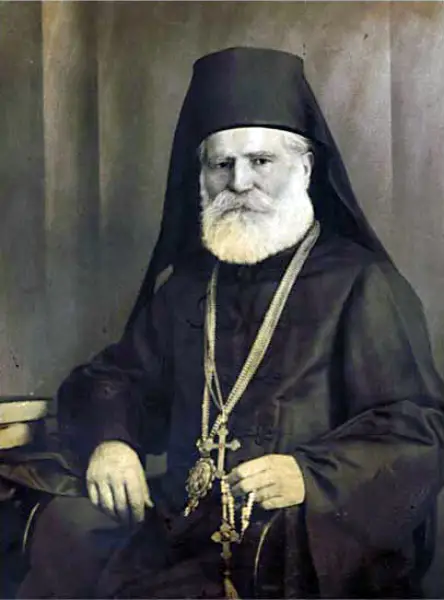
Overview
Petar Zimonjić, born Jovan Zimonjić on 24 June 1866 at Grahovo in Montenegro, rose from a priestly and noble Herzegovinian family to become metropolitan of Dabar and Bosnia, the see he governed in the Kingdom of Yugoslavia from 1920 until the Second World War. Educated at the Reljevo seminary near Sarajevo and at the theological faculty in Cernowitz, he spent his early career as a seminary professor before taking monastic vows in 1895 under the name Petar. Consecrated bishop of Zachlumia in 1903 at Mostar, he led the diocese for seventeen years before his translation to Sarajevo by royal charter. When war engulfed Yugoslavia in 1941 and the Ustaše regime of the Independent State of Croatia turned on the Orthodox population, he refused every counsel to flee, declaring that a shepherd must share the fate of his people. Arrested in May 1941, imprisoned and tortured, he perished in the camp system that summer — most accounts placing his death at Jasenovac, others at Jadovno. The Serbian Orthodox Church canonized him in 1998 as a hieromartyr, numbering him among the victims of the genocide of Serbs in the wartime Croatian state.
The Complete Life
A Priestly House in Herzegovina
The future metropolitan was born into one of those Herzegovinian families in which nobility and priesthood were joined. His father, Bogdan Zimonjić, was both a vojvoda, a nobleman and chieftain, and an Orthodox priest, and the boy grew up as Jovan in the village of Grahovo in the Nikšić region of Montenegro, close to the Herzegovinian lands where the family's roots lay. His education followed the classic path of a Serbian churchman of the late nineteenth century: from 1883 to 1887 he studied at the seminary of Reljevo, on the outskirts of Sarajevo in Austro-Hungarian Bosnia, and then crossed into the Habsburg lands further afield to read theology at the Orthodox Theological Faculty in Cernowitz, graduating in 1893. He was still a young man of twenty-seven when the Reljevo seminary engaged him as assistant professor that October, promoting him to full professor within a year. The classroom, however, was not his final destination; the monastic life and the hierarchy of the Serbian Orthodox Church lay ahead, and the professor of Reljevo would take the name Petar and never return to lay teaching.
§ Life
Tonsure, Priesthood, and the Episcopate
Petar's monastic profession came on 6 September 1895, when he received the tonsure and the name by which history knows him. The sacraments of order followed immediately: diaconal ordination on 7 September, and the priesthood the day after. His administrative gifts soon found employment in the church of Bosnia, and in 1901 he became a consistorial advisor in Sarajevo, serving the metropolitanate in which he would one day rule. Election to the episcopate came two years later, when the diocese of Zachlumia, Herzegovina and the Littoral chose him as its bishop; on 9 June 1903 he was consecrated and enthroned in Mostar, the ancient seat among the mountains of Herzegovina. For seventeen years he governed that diocese, returning in effect to the land of his fathers. When Metropolitan Evgenije (Letica) of Dabar and Bosnia retired, the crown moved Petar to Sarajevo: a royal charter dated 7 November 1920 appointed him metropolitan of the great Bosnian see, which he was to lead through the two remaining decades of the Kingdom of Yugoslavia. From Mostar he watched over the Orthodox villages of Herzegovina through the last years of Austro-Hungarian rule and the upheavals that followed, acquiring the experience of a working bishop that the Sarajevo metropolitanate would soon require. From Mostar he watched over the Orthodox villages of Herzegovina through the closing years of Austro-Hungarian rule, acquiring the experience of a working bishop that the Sarajevo metropolitanate would soon require of him.
§ Life
Shepherd in a Gathering Storm
As metropolitan of Dabar and Bosnia, Petar led the largest Orthodox see of Bosnia from Sarajevo throughout the 1920s and 1930s, years in which the Serbian population of the region looked to its bishops for both spiritual and national leadership. The storm broke in April 1941, when the Kingdom of Yugoslavia collapsed and the Independent State of Croatia, aligned with Nazi Germany, set out to erase the Orthodox presence in its territory. A key instrument of that policy in Bosnia was a Roman Catholic priest, Božidar Bralo, an Ustaše adherent charged with affairs in Bosnia and Herzegovina, who drove through the prohibition of the Serbian Cyrillic alphabet in favour of the Latin script. Before the German Gestapo the metropolitan defended the Orthodox faith and insisted that his people's Cyrillic letters would not be surrendered. Advised to slip away to Serbia or Montenegro while there was time, he answered with the words for which he is remembered: he was the people's shepherd, bound to share their evil as he had shared their good. The refusal fixed his course; within weeks the regime moved against him.
§ Martyrdom
Arrest, Torture, and Martyrdom
On 12 May 1941 the metropolitan was arrested. He was held first in the Beledija prison, and three days later transported to the Kerestinec camp near Zagreb, where he was registered under the number 29781. There his beard was shaved and his hair cut away, and everything that marked his episcopal rank was stripped from him — humiliations meant to strip away the dignity of a hierarch. What followed he endured under torture, and the record of his final weeks is shadowed by the chaos of the camp system: he was moved to Koprivnica and from there either to Jasenovac or to Gospić. Witnesses from Sarajevo district, Jovo Furtula and Jovo Lubura, testified that he was killed at the Jasenovac concentration camp and that his body was thrown into the fiery furnace used for making bricks. A second tradition holds that he was taken to the Jadovno camp and there put to death, his remains cast into an acid pit. The accounts differ in detail but agree in substance: in June 1941, at about seventy-five years of age, the metropolitan of Dabar and Bosnia died a martyr's death in the Ustaše camps.
§ Martyrdom
Ranked Among the Serbian Saints
In 1998, at a regular session of the Holy Synod of the Serbian Orthodox Church, Metropolitan Petar was canonized, and his name was inscribed on the list of the saints of the Serbian people and of the Orthodox faith. The church honours the holy hieromartyr on 17 September, corresponding to 4 October on the Old Calendar, and marks his memory liturgically in the third week of September. He stands in the long line of Serbian hierarchs who died for their flock — remembered alongside the other bishops and priests who perished in the camps of the Independent State of Croatia — and his cult belongs especially to Bosnia and Herzegovina, the diocese he refused to leave. As one of the Holy Martyrs of Jasenovac he is invoked with the thousands of Orthodox victims of the wartime genocide, a witness that the shepherding office is fulfilled not in safety but in self-offering. Veneration of the metropolitan has grown through the decades since his glorification, in parishes of the Serbian church across the Balkans and the diaspora. Devotion to him has grown steadily in the decades since his glorification, in the cathedrals of Bosnia, in the monasteries of Fruska Gora, and among Serbian communities across the diaspora.
§ Martyrdom
Memory and Witness
Petar Zimonjić is remembered today chiefly as the bishop who answered terror with presence. His refusal to abandon Sarajevo when the Ustaše state turned against the Serbs became a defining image of episcopal fidelity in the Serbian church's memory of the Second World War, and the details preserved by witnesses — the shaved beard, the confiscated insignia, the prisoner's number at Kerestinec — have fixed his martyrdom in the conscience of his people. Historians of the period place his death among the documented killings of Orthodox clergy in the Independent State of Croatia, alongside accounts compiled from the testimonies of survivors of the camps. Within the Serbian Orthodox Church his canonization in 1998 gave his story a liturgical home: his icon shows him vested as a bishop, his feast is kept each September, and his name is read among the holy hieromartyrs of the genocide. For the dioceses of Bosnia and Herzegovina he remains a local father in the faith, and for the wider church a witness that the shepherd's bond to his people outlasts every threat that can be raised against it.
§ Martyrdom
Timeline
- 24 Jun 1866
Born at Grahovo near Nikšić, Montenegro, son of the vojvoda and priest Bogdan Zimonjić.
§ Life
- 1883
Enters the seminary at Reljevo, near Sarajevo, beginning four years of study.
§ Life
- 1893
Graduates from the Orthodox Theological Faculty in Cernowitz and is appointed assistant professor at Reljevo in October.
§ Life
- 6 Sep 1895
Receives monastic tonsure with the name Petar; ordained deacon the next day and presbyter the day after.
§ Life
- 1901
Named a consistorial advisor in Sarajevo.
§ Life
- 9 Jun 1903
Consecrated and enthroned at Mostar as bishop of Zachlumia, Herzegovina and the Littoral.
§ Life
- 7 Nov 1920
Appointed Metropolitan of Dabar and Bosnia by royal charter, succeeding the retired Evgenije (Letica).
§ Life
- 12 May 1941
Arrested by the authorities of the Independent State of Croatia and imprisoned in the Beledija prison.
§ Martyrdom
- Jun 1941
Dies in captivity after torture and transfers through Kerestinec, Koprivnica and the camp system; most testimonies place his death at Jasenovac.
§ Martyrdom
- 1998
Canonized during a regular session of the Holy Synod of the Serbian Orthodox Church, his name joined to the saints of the Serbian people.
§ Martyrdom
In Their Own Words
I am the people's shepherd, which means that I am bound to stay here and share evil with these people, as I used to share well with them; thus I have to share the destiny of my people and stay where I am supposed to be.
The Record
- Major works
- Shepherding the Eparchy of Zachlumia (1903-1920) and the Metropolitanate of Dabar and Bosnia (1920-1941)
- Patron of
- Serbian Orthodox clergy under persecution·Martyrs of the Jasenovac camps
- Symbols
- Vested as a bishop
- Canonization
- Canonized in 1998 at Belgrade by the Holy Synod of the Serbian Orthodox Church
Prayer
Bibliography
Show 6 sources
- Vasilik, Vladimir. "The Role of the Roman Catholic Church in the Genocide of Serbs on the Territory of the 'Independent State of Croatia'". OrthoChristian.Com. Retrieved 2019-08-26.
- Greble, Emily (2011-02-25). Sarajevo, 1941-1945: Muslims, Christians, and Jews in Hitler's Europe. Cornell University Press. p. 70. ISBN 9780801461217.
- Lees, Michael (1992). The Serbian Genocide 1941-1945. Serbian Orthodox Diocese of Western America.
- Rivelli, Marco Aurelio (1998). Le Genocide Occulte (in French). L'AGE D'HOMME. ISBN 9782825111529.
- Dzomic, Velibor V. "Ustaski zlocini nad srpskim svestenicima (Stradanje srpskih episkopa u NDH)". Projekat Rastko. Retrieved 2019-11-27.
- Peršen, Mirko (1990). Ustaški logori (in Croatian). Globus. ISBN 9788634305470.
Profile text adapted from the Wikipedia article, licensed CC BY-SA 4.0.
Pray with this saint every day
Save St. Petar Zimonjić to your favorites, read the full profile, and get feast-day reminders in the Saints app.
Get the Saints AppFree on the App Store for iPhone and iPad