
c. 1 BC – AD 64/68·Feast June 29
St. Peter
Prince of the Apostles and Martyr of Rome
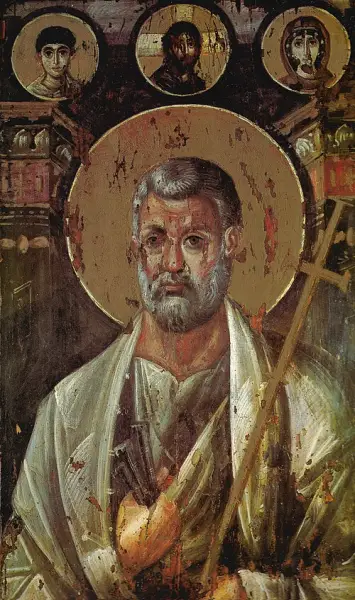
Overview
Peter — born Simon bar Jonah around 1 BC in Bethsaida on the Sea of Galilee — was a fisherman whom Jesus called to stand first among the Twelve Apostles. His brother Andrew brought him to Jesus, who gave him the Aramaic name Cephas, rock, rendered in Greek as Petros. The gospels show him as spokesman of the apostles: confessing Jesus as the Messiah at Caesarea Philippi, walking briefly on the water, striking the high priest's servant in Gethsemane, and, on the night of the arrest, denying three times that he knew his Lord. The risen Christ appeared to him first among the apostles, and by the Sea of Galilee three times asked for his love, restoring what the denial had lost. Acts portrays him leading the Jerusalem community, preaching at Pentecost, opening the faith to the Gentile centurion Cornelius, and escaping Herod Agrippa's prison under angelic guard. Tradition makes him the first bishop of Antioch and first bishop of Rome, and early fathers from Clement onward attest that he died a martyr in that city, crucified head downward under Nero between 64 and 68. Constantine raised a basilica over his grave on the Vatican; the bones announced in 1968 by Paul VI rest beneath its high altar. East and West keep his feast with Paul on 29 June.
The Complete Life
A Fisherman of Bethsaida
Peter's world was the shore of Galilee. He was born Simon, son of Jonah — some manuscripts of John give the father's name as John — in the fishing village of Bethsaida, and he plied that trade with his brother Andrew and, in partnership, with the sons of Zebedee, James and John. The gospels preserve domestic traces of the man: the synoptics tell of Jesus healing his mother-in-law at his home in Capernaum, where a Franciscan church today stands over the traditional site of the house, and Paul's first letter to the Corinthians implies that he was married. Clement of Alexandria would later claim that his wife was executed for her faith, though the New Testament itself is silent about her, and another tradition holds she had already died by the time he met Jesus. His original name was a common Jewish one, spelled sometimes Simon and sometimes Simeon; the ordinariness of the fisherman from Bethsaida is part of the story's force. From this household of nets and boats came the man the church would call its rock — thick-set, impulsive, capable of splendid confession and shattering collapse. His mother tongue was Aramaic; the Greek of the New Testament rendered his new name from the Aramaic kepha, meaning rock or stone.
§ Biographical information
Called, Named, and Sent
All four gospels agree that Simon stood at the head of the called. Mark and Matthew set the summons by the sea — the call to become fishers of men — while John tells it differently: Andrew, having heard John the Baptist hail Jesus as the Lamb of God, brings his brother to Jesus, who looks at him and names him Cephas. Luke supplies the miraculous catch: Jesus borrows Simon's boat to preach to the crowds pressing upon him at the shore, then commands a lowering of the nets after a fruitless night; the haul threatens to burst them, and Simon falls at the Lord's knees. At Caesarea Philippi comes the confession of Jesus as the Christ, God's own living Son, and with it the promise that he is Peter, upon the rock the church will be built, with the keys of the kingdom. Matthew alone adds the walking on the water: a few steps of faith, then sinking, and the rebuke of little faith. At the Last Supper he first refuses, then begs, the washing of his feet; in Gethsemane he draws a sword and strikes the servant Malchus, whose ear Jesus heals. The portrait joins first place to first failure, and both by design.
§ Accounts
Pillar of the Jerusalem Church
After the resurrection, Peter becomes the central figure of the Acts of the Apostles. He directs the election of Matthias, preaches at Pentecost, heals the lame man at the temple gate, and judges Ananias and Sapphira for lying about their alms. Twice arraigned with John before the Sanhedrin, he defies the council directly. A missionary journey carries him to Lydda, Joppa, and Caesarea; at Joppa a vision of clean and unclean animals prepares him for the house of Cornelius the centurion, where he concludes that God shows no partiality — the decisive opening of the church to the Gentiles. Paul confirms his standing: Peter was entrusted with the gospel for the Jews as Paul for the Gentiles, and together with James the Just and John he was reckoned a pillar of the church. Yet leadership proved complicated. James soon eclipsed him in Jerusalem, and at Antioch Paul opposed him to his face over table fellowship with Gentile converts. Later tradition gave him seven years as bishop of Antioch, and Origen and Eusebius record that he founded that church before moving on to Rome. One modern historian has called him the bridge-man of first-century Christianity, holding together its opposing parties.
§ Leader of the early Church
The Denial and the Restoration
On the night of the arrest, each of the four gospels tells how the Lord announced that before the cock crowed Peter would disown him three times over. The prediction came true in stages: a servant girl of the high priest recognized him as a companion of Jesus while he warmed himself by the fire; again, out at the gateway, he was identified as a follower of the Galilean; finally his own accent betrayed him to the bystanders. Luke alone preserves the Lord's warning and promise — that Satan had asked to sift the apostles like wheat, but that Jesus had prayed for Peter's faith, and that once converted he must strengthen his brothers. What redeems the story is its reversal. Paul's first letter to the Corinthians transmits the oldest list of resurrection appearances, and its first name is Peter. John's gospel sends him racing to the empty tomb, the first to enter it; and by the Sea of Galilee the risen Jesus three times asks whether Peter loves him, once for each denial, restoring his office with the charge to feed his sheep. From Easter onward, Peter has stood in Christian reflection as the exemplar of the forgiven sinner — the apostle whose failure and restoration are woven into the very foundation he represents.
§ Denial of Jesus by Peter
Rome and the Martyr's Cross
Early tradition is unanimous that Peter closed his life in Rome. Clement of Rome, writing within living memory, speaks of the apostle's many labors ending in a martyr's testimony; Irenaeus, Tertullian, Hegesippus, Clement of Alexandria, Lactantius, and Eusebius all attest that he spent his final years there and, with Paul, founded the Roman church. Jerome dates his arrival to the second year of Claudius and his death to the fourteenth of Nero, an episcopate of twenty-five years; most modern scholarship settles on a death between 64 and 68, probably some three months after the Great Fire of Rome, for which Nero blamed the Christians. The manner of his death was the cross. Tertullian says he endured a passion like his Lord's; Origen adds that he was crucified head downward, as he himself had desired, counting himself unworthy to die in the same posture as his Savior — the origin of the inverted Cross of Saint Peter. The apocryphal Acts of Peter supplies the legend of the flight from the city and the meeting with the risen Lord on the road: where are you going, Lord? — to Rome, to be crucified again. Peter turned back to the city and to his cross.
§ Death and burial
Veneration Without Canonization
Peter belongs to the earliest company of the church's saints, honored from the generation after his death rather than through any process of canonization. The Roman Martyrology assigns 29 June jointly to Peter and Paul — Augustine preached that although the two apostles died on different days, they were one, and so share a single day. That feast, kept across the Catholic, Orthodox, Anglican, and Lutheran calendars, is preceded in the East by a period of fasting known as the Apostles' Fast. The Roman Rite adds the feast of the Chair of Saint Peter on 22 February, and before 1960 kept another Chair feast on 18 January and Saint Peter in Chains on 1 August. Orthodox tradition dedicates every Thursday of the year to the apostles and adds three feasts of its own: the veneration of the Precious Chains on 16 January, the joint feast on 29 June, and the Synaxis of the Twelve on 30 June. The Church of England keeps a festival on 29 June, and Peter may be celebrated alone or with Paul. In every one of these calendars he appears as the earliest artists already drew him — the old, thick-set fisherman with the keys, whose memory the whole church keeps without any formal act ever having been needed.
§ Feast days
The Grave on the Vatican
Peter's grave fixed the geography of Western Christendom. Caius, writing about 198, could point visitors to the Vatican and to the Ostian Way and say: there are the trophies of the founders of this church. Jerome describes his burial near the triumphal way, venerated by the whole world; the Liber Pontificalis gives 29 June as the date of his burial. When Constantine resolved in the early fourth century to honor the apostle with a great basilica, the certainty of Rome's Christians about the spot forced the builders to excavate the slope of the Vatican Hill and even to demolish a cemetery, rather than raise the church anywhere easier; the altar over the place of burial remains the focal point of the basilica in both its original form and its reconstruction. The relics have a long afterlife: in 665 Pope Vitalian sent a cross containing filings from the apostle's chains to the queen of King Oswy of Northumbria, and and from the ninth century onward the sacred skull has rested at the Lateran basilica beside that of Paul. In 1950 excavators found bones beneath the altar; a forensic study reported a robust man of about sixty from the first century, and in 1968 Paul VI announced them most probably the apostle's. In 2019 Pope Francis gave nine fragments to Patriarch Bartholomew as a pledge of communion.
§ Relics
Timeline
- -1
Born Simon bar Jonah in Bethsaida, a fishing village on the Sea of Galilee
§ Biographical information
- 30
Called from his nets to follow Jesus, who gives him the name Cephas, the rock
§ Accounts
- 42
Jerome dates his arrival in Rome to the second year of the emperor Claudius
§ Death and burial
- 44
Imprisoned by Herod Agrippa in Jerusalem and freed by an angel, according to Acts 12
§ Accounts
- 64
Crucified, head downward, on Vatican Hill under Nero in the aftermath of the Great Fire of Rome
§ Death and burial
- 67
Jerome and Eusebius assign his death to this year, twenty-five years after his arrival in Rome
§ Death and burial
- 665
Pope Vitalian sends relics of the saint to the queen of Oswy, king of Northumbria
§ Relics
- 1950
Human bones are discovered buried beneath the altar of St. Peter's Basilica
§ Relics
- 1968
Pope Paul VI announces that the Vatican bones are most likely the relics of the apostle
§ Relics
- Nov 2013
Pope Francis presents bone fragments from the relics in public for the first time in St. Peter's Square
§ Relics
- Jul 2019
Nine bone fragments are transferred in a bronze reliquary to Ecumenical Patriarch Bartholomew of Constantinople
§ Relics
In Their Own Words
Blessed are you, Simon son of Jonah, for this was not revealed to you by flesh and blood, but by my Father in heaven.
Quo vadis, Domine?
Peter, through unjust envy, endured not one or two but many labours, and at last, having delivered his testimony, departed unto the place of glory due to him
The Record
- Major works
- First Epistle of Peter (traditionally attributed)·Second Epistle of Peter (traditionally attributed)·Preaching remembered as the source of the Gospel of Mark
- Patron of
- Fishermen·Bakers·Butchers·Bridge builders·Locksmiths·Net makers·The papacy·Invoked against fever, foot problems, and frenzy
- Symbols
- Keys of Heaven·Rooster·Inverted cross (Cross of Saint Peter)·Pallium and papal vestments·Book or scroll
- Canonization
- Pre-congregation; honored as a martyr from the apostolic age by all Christian churches
Prayer
Bibliography
Show 5 sources
- McDowell, Sean (2016). The Fate of the Apostles: Examining the Martyrdom Accounts of the Closest Followers of Jesus. Routledge.
- Siecienski, A. Edward (2017). The Papacy and the Orthodox: Sources and History of a Debate. Oxford University Press.
- Kelly, J. N. D. (2010). A Dictionary of Popes. Oxford University Press.
- Vidmar, John (2005). The Catholic Church Through the Ages: A History. Paulist Press.
- "Peter, St", by F. L. Cross, The Oxford Dictionary of the Christian Church, Oxford University Press, 2005.
Profile text adapted from the Wikipedia article, licensed CC BY-SA 4.0.
Pray with this saint every day
Save St. Peter to your favorites, read the full profile, and get feast-day reminders in the Saints app.
Get the Saints AppFree on the App Store for iPhone and iPad