
1542-1597·Feast February 6
St. Peter Baptist
Priest, Franciscan, and Martyr
Overview
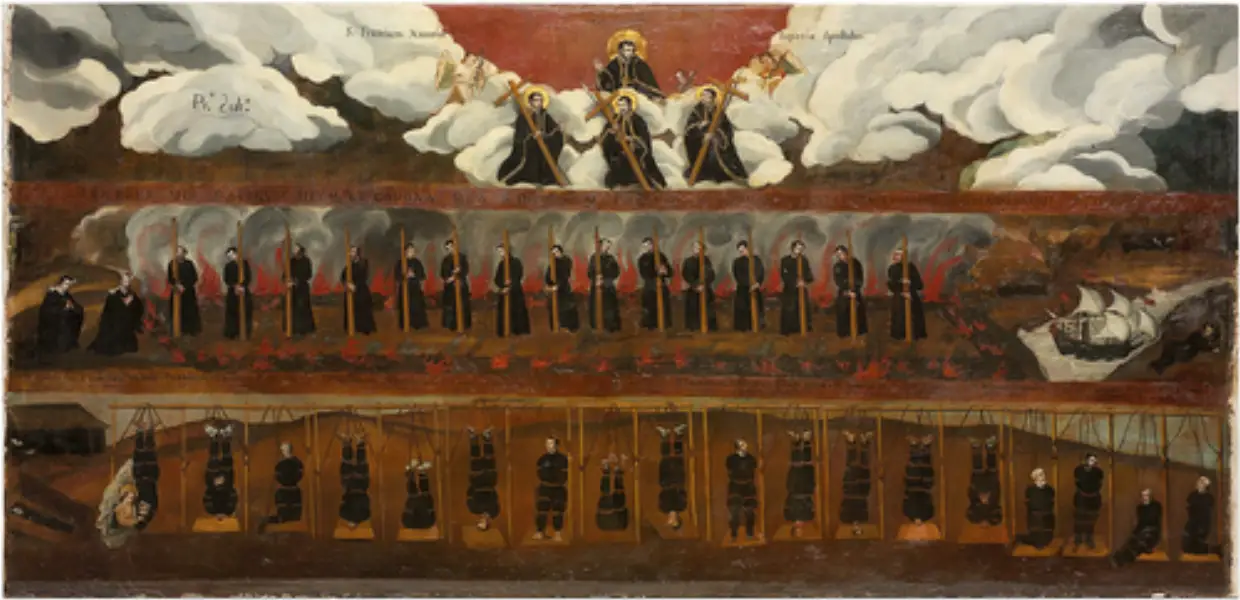
Peter Baptist — born Pedro Bautista Blásquez — was a Spanish Franciscan of the Alcantarine reform who labored as a missionary in Japan at the close of the sixteenth century. The Japanese mission had flourished since Francis Xavier's arrival in 1549, but the regent Toyotomi Hideyoshi grew suspicious of foreign influence and in 1587 ordered all Christians expelled. After the San Felipe incident of 1596, Hideyoshi moved against the friars: in January 1597 Peter Baptist was seized in Kyoto together with twenty-five companions — fellow Franciscan missionaries, three Japanese Jesuits among them Paul Miki, and seventeen Japanese tertiaries, including three altar boys. The prisoners were roped together and paraded for weeks toward Nagasaki, their left ears cut off, abused and stoned by crowds along the road. On 5 February 1597, on the hill above Nagasaki, they were raised on crosses and finished with lances. Their execution proved a seed for the hidden Church of Japan, which survived two and a half centuries underground.
The Complete Life
Early Life
Peter Baptist Blasquez was a Spanish Franciscan friar of the sixteenth century, formed in the Observant tradition of the order in Spain at the height of its missionary revival. The Franciscans were the pioneer evangelists of the New World and the Philippines, and the order's provinces supplied men continuously for the Asian missions in the decades after Spain acquired the Philippines in 1565. Peter Baptist's road to the mission ran through the Spanish Pacific: he served in the Philippines, where the friars had built the church of the archipelago with remarkable speed, and there he held office in the Franciscan province, acquiring the experience of administration that he would exercise in Japan. He was a mature religious, a priest of standing in his province, when he was sent to Japan, not a young volunteer.
§ References
Conversion and Vocation
The Franciscan entry into Japan came late and unofficially. The Jesuits, established there since 1549, had built the Japanese church with great caution; the Franciscans arrived from the Philippines in 1593 as chaplains to a Spanish embassy, seeking to found houses despite the ambiguity of the permissions involved. Peter Baptist led this Franciscan venture, establishing the friary and the works of charity in Kyoto and Nagasaki that gave the mission its shape: a hospital for lepers, care of the poor, and preaching. The mission's brief flourishing was conducted in the shadow of Toyotomi Hideyoshi's suspicion of foreign religion, already displayed in 1587 by his expulsion decree, and the friars worked knowing their situation rested on the ruler's forbearance.
§ External links
Mission and Ministry
Peter Baptist's ministry in Japan lasted about four years. Under his direction the Franciscans of Kyoto maintained their house at the church of the Jesuits' tolerance and their own hospital, ministered to the sick, and received converts, among them the Japanese lay tertiaries who would die with them. The friars' public works, especially the care of lepers, gave the mission a visibility that was both its strength and its danger. In 1596, after the San Felipe incident, in which the cargo and papers of a Spanish galleon suggested to the Japanese authorities the connection between missionaries and imperial expansion, Hideyoshi ordered the arrest of the Christians in the capital. Peter Baptist and his companions, friars, Japanese tertiaries, and the Jesuit Paul Miki among them, were seized in Kyoto and December, and sentenced to crucifixion at Nagasaki.
§ External links
Trial and Final Years
The twenty-six were marched from Kyoto to Nagasaki, a winter journey of nearly a month, tied together and paraded through the towns with a placard declaring their crime of defying the regent's prohibition, an ordeal intended as exemplary punishment that contemporaries saw instead as a triumphal procession. On 5 February 1597, on the hill above Nagasaki, the twenty-six, among them three Japanese Jesuits and seventeen Japanese Franciscan tertiaries including three altar boys, were raised on crosses and killed with lance thrusts. Peter Baptist, the superior of the friars, died with his community. The site became at once a place of pilgrimage, and the Christians of Nagasaki counted the twenty-six as the seed of their church.
§ Martyrdom
Canonization
The twenty-six martyrs of Nagasaki were canonized remarkably quickly: Pope Urban VIII beatified them in 1627 and Pope Pius IX canonized them in 1862, making them the first canonized martyrs of Japan and among the earliest canonizations of the modern missionary era. Their feast, 6 February, entered the universal calendar. For the Franciscan order Peter Baptist is the superior of its Japanese proto-martyrs; for the church in Japan the twenty-six are the founders of its long martyr tradition, invoked through the centuries of hidden Christianity and the later persecutions of the seventeenth century.
§ Introduction
Legacy
Peter Baptist's legacy is inseparable from the hill of the twenty-six martyrs at Nagasaki, the mother shrine of Japanese Catholicism, where the church of Japan has commemorated its dead from 1597 through the great persecutions to the martyrs of the twentieth century. The crucifixion of 1597 fixed the pattern of Japanese martyrdom: public, exemplary, intended to terrify, and received by the Christian community as glory. Historically, the Franciscan mission he led was a minor episode beside the Jesuit enterprise, but its bloodshed gave it a permanent place in the story. In art the twenty-six are shown on their crosses at Nagasaki, Peter Baptist among the friars, and his name heads the lists of the order's Japanese martyrs.
§ External links
Timeline
- 1596
San Felipe incident hardens Hideyoshi's stance against Christians; arrests are ordered
§ Martyrdom
- 1597
Seized in Kyoto in January with twenty-five companions and paraded to Nagasaki
§ Martyrdom
- 1597
Crucified and lanced on the hill overlooking Nagasaki, 5 February
§ Introduction
- 1627
Beatified with the 26 Martyrs of Japan by Pope Urban VIII
§ Introduction
- 1862
Canonized by Pope Pius IX; liturgically commemorated as Sts. Paul Miki and Companions
§ Introduction
- 1969
The martyrs enter the General Roman Calendar (feast 6 February)
§ Recognition
The Record
- Symbols
- Franciscan habit·Cross and lance, instruments of his martyrdom at Nagasaki
- Canonization
- Beatified with his companions by Pope Urban VIII on 14 September 1627; canonized among the 26 Martyrs of Japan by Pope Pius IX on 8 June 1862
Prayer
Bibliography
Show 12 sources
- ↑ Astrain, Antonio. "St. Francis Xavier." The Catholic Encyclopedia Vol. 6. New York: Robert Appleton Company, 1909. 12 February 2019
- ↑ " "Site of the Martyrdom of the 26 Saints of Japan", Visit Nagasaki" . Archived from the original on 2019-02-07 . Retrieved 2019-02-05 .
- ↑ Solly, Meilan (September 10, 2024). "Why Japan's Shogun Executed Dozens of Christians During the Great Genna Martyrdom of 1622" . Smithsonian Magazine .
- ↑ Kennedy, Thomas. "Nagasaki." The Catholic Encyclopedia Vol. 10. New York: Robert Appleton Company, 1911. 6 May 2018
- ↑ Lavrin, Asunción (July 2003). "Spanish American Saints and the Rhetoric of Identity, 1600-1800. By Ronald J. Morgan. Tucson: The University of Arizona Press, 2002. Pp. x, 238. Illustrations. Notes. Works Cited. Index. $45.00 cloth" . The
- ↑ Conover, Cornelius; Conover, Cory (2011). "Saintly Biography and the Cult of San Felipe de Jesús in Mexico City, 1597-1697" . The Americas . 67 (4): 441– 466. ISSN 0003-1615 .
- ↑ "Saint of the Day: St. Paul Miki and Companions" . 6 February 2022. Archived from the original on August 14, 2022.
- ↑ "Martyrs List" . Twenty-Six Martyrs Museum. Archived from the original on 2010-02-14 . Retrieved 2010-01-10 .
- ↑ Delplace, Louis. "Japanese Martyrs." The Catholic Encyclopedia Vol. 9. New York: Robert Appleton Company, 1910. 29 March 2019 This article incorporates text from this source, which is in the public domain .
- ↑ Heckmann, Ferdinand. "Sts. Peter Baptist and Twenty-Five Companions." The Catholic Encyclopedia Vol. 11. New York: Robert Appleton Company, 1911. 6 May 2018
- ↑ In the 1962 typical edition of the Roman Missal Archived 2008-08-28 at the Wayback Machine , page [143], the text goes directly from the Mass of St. Francis de Sales (January 29) to that of St. Margaret of Cortona (February 22).
- ↑ The Daily Missal and Liturgical Manual . London: Baronius Press. 2008. pp. 1722– 1723. ISBN 978-0-9545631-2-7 .
Profile text adapted from the Wikipedia article, licensed CC BY-SA 4.0.
Pray with this saint every day
Save St. Peter Baptist to your favorites, read the full profile, and get feast-day reminders in the Saints app.
Get the Saints AppFree on the App Store for iPhone and iPad