
1521-1597·Feast December 21
St. Peter Canisius
Priest, Doctor of the Church, 'Second Apostle of Germany'
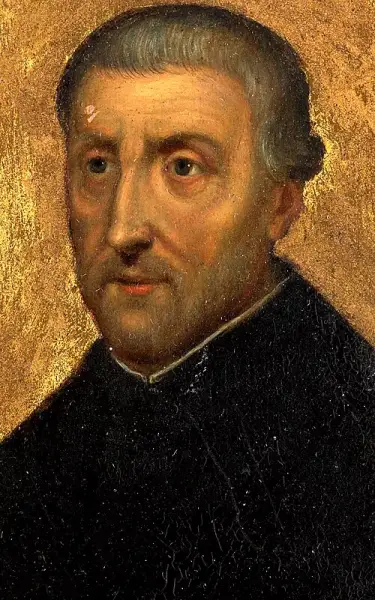
Overview
Born at Nijmegen in the Duchy of Guelders on 8 May 1521, Pieter Kanis was the son of a prosperous burgermeister and lost his mother while still an infant. Studying at Cologne, he earned a master's degree at nineteen and there met Peter Faber, one of Ignatius Loyola's first companions; through Faber he became in 1543 the first Dutchman admitted to the young Society of Jesus. Ordained in 1546, he gave his life to the defence of the Catholic faith across German-speaking Europe as the Reformation advanced. He attended sessions of the Council of Trent in 1547, supervised the founding of the first German-speaking Jesuit colleges, declined election as Bishop of Vienna in 1554 while administering that diocese for a year, and argued the Catholic case at the Colloquy of Worms in 1557. As preacher of Augsburg cathedral from 1559 to 1568 he spoke for the faith several times each week, and in 1562 he founded what grew into the University of Innsbruck. His catechisms, issued in Latin and in German, spread Catholic teaching through nearly every language of Europe. A stroke in 1591 left him partly paralysed, yet with a secretary's help he kept preaching and writing until his death at Fribourg on 21 December 1597. Pius XI canonized him in 1925 and named him a Doctor of the Church.
The Complete Life
Early Life
Pieter Kanis was born at Nijmegen in the Duchy of Guelders on 8 May 1521, the son of a prosperous burgermeister; his mother died while he was an infant, and his father's second household was not a pious one. He studied at Cologne, took a master's degree at nineteen, and came under the influence of the Carthusians and of the devotio moderna before meeting Peter Faber, one of Ignatius Loyola's first companions, who gave him the Spiritual Exercises. In 1543, through Faber, he became the first Dutchman admitted to the young Society of Jesus. He was ordained in 1546, and was sent almost at once into the German-speaking lands, where the Reformation had been advancing for a generation and where the Catholic response had so far been largely rhetorical. The Cologne of his student years was still the largest city north of the Alps and a cathedral of the old learning; it gave him his lifelong equipment — the fathers of the Church, especially Jerome and Cyril of Alexandria, whom he edited and preached all his life.
§ Introduction
Conversion and Vocation
Canisius's vocation was the restoration of Catholic Germany by education rather than polemic. He began as a theologian — at Trent in 1547, as the young Society's representative, and then in the public disputations of the period, where his manner was already noticeable: courteous, exact, and free of the abuse that disfigured confessional controversy. He declined election as Bishop of Vienna in 1554 while administering that diocese for a year, and argued the Catholic case at Worms in 1557, and then, as preacher of Augsburg cathedral from 1559 to 1568, preaching several times a week to congregations that included the imperial court. But his real instrument was the college: he supervised the founding of the first German-speaking Jesuit colleges, at Cologne, Vienna, Ingolstadt, and elsewhere, and founded at Innsbruck in 1562 what grew into a university. Ignatius, who kept a close eye on him, once refused his request to be sent to the foreign missions; the answer was that Germany was his mission, and the rest of Canisius's life was the working out of that judgment.
§ Life
Mission and Ministry
Canisius worked for four decades as the Catholic Church's chief public teacher in Germany, Bohemia, Austria, Switzerland, and his native Netherlands, as provincial of the German province and as the man Rome trusted with delicate missions. The work he is remembered for is the catechism. His Summa doctrinae christianae of 1555, the larger catechism for the learned, was followed the same year by a smaller one for children and in 1556 by a minimum for the simplest — three graded texts, issued in Latin and German, which went through hundreds of editions and were translated into most of the languages of Europe. They carry his signature method: plain questions, plain answers, scripture and fathers cited without invective, and the differences with the Protestants stated so that a reader could judge them. Their circulation gave German Catholicism a common vocabulary at the moment it needed one. He was also, throughout these years, the Society's organizer: provincial of Upper Germany from 1556, founder or refounder of colleges at Prague, Innsbruck, and Fribourg, and the author of the German province's stable shape. Contemporaries and successors credited him with keeping southern Germany and Austria Catholic where the north was lost.
§ Life
Spirituality and Teaching
Canisius's spirituality was Ignatian and practical: obedience, work without regard for health, and a devotion to the Sacred Heart that he expressed in language earlier than the better-known seventeenth-century revelations — he prayed habitually to the Heart of Jesus and is counted a precursor of that devotion. His letters, thousands of which survive, show a man carrying the anxieties of an entire church on his correspondence: colleges short of money, princes wavering, superiors in Rome slow to understand German conditions, and through it all an uncomplaining labor that his contemporaries already found remarkable. His own summary of his method was that it was better to instruct than to condemn, and he kept to it under provocation that would have justified harsher tones. The balance of his temperament — zeal without fanaticism — has made him, in every century since, the Counter-Reformation's most quotable moderate, and modern ecumenical writers have adopted him as evidence that the era's divisions were not necessarily conducted in bad faith.
§ Introduction
Trial and Final Years
In 1591 a stroke left him partly paralyzed. He continued to preach and to write with a secretary's help, and when Fribourg, in Switzerland, asked for his help in founding a college he went there in 1580 and stayed; the university of Fribourg regards him as its founder. He died at Fribourg on 21 December 1597, at seventy-six, with the words on his lips, in the accounts, of the psalm and of his desire to see Christ. By his own request he was buried in the church of the college he had built, among his students rather than among the great. The paralysis slowed but did not stop the publication program; his last years produced the editions of the fathers and the letters that kept the province together, and his death was quiet and expected. He had already, before the stroke, retired from the government of the province to Fribourg, choosing the smallest of his foundations for his old age, and the last six years were spent teaching, writing, and directing the college he had built there.
§ Introduction
Canonization
Pius IX beatified Canisius in 1864; Pius XI canonized him in 1925 and declared him a Doctor of the Church — the same year that gave the Church Therese of Lisieux — with his feast set on 21 December. He is the 'Second Apostle of Germany' after Boniface, a title that summarizes what his contemporaries and his successors agreed he had done, and his designation as a Doctor rests on the catechisms and on his place in the theological literature of the Counter-Reformation. The canonization of 1925, in the same ceremony as that of several other reformers, was Pius XI's statement about the kind of Catholic reconstruction he wished to honor, and the Doctorate put Canisius's catechetical writing on the Church's permanent shelf. The choice of 21 December, two days before Christmas, has always made his feast a quiet one, and his cult has accordingly never been spectacular; his influence was exerted through print and through institutions, and that is where it remains visible.
§ Introduction
Legacy
The catechisms were his monument for three centuries: Canisius's name became, in Catholic Europe, almost a synonym for the catechism itself, and his texts were the standard religious instruction of German-speaking lands until the twentieth. The colleges he founded and supervised became the backbone of Catholic higher education in central Europe, several of them universities still. His method — catechesis without invective, the differences with Protestantism stated fairly — has been held up since the ecumenical century began as a model worth recovering. In the Netherlands and Germany he is a national figure of the Counter-Reformation, and the Society of Jesus counts him, after Ignatius himself, as the most consequential of its first Germans. Fribourg's university, which he founded and where he died, keeps him as its patron, and a substantial modern critical edition of his works exists. His letters in particular, published in the twentieth century, changed the older picture of a mere catechist into that of an administrator of genius.
§ Introduction
Timeline
- 1521
Born at Nijmegen, son of the burgermeister Jacob Kanis
§ Introduction
- 1540
Master's degree at the University of Cologne at age nineteen
§ Life
- 1543
First Dutchman to join the Society of Jesus, through Peter Faber
§ Life
- 1546
Ordained to the priesthood
- 1547
Attends several sessions of the Council of Trent
§ Life
- 1554
Declines the see of Vienna but administers the diocese for a year
§ Life
- 1557
Leading Catholic theologian at the Colloquy of Worms
§ Life
- 1559
Becomes cathedral preacher of Augsburg, serving until 1568
§ Life
- 1562
Founds the college that became the University of Innsbruck
§ Life
- 1597
Dies at Fribourg on 21 December after six years of paralysis
§ Introduction
In Their Own Words
If you treat them right, the Germans will give you everything. Many err in matters of faith, but without arrogance. They err the German way, mostly honest, a bit simple-minded, but very open for everything Lutheran. An honest explanation of the faith would be much more effective than a polemical attack against reformers.
I wish to awaken in others and in myself a greater fervour so that the Catholic deposit of faith, which the Apostle entrusted to us for good reason and which is preferable to all the treasures of this world, may be preserved intact and authentic, since Christian wisdom, general peace and the holiness of man depend on it.
You know, O Lord, how intensely you entrusted Germany to me that day. Since then, Germany has increasingly occupied my thoughts, and I have ardently desired to offer my life and my death for the eternal salvation of Germany.
Christ, the Wisdom of God Himself, did not hold back and treated children with confidence.
The opinions and hesitations of some do not stop us from now believing in the bodily Assumption of Mary more resolutely, from affirming it more plainly and from professing it more openly-together with the Church than was done in the first centuries of Christianity.
The Record
- Major works
- Summa doctrinae christianae (1555)·Catechisms of 1555-1558, including the 'German Catechism'·De Maria Virgine Incomparabili et Dei Genitrice Sacrosancta (1577)
- Patron of
- Catholic press·Germany
- Symbols
- Jesuit cassock·Catechism book·Cardinal's or doctor's biretta
- Canonization
- Beatified 1864 by Pope Pius IX; canonized and declared Doctor of the Church on 21 May 1925 by Pope Pius XI
Prayer
Bibliography
Show 11 sources
- ↑ Pabel, Hilmar M. (April 2014). "Peter Canisius and the Protestants" . Journal of Jesuit Studies . 1 (3): 373– 399. doi : 10.1163/22141332-00103002 . S2CID 170005470 .
- 1 2 3 Braunsberger, Otto. "Blessed Peter Canisius" , The Catholic Encyclopedia , vol 11. New York: Robert Appleton Company, 1911.
- ↑ Rochford, SJ, Tom. "Peter Canisius", Jesuits Global
- 1 2 3 "Saint Peter Canisius" . Franciscan Media . 21 December 2015. Archived from the original on 11 August 2018 . Retrieved 20 August 2018 .
- ↑ "CATHOLIC ENCYCLOPEDIA: University of Innsbruck" . newadvent.org . Retrieved 28 June 2017 .
- ↑ The college was lost by the Jesuits at the time of their Suppression in 1773. First under the administration of the local diocese and then of the canton , the college, now known as St. Michael College, continues to exist as a coeducationa
- ↑ Law LLD, Thomas Graves. Catholic Tractes of the Sixteenth Century 1573-1600 (PDF) . William Blackwood and Sons . pp. lvi.
- ↑ Law LLD, Thomas Graves (1901). Catholic Tractes of the Sixteenth Century (1573-1600) (PDF) . William Blackwood and Sons. pp. xxvi.
- ↑ Ghezzi, Bert. "St. Peter Canisius, SJ (1521-1597)" , ignatianspirituality.com' accessed 27 June 2017.
- ↑ "CSM - l'Historique" (in French). Archived from the original on 9 September 2013 . Retrieved 7 August 2014 . {{ cite web }} : CS1 maint: bot: original URL status unknown ( link )
- ↑ Burg, Kontroverslexikon, Essen, 1903, p. 224
Profile text adapted from the Wikipedia article, licensed CC BY-SA 4.0.
Pray with this saint every day
Save St. Peter Canisius to your favorites, read the full profile, and get feast-day reminders in the Saints app.
Get the Saints AppFree on the App Store for iPhone and iPad