
c. 380 – c. 450·Feast July 30
St. Peter Chrysologus
Golden-worded Bishop of Ravenna, Doctor of Homilies
Overview
Peter Chrysologus (c. 380 – c. 450) was an Italian prelate who governed the church of Ravenna, capital of the Roman West, from about 433 until his death. His surname, given him by tradition after the empress Galla Placidia heard his first sermon, means "golden-worded", and he earned it by doing the opposite of what preachers usually do to impress: he kept his sermons astonishingly short, fearing to weary his hearers, yet filled them with theological substance. Some 176 of these homilies survive, gathered in the early eighth century by Archbishop Felix of Ravenna, and they remain a portrait of Christian life in fifth-century Ravenna. In them Peter expounded the Apostles' Creed and the mystery of the Incarnation, denounced Arianism and Monophysitism, preached on John the Baptist and the Virgin Mary, urged daily reception of the Eucharist, and pointed his hearers to the forgiveness offered in Christ. When the condemned archimandrite Eutyches appealed to him against the synod of Constantinople in 448, Peter refused his support and admonished him to obey both the synod and the Bishop of Rome. Venerated since antiquity, Benedict XIII raised him to the rank of Doctor of the Church in 1729, and he is honoured on 30 July.
The Complete Life
The Deacon of Imola
Peter came from Imola, a town in the province of Aemilia in northern Italy, around the year 380. The church of that city formed him entirely: the local bishop, Cornelius, baptized him, gave him his education, and called him to the diaconate, so that the whole of his Christian upbringing belonged to the clergy of his native place. His talents raised him to the office of archdeacon, and it was in that capacity that imperial attention found him — his advancement came through the influence of the emperor Valentinian III, whose court then governed the West from Ravenna. The bishop who baptized him would soon play a part in his elevation: when a delegation travelled from Ravenna to Rome, Cornelius went with it, bringing his own archdeacon Peter among those presented for the vacant episcopal throne. The young deacon of Imola thus stood before the pope as the representative of a city he had never served, recommended both by the power of an emperor and, as his biographers insisted, by a heavenly sign that had already marked him out for the capital of the Roman West.
§ Life
Chosen by a Vision
When the see of Ravenna fell vacant, the people of the city elected their own candidate, but Pope Sixtus III set that choice aside and appointed Peter instead, around the year 433. The traditional story, preserved in the Roman Breviary, tells how the pope had seen a vision in which the Apostle Peter appeared together with Apollinaris, first bishop of Ravenna, and showed him a young man who was to take the throne of that church. When the Ravennese embassy arrived, Cornelius of Imola among them, Sixtus recognized in Cornelius's archdeacon the very figure the vision had displayed, and consecrated him bishop. The appointment mattered far beyond the question of personnel, for Ravenna was then the capital of the western empire, and there are indications that the city had already enjoyed the rank of a metropolitan see. The new bishop thus took charge of the most politically important church in the West, in the shadow of the imperial court of Galla Placidia and her son Valentinian III, with the eyes of Italy fixed on the stranger whom the pope had preferred to the city's own choice.
§ Life
The Golden-Worded Preacher
The bishop of Ravenna made his name by refusing to make speeches. His homilies were famously brief — the record of his preaching says he dreaded wearing out his listeners' attention — yet such theological weight filled those short pieces that devout zeal won him admiration everywhere. After that first sermon as bishop, the empress Galla Placidia is said to have bestowed on him the surname Chrysologus, "golden-worded", the name by which history has kept him. His preaching embraced the whole catechetical and controversial task of a fifth-century bishop: he explained the texts of Scripture briefly and concisely, expounded the Apostles' Creed and the mystery of the Incarnation in plain language, condemned the heresies of Arianism and Monophysitism, and devoted series of sermons to John the Baptist and to the Mother of God. His surviving works attest the church's traditional faith in Mary's perpetual virginity, in the penitential value of Lent, in Christ's Eucharistic presence, and in the primacy of Peter and his successors. As a patron at court, Galla Placidia supported many of the bishop's projects, and their cooperation bound the church of Ravenna to the imperial household.
§ Life
The Daily Bread of the Altar
Beneath the brevity of Peter's sermons lay a spirituality of the altar and of mercy. He advocated the daily reception of the Eucharist, holding before the Christians of Ravenna a life nourished continually by the body of Christ rather than fed on feast days alone, and he urged his hearers to confide in the forgiveness that Christ offers to sinners — a preaching of confidence rather than terror, remarkable in an age of public penance. The Lenten season he taught as a penitential medicine of the soul, and his homilies returned often to the Incarnation as the central mystery in which every other doctrine is grounded. In the crises of his time this Eucharistic and Petrine faith had practical consequences: when Eutyches, condemned by the synod of Constantinople in 448 for Monophysitism, appealed to the bishop of Ravenna hoping for support, Peter refused. The letter he sent back, preserved in the Acts of the Council of Chalcedon, admonishes the archimandrite to accept the synod's ruling and to render obedience to the Bishop of Rome as successor of the Apostle Peter. In this he stood with Pope Leo the Great, another Doctor of the Church, whose confidence he fully shared.
§ Life
Death at Imola
Peter died about the year 450 while staying at Imola, the city where he had first seen light, going back in death to the community that had baptized and ordained him. The date of his death was long given as 2 December in older reference works, but fresh study of the ninth-century Liber Pontificalis Ecclesiae Ravennatis points instead to 31 July, and the modern Roman calendar has followed this testimony, keeping his feast on 30 July, the date closest to that anniversary that the calendar allows before the feast of Ignatius of Loyola claims the day itself. The Orthodox churches of the East likewise honour him, keeping his commemoration on 3 December. He had governed the capital church of the West for some seventeen years, through the last decades of the western empire, and died before the overthrow that would come within a generation. Of his last days the record preserves nothing dramatic: the golden-worded bishop, whose sermons were designed to end before his hearers grew tired, closed his life with the same unshowy restraint, in the small city on the Santerno where his story had begun.
§ Death and veneration
Doctor of the Church
Peter's sanctity was acknowledged from the earliest centuries without any formal process; Catholic, Eastern Orthodox, and Anglican traditions alike revere him as a saint. The decisive recognition of his teaching came much later: when Benedict XIII proclaimed him a Doctor of the Church in 1729, his feast — as yet absent from the Tridentine calendar — was inserted into the General Roman Calendar for 4 December. There it stood for 240 years, until the 1969 reform of the calendar moved his commemoration to 30 July, aligning it with the anniversary of his death. His titles gather up the double testimony of his life: Bishop, Confessor, and Doctor of the Church, and the distinctive appellation "Doctor of Homilies", earned by the compact, theologically dense reflections he preached from the throne of Ravenna. In the cathedral of Ravenna a painting by Giuseppe Milani shows him in the company of two other saints of the city's calendar, Romuald and Peter Damian, while a far older witness survives in mosaic: the contemporary portrait in the church of San Giovanni Evangelista, which places the living bishop among the imperial family of his day.
§ Death and veneration
The Homilies Preserved
The survival of Peter's preaching is itself a work of Ravennese devotion: early in the eighth century Archbishop Felix of Ravenna collected and preserved 176 of the homilies, and later editors and translators have carried them into numerous languages. Modern scholarship makes the corpus readily available in the Fathers of the Church series of the Catholic University of America Press, where three volumes of selected sermons — numbers 17, 109, and 110 — contain, despite the title, all the genuine sermons, and a 2020 Routledge volume translated a further selection by David Vincent Meconi Jr. Historians prize the collection for a reason Peter never intended: the sermons reveal, almost sermon by sermon, the texture of Christian life in fifth-century Ravenna, from the practice of the sacraments to the fears and hopes of an imperial capital. As a Doctor of the Church he stands in the line of the great Latin fathers, and his example remains pointed: the shortest sermons of antiquity proved among the most enduring, and the preacher who feared to weary his hearers has kept the attention of the church for fifteen centuries.
§ Works
Timeline
- 380
Born at Imola in the province of Aemilia around this year.
§ Introduction
- 433
Appointed Bishop of Ravenna by Pope Sixtus III, who consecrates him after recognising the young man shown in a vision of the Apostle Peter and Apollinaris.
§ Life
- 448
Rejects the appeal of Eutyches, condemned for Monophysitism by the synod of Constantinople, and urges submission to the Bishop of Rome.
§ Life
- 31 Jul 450
Dies at Imola, his birthplace, during a visit to the town, according to the ninth-century Liber Pontificalis Ecclesiae Ravennatis.
§ Death and veneration
- 1729
Proclaimed Doctor of the Church by Pope Benedict XIII; his feast is then inserted into the General Roman Calendar for 4 December.
§ Death and veneration
- 1969
His feast is moved to 30 July, the nearest free date to his death day, under the reformed Roman calendar.
§ Death and veneration
The Record
- Major works
- 176 surviving homilies, collected by Archbishop Felix of Ravenna in the early eighth century·Series of homilies on John the Baptist and on the Virgin Mary
- Patron of
- Preachers
- Symbols
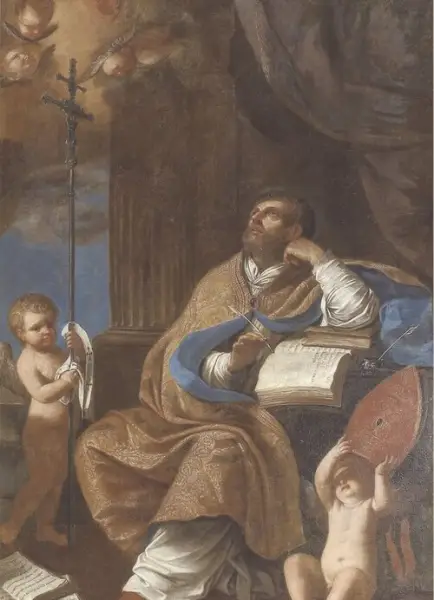
- Bishop's vestments and a Gospel book
- Canonization
- Pre-congregation; declared a Doctor of the Church by Pope Benedict XIII in 1729
Prayer
Bibliography
Show 7 sources
- Bardenhewer, Otto. Patrology, tr. Shanan, pp. 526 ff.
- Dapper. Der hl. Petrus von Ravenna Chrysologus. Posen, 1871.
- Looshorn. "Der hl. Petrus Chrysologus und seine Schriflen". Zeitschrift f. kathol. Theol., III, 1879, pp. 238 ff.
- Wayman. "Zu Petrus Chrysologus". Philologus, LV (1896), pp. 464 ff.
- San Pietro Crisologo, Sermoni. Two volumes. Città Nuova, Roma 1997.
- Walsh, Michael, ed. Butler's Lives of the Saints. New York: HarperCollins Publishers, 1991.
- Smith, Ignatius. "St. Peter Chrysologus". The Catholic Encyclopedia. Vol. 11. New York: Robert Appleton Company, 1911.
Profile text adapted from the Wikipedia article, licensed CC BY-SA 4.0.
Pray with this saint every day
Save St. Peter Chrysologus to your favorites, read the full profile, and get feast-day reminders in the Saints app.
Get the Saints AppFree on the App Store for iPhone and iPad