
1580-1654·Feast September 9
St. Peter Claver
Jesuit Priest, Missionary and Apostle to the Enslaved
Overview
Pedro Claver y Corberó was born on 26 June 1580 at Verdú in Catalonia, the son of a prosperous and devout farming family. Noticed at the University of Barcelona for intelligence as much as piety, he entered the Society of Jesus at Tarragona around the age of twenty and studied philosophy at Palma in Mallorca, where the holy porter Alphonsus Rodriguez kept insisting that God wanted him for the missions of the New World. He reached Cartagena de Indias in 1615 to assist Alonso de Sandoval, the Jesuit who had already spent decades serving Africans landed from the slave ships. Ordained after his theology years, spent largely at Tunja and Bogotá, Claver signed his solemn profession of 1622 with the Latin formula Petrus Claver, aethiopum semper servus — of the Africans, a servant in perpetuity. For four decades he boarded the arriving vessels, tending the sick, winning trust with fruit and water, teaching through translators and memory aids, and baptizing — the estimates run toward three hundred thousand, with some five thousand confessions heard each year. Off-season he walked plantation after plantation, sleeping in slave quarters, and preached in the squares of the city to sailors and traders; he also served the hospitals and prepared condemned criminals for death. Paralysed and neglected through his last four years, abused even by the ex-slave hired to nurse him, he died on 8 September 1654 and was buried by the city magistrates with public pomp.
The Complete Life
Early Life
Pedro Claver y Corberó was born on 26 June 1580 at Verdú in the Urgell region of Catalonia, some eighty-seven kilometers from Barcelona, into a farming family of the Urgell, prosperous and devoutly Catholic — seventy years after Ferdinand of Spain had given his authorization for the purchase of 250 African slaves at Lisbon, the act that set the colonial slave system in motion and would define Claver's life. While still reading at Barcelona University he was noted for intelligence and piety alike, and in the notebook he kept all his life he wrote, after two years of study, a sentence that reads like a prophecy: God's service must claim him until death, and on terms that made him, as it were, a slave.
§ Early life
Conversion and Vocation
Claver entered the Society of Jesus at Tarragona at twenty, and after the novitiate was sent to study philosophy at Palma in Mallorca. There he came to know the college's porter, St Alphonsus Rodriguez, a lay brother of recognized holiness, who was convinced — and said so repeatedly — that God had told him Claver was to spend his life serving in the colonies of the New World. Claver volunteered for the missions, and New Granada received him: he landed at Cartagena de Indias in 1615 to work under the Jesuit Alonso de Sandoval. His six years of theology before ordination, lived in the Jesuit houses of Tunja and Bogotá, coincided with a deepening horror at the treatment of the Africans being landed: he was watching the machine he would spend forty years serving. At his solemn profession in 1622 he signed the document in Latin with a formula he had chosen deliberately: Petrus Claver, aethiopum semper servus — of the Africans, servant in perpetuity.
§ Formation and Work in the New World
Mission and Ministry
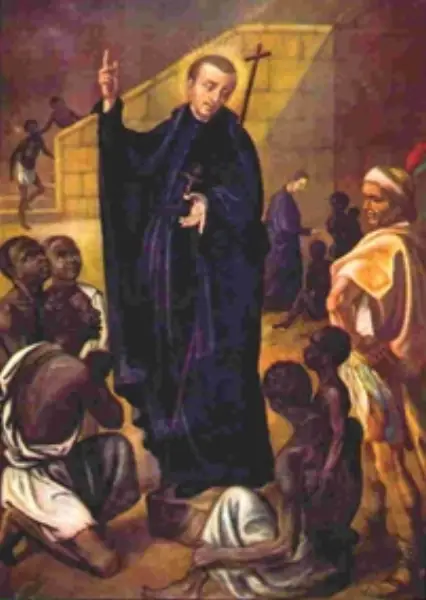
Cartagena was one of the great slave ports of the Americas, receiving on the order of ten thousand Africans a year; perhaps a third died in the crossing. Claver's method was built on his predecessor's. When a ship was sighted he mobilized his interpreters and went out to meet it, often among the first people the enslaved saw after landing, carrying fruit, citrus, water, and tobacco — the traditional Jesuit gifts for establishing trust with people who had every reason to trust no one. He nursed the sick and dying on board and ashore, sometimes for hours with a single dying man in order to baptize him. For instruction he used the interpreters to speak Spanish and the Africans' own languages at once, taught mnemonic gestures — the fingers of the hand for the sacraments — and handed out medals and stamps as rewards for remembering doctrine. He learned a language himself, called in the sources the 'language of Angola.' Over forty years the estimates run to some three hundred thousand baptisms and five thousand confessions a year. In the off-season, when the slavers did not come, he traveled the country plantation by plantation, sleeping in the slave quarters, and in the city he preached in the squares to sailors and traders, served the hospitals, and prepared condemned criminals for execution. He encouraged and accompanied Christian marriage among the enslaved. He also worked, as his mentor had, to suppress the Africans' own ritual practices — dances and observances he called superstitions — which modern readers see as the limit of his horizon even amid his extraordinary charity.
§ Formation and Work in the New World
Trial and Final Years
In 1650 Claver fell too ill to leave his room, and paralysis confined him for the last four years. The man who had been Cartagena's most conspicuous figure was neglected — abused, the sources record, even by the former slave hired to nurse him. He died on 8 September 1654. The city magistrates, who understood what they had lost even if the mission's superiors had half forgotten him in his seclusion, ordered him buried with public pomp.
§ Introduction
Canonization
Recognition came late and then completely. Pope Pius IX beatified him in Rome in 1850, and Pope Leo XIII canonized him on 15 January 1888, in the same ceremony as Alphonsus Rodriguez — the porter of Mallorca and the slave of the Africans raised to the altars together. In 1896 the same pope named him the patron of missionary work among Africa's peoples.
§ Introduction
Legacy
Peter Claver is invoked today as patron of slaves, of Colombia, of ministry to African Americans, and of seafarers. The the Congress of Colombia has made 9 September a national day of human rights for his sake, and he is held up as an early and heroic instance of Christian love and of respect for human rights — a reading that honors the practical defense of enslaved persons he carried out, while recognizing that he operated within, and never attacked, the slave system itself. Every later Catholic ministry to people of African descent — and the uncomfortable questions raised about the Church's complicity in the trade — argue their cases with Claver's life in hand.
§ Introduction
Timeline
- 26 Jun 1580
Born at Verdú, Crown of Aragon, into a devoutly Catholic farming family
§ Introduction
- 1615
Arrives at Cartagena in the New Kingdom of Granada to work under Alonso de Sandoval
§ Formation and Work in the New World
- 1622
Makes solemn profession, signing himself 'Peter Claver, servant of the Africans forever'
§ Formation and Work in the New World
- 8 Sep 1654
Dies at Cartagena; the city magistrates order a public funeral with pomp and ceremony
§ Illness, and death
- 20 Jul 1850
Beatified in Rome by Pope Pius IX
§ Introduction
- 15 Jan 1888
Canonized by Pope Leo XIII together with the humble porter Alphonsus Rodriguez
§ Legacy
- 1896
Leo XIII names him patron of mission work among the peoples of Africa
§ Legacy
In Their Own Words
I must dedicate myself to the service of God until death, on the understanding that I am like a slave.
The Record
- Patron of
- Slaves·Colombia·Race relations·Ministry to African Americans·Seafarers
- Symbols
- Final profession signed 'Petrus Claver, aethiopum semper servus' (servant of the Africans forever)
- Canonization
- Beatified by Pope Pius IX on 20 July 1850; canonized by Pope Leo XIII on 15 January 1888; declared patron of missionary work among African peoples by Leo XIII in 1896
Prayer
Bibliography
Show 12 sources
- 1 2 3 "St. Peter Claver, SJ (1581-1654)" . Ignatian Spirituality . LoyolaPress. Archived from the original on 13 August 2012 . Retrieved 22 August 2018 .
- ↑ "La virtud heroica del "esclavo de los esclavos" en Claver , de Oswaldo Díaz Díaz" . Más allá del héroe. Antología crítica de teatro histórico hispanoamericano . Editorial Universidad de Antioquía. 2008. p. 60. ISBN 978-958-714-172-6 .
- 1 2 3 4 "CATHOLIC ENCYCLOPEDIA: St. Peter Claver" . www.newadvent.org . Archived from the original on 27 October 2012 . Retrieved 22 August 2018 .
- 1 2 3 Sladxy, Joseph F.X. (8 September 2014). "St. Peter Claver: Slave of the Slaves Forever" . Crisis Magazine . Archived from the original on 23 April 2016 . Retrieved 10 February 2020 .
- ↑ Catholic News Agency (7 September 2017). "Who was St. Peter Claver, whose tomb the Pope will visit this week?" . Crux . Archived from the original on 5 February 2020 . Retrieved 10 February 2020 .
- 1 2 3 Morgan, Ronald J. (28 July 2017), "Jesuit confessors, African slaves and the practice of confession in seventeenth-century Cartagena" , Penitence in the Age of Reformations , Routledge, pp. 222– 239, ISBN 978-1-315-24720-5 , retrieved
- 1 2 3 "St. Peter Claver" . Knights of Peter Claver and Ladies Auxiliary . Archived from the original on 21 July 2011 . Retrieved 22 August 2018 .
- 1 2 "Saint Peter Claver" . Franciscan Media . 9 September 2016. Archived from the original on 22 January 2019.
- ↑ Olsen, Margaret M. (2004). Slavery and salvation in colonial Cartagena de Indias . Gainesville: University Press of Florida. ISBN 978-0-8130-2757-9 .
- 1 2 3 Landers, Jane (31 December 2013), "Chapter 7. The African Landscape of Seventeenth-Century Cartagena and Its Hinterlands" , The Black Urban Atlantic in the Age of the Slave Trade , University of Pennsylvania Press, pp. 147– 162, ISBN
- ↑ Brewer-García, Larissa (22 July 2020). Beyond Babel . Cambridge University Press. ISBN 978-1-108-63241-6 .
- 1 2 3 Block, Kristen (2012). Ordinary Lives in the Early Caribbean: Religion, Colonial Competition, and the Politics of Profit . University of Georgia Press. ISBN 978-0-8203-4375-4 .
Profile text adapted from the Wikipedia article, licensed CC BY-SA 4.0.
Pray with this saint every day
Save St. Peter Claver to your favorites, read the full profile, and get feast-day reminders in the Saints app.
Get the Saints AppFree on the App Store for iPhone and iPad