
1390 – 1456·Feast May 13
St. Peter de Regalado
Franciscan Reformer and Preacher of the Observance
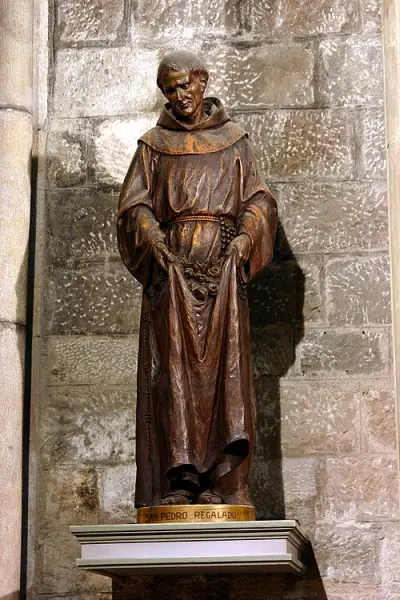
Overview
Peter Regalado y de la Constanilla, known in his lifetime as Peter of Valladolid, was a Spanish Friar Minor and priest who became one of the great reforming figures of the Franciscan Order in Spain. Born around 1390, the son of the noble Pedro Regalado and of Maria de la Costanilla, he lost his father in early childhood and was raised piously by his mother, in whose parish church he came to serve the daily offering. He begged his way into the Friars Minor as a boy and embraced the Observance reform of Pedro de Villacreces, which sought to restore the fervor and simplicity of Francis of Assisi. At the reform's headquarters friary of La Aguilera he found the life of solitude, prayer, and poverty he sought, and he rose to govern it: guardian in 1415, head of the Tribulos community after Villacreces died in 1422, and in 1442 leader of all the Spanish friars of the reform. He disciplined his body by fasting nearly the whole year from meat and dairy, and was beloved for charity to the poor. His death came at La Aguilera on 30 March 1456; pilgrims soon turned his grave into a shrine, his exhumed body proved incorrupt, and he joined the canonized saints in 1746.
The Complete Life
A Mother's Church
Peter Regalado was born at Valladolid about 1390, the child of a noble house: his father Pedro Regalado, his mother Maria de la Costanilla. The father's death in the boy's early youth left his formation to his mother, a woman of piety who prayed often at the nearby Franciscan church. It was there, assisting at the daily offering, that the child's vocation took shape — not through visions or crisis, but through the steady rhythm of the altar and the example of the friars who administered that church. At ten years old he begged to be admitted among the Friars Minor; the favor was granted three years later, when he reached the legal age of fourteen, and he entered the friary of his native town. The pattern of his whole life was already legible: a taste for strictness that outran his years, and a readiness to ask for what seemed impossible and to wait for it with patience.
§ Life
The Observance
In 1404 the young friar's community received a visitor who would decide his future. Pedro de Villacreces had begun in 1397 a movement to reform the Franciscan life in Spain, calling the Order back to the fervor and simplicity of its founder Francis of Assisi — the renewal that came to be known as the Observance. Regalado attached himself to Villacreces as one of the first disciples of the movement, and in the reform's new friary at La Aguilera, its headquarters, he discovered the existence he had been seeking: solitude, prayer, and poverty held in common under a severe discipline. He was ordained a priest in 1412 and in 1415, still a young man, was made guardian of the friary itself. The disciple had become a master without leaving the school; his authority in the reform rested on the fact that no one kept its rigor more faithfully than he did.
§ Life
Reformer of Spanish Franciscanism
When Villacreces died in 1422, the movement's leadership passed naturally to his first disciple. Regalado took charge not only of La Aguilera but of the community at Tribulos del Abroyo as well, and across the following decades he carried out many important reforms in the discipline of the Spanish friaries. He was a noted itinerant preacher, and the pulpit gave his reforming zeal its public voice; the friary gave it its institutional hand. In 1442 the extent of his influence was formally recognized when the leadership of every Spanish friar of the reform was placed in his hands, a jurisdiction that made him, in effect, the second founder of the Observance in Spain. What he demanded of others he practiced first: the fasting that kept him from meat and dairy almost the entire year, the poverty that his noble birth had made voluntary, and the charity to the poor for which he became known throughout the region. Reform, in his hands, was less a program than a contagion of example.
§ Life
Solitude, Prayer, and Fire
The spirituality of Peter de Regalado was formed at La Aguilera and never left it. The reform friary offered a life of solitude and prayer within the Franciscan poverty of the Observance, and he preserved that pattern even as his responsibilities multiplied — guardian, superior of Tribulos, head of the Spanish reform. His asceticism was constant and bodily: through almost the whole year he abstained from meat and dairy, a fast sustained across decades rather than seasons. Yet the tradition that remembered him did not dwell chiefly on severity. His charity to the poor was a mark of his holiness in his own lifetime, the counterweight of a discipline that might otherwise have seemed only hard. Artists have always shown him with flames pouring from his heart — an image of a prayer life that could not be contained, the outward sign Christians gave to a man whose interior fire, kindled at his mother's Franciscan altar and fed for a lifetime in the quiet of La Aguilera, was felt by everyone who came near him.
§ Life
Death and Incorruption
Regalado's death came at La Aguilera, the friary he had entered as a disciple and governed as its head, on 30 March 1456, in his sixty-sixth year. Pilgrims soon made a shrine of the reformer's grave, drawing the faithful of Castile to the spot where the holy man lay. Thirty-six years after his death, at the insistence of Queen Isabel I, his body was exhumed and was found incorrupt — a discovery that confirmed the devotion already gathering around his name and led to his remains being placed in a more precious tomb. The queen's interest tells its own story: the reformer of the Spanish friars had become a figure of national veneration within a single generation, honored by the crown whose century he had helped to sanctify. He had spent his last years as he had spent his first, in the strictness and silence of the Observance, and the preservation of his body was read as heaven's verdict on a life of ordinary fidelity extraordinarily kept.
§ Life
Beatified and Canonized
The cause of Peter de Regalado moved through the Roman machinery of the seventeenth and eighteenth centuries to a double culmination. Innocent XI raised him to the altars as blessed on 11 March 1684, in Saint Peter's Basilica; Benedict XIV brought the cause to its completion with canonization on 29 June 1746. Benedict XIV, the great canonist pope whose own reforms of the canonization process gave the modern procedure its shape, thus enrolled among the saints a Franciscan whose cause had rested on a fame of holiness two centuries old — the fasting, the preaching, the reforms, and the incorrupt body at La Aguilera. His feast took the date of 13 May, kept in memory of the day his body was translated, so that the calendar itself remembers the pilgrimage of his relics from the grave to the precious tomb. With his canonization the reformer whom Spain had already treated as a saint became a saint of the universal Church.
§ Life
Patron of Valladolid
After his canonization, Peter de Regalado was named patron saint both of his native city of Valladolid and of its diocese — the city whose Franciscan church had formed him as a serving boy returning to him, centuries on, as its father and protector. The Observance reform he inherited from Villacreces and carried across the Spanish friaries reshaped Franciscan life in the peninsula, and the friary of La Aguilera, the reform's headquarters, remained a center of the strict Observant life that his guardianship had consolidated. His grave continued to draw pilgrims; his feast on 13 May kept the memory of his translation alive in the universal calendar; and his emblem of the flaming heart passed into the iconography of Franciscan holiness. Among the reformers of the fifteenth century he belongs to the quiet sort: no writings left behind, no councils attended, only communities renewed in discipline and a reputation for charity that outlasted the men who had watched him live it.
§ Life
Timeline
- 1390
Born at Valladolid to the nobleman Pedro Regalado and Maria de la Costanilla
§ Life
- 1404
Admitted to the Friars Minor at the friary of his native town at the legal age of fourteen
§ Life
- 1404
Meets Pedro de Villacreces and becomes one of the first disciples of the Observance reform in Spain
§ Life
- 1412
Ordained to the priesthood
§ Life
- 1415
Named guardian of the reform friary at La Aguilera
§ Life
- 1422
Assumes leadership of the community at Tribulos del Abroyo upon the death of Pedro de Villacreces
§ Life
- 1442
Appointed leader of all the Spanish friars of the Observance reform
§ Life
- 30 Mar 1456
Dies at La Aguilera, aged about sixty-five
§ Life
- 1492
Body exhumed at the insistence of Queen Isabel I and found incorrupt; translated to a more precious tomb
§ Life
- 11 Mar 1684
Beatified by Pope Innocent XI in Saint Peter's Basilica
§ Life
- 29 Jun 1746
Canonized by Pope Benedict XIV in Saint Peter's Basilica
§ Life
The Record
- Major works
- Reform of the Spanish friaries of the Observance movement
- Patron of
- Valladolid·Archdiocese of Valladolid
- Symbols
- Flames bursting from his heart
- Canonization
- Beatified by Pope Innocent XI on 11 March 1684; canonized by Pope Benedict XIV on 29 June 1746
Prayer
Bibliography
Show 6 sources
- "Santos: San Pedro Regalado, O.F.M.", Arquidiócesis de Valladolid, retrieved February 8, 2026
- "Saint Peter Regalado", Franciscan Media, archived from the original on 2020-10-08, retrieved 2018-07-29
- Monks of Ramsgate. "Peter Regalatus". Book of Saints, 1921. CatholicSaints.Info, 19 October 2016
- Monti OFM, Dominic. "Saint Pedro Regalado: Devoted to Prayer and Contemplation", Franciscan Tradition, May 14, 2022
- Heckmann, Ferdinand. "St. Peter de Regalado." The Catholic Encyclopedia, Vol. 11. New York: Robert Appleton Company, 1911
- Herbermann, Charles, ed. (1913). "St. Peter de Regalado". Catholic Encyclopedia. New York: Robert Appleton Company
Profile text adapted from the Wikipedia article, licensed CC BY-SA 4.0.
Pray with this saint every day
Save St. Peter de Regalado to your favorites, read the full profile, and get feast-day reminders in the Saints app.
Get the Saints AppFree on the App Store for iPhone and iPad