
1506-1546·Feast August 2
St. Peter Faber
Jesuit Priest, Co-founder of the Society of Jesus
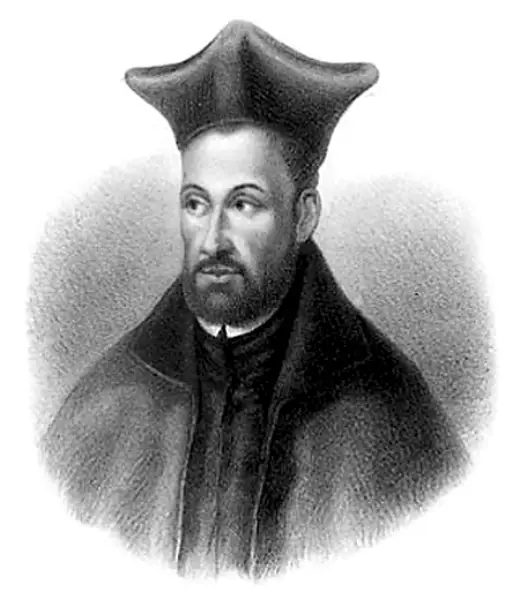
Overview
Peter Faber, born in 1506 to a peasant family at Villaret in the Duchy of Savoy, spent his boyhood as a shepherd in the Alps before making his way to Paris in 1525. At the Collège Sainte-Barbe he lodged with Francis Xavier, earned a master's degree in 1530, and fell under the influence of Ignatius of Loyola, tutoring him in Aristotle while receiving spiritual direction in return. Ordained on 30 May 1534, he was the first of the little band to become a priest and received the vows of Ignatius and his companions at Montmartre that August. When war blocked their planned pilgrimage to the Holy Land, the group placed itself at the Pope's service, becoming the Society of Jesus. Faber then laboured as a papal emissary across Europe: reviving piety in Parma and Piacenza, defending the Catholic position at the diets of Worms and Ratisbon, and working for reform of clergy and princes at Speyer, Mainz, Cologne, Leuven, Portugal and Spain, winning recruits such as Peter Canisius and Francis Borgia. Famous less for preaching than for friendship, conversation and the Spiritual Exercises, he walked everywhere, invoking the angels and saints of each region he entered. Summoned as a papal expert to the Council of Trent, he reached Rome exhausted and feverish, dying there on 1 August 1546, reportedly in Ignatius's arms.
The Complete Life
Early Life
Peter Faber was born on 13 April 1506 into a peasant family at Villaret, a village of the Duchy of Savoy — the place is today Saint-Jean-de-Sixt in Haute-Savoie, France. Boyhood passed as a shepherd in the high Alpine pastures, with little schooling but a remarkable memory: a sermon heard in the morning could be repeated verbatim in the afternoon to entertain his friends. Two of his uncles were Carthusian priors, a link to the contemplative tradition that stayed with him. He was entrusted first to a priest at Thônes and then to a school at La Roche-sur-Foron, and in 1525 went up to Paris, gaining admission to the Collège Sainte-Barbe — the university's oldest school — and lodging with Francis Xavier. The two became close friends and received the Master of Arts degree together on a single day in 1530. His spiritual outlook took shape from a blend of popular devotion, of Christian humanism, and of late medieval scholasticism.
§ Early life
Conversion and Vocation
It was in Paris that Faber came to know Ignatius of Loyola and joined the circle of his associates, in the exchange that fixed both lives: Faber tutored Loyola in the philosophy of Aristotle, and Loyola tutored Faber in spiritual matters. Faber's own account of what Ignatius gave him — an understanding of his conscience, of the temptations and scruples he had carried for years without seeing the way to peace — is the earliest testimony to what the Spiritual Exercises would become. Ordained priest on 30 May 1534, Faber was the first of the small circle to be ordained, and on 15 August it was he who received the religious vows of Ignatius and the five companions at Montmartre. When the planned pilgrimage to the Holy Land was blocked by war, the companions offered themselves to the Pope, and the Society of Jesus took on the shape history knows. After Loyola, it was Faber whom Xavier and the companions esteemed the most.
§ Jesuit preacher
Mission and Ministry
Faber's decade of priesthood was spent as a papal emissary across a dividing Europe. Sent to Parma and Piacenza, he worked a revival of Christian piety by preaching and teaching. Recalled to Rome in 1540, he was sent to Germany to defend the Catholic cause at the Diet of Worms and afterwards at the Diet of Ratisbon in 1541. The Catholic theologian Johann Cochlaeus noted his method there: Faber skipped theological debate and put the weight on personal reformation, and Cochlaeus called him 'a master of the life of the affections'. He was startled by the unrest the Protestant movement had stirred in Germany, and his response to it shaped his approach everywhere. After months at Leuven in 1543, where he planted numerous vocations among the city's young, he went back to Cologne; from 1544 to 1546 he worked in Portugal and Spain, preaching fervently and effectively, and at the royal court of Lisbon was instrumental in establishing the Society of Jesus in Portugal. All of it he did on foot, journeying unceasingly.
§ Jesuit preacher
Spirituality and Teaching
Faber is the first writer of the Ignatian tradition after Ignatius: his Memoriale, the spiritual diary he kept from 1542, records the applications of the Exercises to a working life — consolation and desolation noted daily, the discernment of spirits practiced on himself as he traveled. His combination of peasant realism, humanist learning and affective devotion made him the gentlest of the first Jesuits, the one whom Cochlaeus could hail as a master of affective life rather than of controversy. His conviction that reform of the Church travelled by way of reformed persons, clergy and princes first, set the tone of the early Society's German and Iberian work.
§ Jesuit preacher
Trial and Final Years
In 1546 Paul III appointed Faber a peritus — an expert acting for the Holy See — at the Council of Trent. He was forty, worn out by his incessant labors and journeys. He left Spain in April 1546 and reached Rome only on 17 July, weakened by fever, dying there on 1 August 1546, reportedly in the arms of Loyola. He was buried at the Church of Our Lady of the Way, the centre of the young Jesuit community in Rome.
§ Death
Canonization
Faber was beatified by Pius IX on 5 September 1872. Because the Society's three founders — Ignatius, Xavier and Faber — were expected to be canonized together and processes stalled, Faber remained Blessed for a century and a half while his companions were saints. On 17 December 2013, in the first months of his pontificate and on his own signature, Pope Francis canonized him by equipollent (equivalent) canonization, completing the trio. His feast is kept on 2 August (formerly 8 August or 5 September); his relics now rest at the Church of the Gesù in Rome.
§ Introduction
Legacy
Faber is the co-founder whom history nearly misplaced: the first priest of the Society, the receiver of the Montmartre vows, and the man Xavier's companions esteemed after Ignatius alone. His Memoriale has made him the patron of a certain kind of Jesuit spirituality — reflective, affective, ecumenical before the word existed — and his canonization by Francis in 2013 was read as a programmatic act, raising the gentle reformer in the year the Church was debating reform again. Retreat centres and chapels of several Jesuit universities bear his name.
§ External links
Timeline
- 13 Apr 1506
Born at Villaret in the Duchy of Savoy to a peasant household, spending his boyhood shepherding flocks in the Alps.
§ Early life
- 1525
Traveled to Paris to study, gaining admission to the College Sainte-Barbe, where he shared lodgings with Francis Xavier.
§ Early life
- 1530
Took his Master of Arts degree the same day as Xavier and fell in with Ignatius of Loyola, who guided him spiritually.
§ Early life
- 30 May 1534
Ordained a priest in Paris, the first of the early companions to reach priesthood.
§ Jesuit preacher
- 15 Aug 1534
Received the religious vows of Ignatius and five companions in a ceremony at Montmartre.
§ Jesuit preacher
- 15 Nov 1536
Left Paris with his companions, charged by Ignatius with leading them to Venice.
§ Jesuit preacher
- Jan 1537
Rejoined Loyola at Venice; blocked from the Holy Land by war, the group resolved to form the Society of Jesus.
§ Jesuit preacher
- 1540
Recalled to Rome, then dispatched to Germany to defend the Catholic position at the Diet of Worms.
§ Jesuit preacher
- 1541
Continued his German church mission at the Diet of Ratisbon, stressing personal reform over theological debate.
§ Jesuit preacher
- Jan 1542
Ordered by the pope back to Germany, beginning nineteen months of clerical reform work in Speyer, Mainz and Cologne.
§ Jesuit preacher
- 1543
Spent several months at Leuven, sowing numerous priestly vocations among the city's young men, before returning to Cologne.
§ Jesuit preacher
- 1544
Worked in Portugal and Spain, helping to found the Society of Jesus in Portugal through his influence at the Lisbon court.
§ Jesuit preacher
- Apr 1546
Appointed a papal expert for the Council of Trent and left Spain for Italy, exhausted by his constant journeys.
§ Death
- 17 Jul 1546
Reached Rome feverish and weakened after traveling from Spain to attend the council.
§ Death
- 1 Aug 1546
Died in Rome at age forty, by tradition in the arms of Ignatius of Loyola, and was buried at Our Lady of the Way.
§ Death
- 5 Sep 1872
Beatified in Rome by Pope Pius IX.
§ Veneration
- 17 Dec 2013
Canonized by Pope Francis through an equivalent canonization, announced on the pope's own seventy-seventh birthday.
§ Veneration
In Their Own Words
He gave me an understanding of my conscience and of the temptations and scruples I have had for so long without either understanding them or seeing the way by which I would be able to get peace.
To obtain for us not only virtues and salvation for our spirits but in particular whatever can strengthen, heal, and preserve the body and each of its parts.
The Record
- Major works
- Memoriale (spiritual diary)·The Blessed Sacrament
- Canonization
- Beatified 5 September 1872 by Pope Pius IX; canonized 17 December 2013 by Pope Francis by equipollent (equivalent) canonization
Bibliography
Show 12 sources
- 1 2 3 4 5 6 "Jesuit Saints and Martyrs, 2nd ed" . LoyolaPress.com. 1998. Archived from the original on 1 June 2016 . Retrieved 19 September 2013 .
- 1 2 3 " "Saint Peter Faber, SJ (1506–1546)", Ignatian Spirituality" . Ignatian Spirituality . Retrieved 19 September 2013 .
- 1 2 "The Spirituality of Peter Faber" (PDF) . 2005 . Retrieved 19 September 2013 .
- 1 2 3 4 5 6 7 8 9 Padberg, John W. (17 July 2006). "A Saint Too Little Known" . America .
- ↑ Michael Servetus Research Archived 11 October 2014 at the Wayback Machine Website that includes graphical documents in the University of Paris of: Ignatius of Loyola, Francis Xavier, Alfonso Salmerón, Nicholas Bobadilla, Peter Faber and S
- 1 2 Suau, Pierre (1911). "Bl. Peter Faber" . The Catholic Encyclopedia. Vol. 11 . New York: Robert Appleton Company: Newadvent.org . Retrieved 19 September 2013 .
- 1 2 3 "Blessed Peter Faber" . sacredspace.ie . Retrieved 19 September 2013 .
- ↑ "Blessed Peter Faber" . Ucanews.com. 2 August 2012 . Retrieved 19 September 2013 .
- ↑ Gavin, John. "Invisible Allies: Peter Faber's Apostolic Devotion to the Saints" (PDF) . New Jesuit Review, Vol.2, No.7 . Archived from the original (PDF) on 21 September 2013 . Retrieved 19 September 2013 .
- ↑ Favre, Pierre Manus online
- ↑ Allen Jr., John L. (17 December 2013). "It's official: Jesuit Fr. Peter Faber is a saint" . National Catholic Reporter . Archived from the original on 16 March 2016 . Retrieved 4 October 2014 .
- ↑ Tornielli, Andrea (24 November 2013). "French Jesuit priest Peter Faber to be made a saint in December" . Vatican Insider . Retrieved 17 December 2013 .
Profile text adapted from the Wikipedia article, licensed CC BY-SA 4.0.
Pray with this saint every day
Save St. Peter Faber to your favorites, read the full profile, and get feast-day reminders in the Saints app.
Get the Saints AppFree on the App Store for iPhone and iPad