
3rd century – 311·Feast November 25
St. Peter I of Alexandria
Seventeenth Patriarch of Alexandria and Hieromartyr
Overview
Peter I of Alexandria led the Church of Alexandria as its seventeenth pope and patriarch from 300 until his martyrdom in 311. Born and raised in Alexandria, he was entrusted by his parents to Patriarch Theonas to be brought up for the priesthood, much as Samuel was given to the Lord in the Old Testament. He rose through the holy orders as reader, deacon, and priest, and as a highly educated man he became head of the school of Alexandria. His eleven years as bishop coincided with the Diocletianic Persecution, which began in 303 and disturbed Egyptian Christian life for a decade. Forced from the city into exile, he encouraged his scattered people by letter before returning to guide the Alexandrian Church in person, secretly visiting prisoners, assisting widows and orphans, and holding clandestine services. He disputed with Meletius of Lycopolis over the treatment of Christians who had weakened under persecution, urging leniency where Meletius demanded rebaptism. Arrested under the emperor Maximinus Daia, Peter was condemned to beheading and, fearing a riot among the faithful who surrounded his prison, arranged his own removal to execution. He was martyred on 25 November 311, and Coptic tradition remembers him as the Seal of the Martyrs.
The Complete Life
A Child Given to the Church
Peter was born and raised in Alexandria, the great Mediterranean metropolis that was then the intellectual heart of the Roman East. The date of his birth falls somewhere in the third century, at a time when the Church in Egypt was expanding rapidly even though it lived under the constant threat of imperial action. Coptic tradition preserves a touching detail about his childhood: his parents, in an act reminiscent of Hannah dedicating the boy Samuel at the temple, handed their son over to Patriarch Theonas to be brought up for the service of the altar. The child thus grew up inside the household of the Church rather than merely beside it. He proved an apt pupil. Advancing through the graduated orders of the clergy, he served first as a reader, proclaiming the Scriptures to the congregation, then as a deacon, and finally as a priest. Alongside his formation for ministry he received a first-rate education, and his learning was such that he was placed at the head of the school of Alexandria, the catechetical institution that had trained generations of the city's Christian teachers. By the end of the third century he was among the most distinguished clerics of Egypt.
§ Life
Successor of Theonas
In early 300 the patriarch Theonas lay dying, and he used his final days to direct the choice of his successor. He advised the leaders of the Alexandrian Church to choose Peter, and they followed his counsel. Thus Peter became the seventeenth Pope and Patriarch of Alexandria, occupying the episcopal throne founded, according to tradition, by the evangelist Mark. The succession took place at a moment of deceptive calm: the era of decisive imperial persecution seemed to have passed, and the Alexandrian Church could devote itself to teaching, liturgy, and the care of its vast urban congregation. Peter's own preparation fitted him for the office in an unusual degree, combining pastoral experience in the lower clergy with the intellectual leadership of the city's catechetical school. The ecclesiastical chronologies list his episcopate as running from 300 to 311, and they record that his immediate predecessor was Theonas and that his successor would be Achillas. What no one at the time could foresee was that nearly the whole of Peter's eleven years in office would be overshadowed by the gravest crisis Egyptian Christianity had yet faced, a crisis that would test the patriarch's courage, his pastoral judgment, and finally his life.
§ Life
Shepherd in the Persecution
In 303 the emperor Diocletian launched the great persecution of Christians, and Egypt suffered under it intermittently for the following ten years. For the Church of Alexandria it was an ordeal without precedent: clergy were sought out, scriptures were demanded and burned, and ordinary believers were pressured to sacrifice to the gods. Accounts of Peter's conduct during these years vary among the sources, but the broad outline is clear. He was forced into exile from the city, and from hiding he traveled through many lands, sustaining his scattered flock by letters of encouragement. Then he returned to Alexandria to guide his church in person through the danger. His ministry became one of concealment and compassion. He made secret visits to the Christians imprisoned for their faith, assisted the widows and orphans whom the persecutions had multiplied, and celebrated clandestine services so that the community would not be deprived of the sacraments. This pattern of a bishop moving among his hunted people gave the Alexandrian persecution its distinctive character: the shepherd refused to save himself while his sheep were slaughtered. It was for this fidelity in office, exercised at daily risk of arrest, that Peter would ultimately be marked out for death.
§ Life
Mercy for the Lapsed
The persecution raised a pastoral question that divided the Church: what should be done with believers who had bowed to pagan sacrifice or given up the sacred books to spare their own lives? At some point Peter was imprisoned for a time alongside Meletius, bishop of Lycopolis, and the two fell into a sharp argument over the treatment of these lapsed believers. Peter urged leniency, holding that the weak who had stumbled should be received back with appropriate penance. Meletius refused any such accommodation: for him those who had fallen away had forfeited their baptism, and only baptism anew could restore them. The dispute grew so heated that Peter finally hung a curtain between himself and his fellow bishop rather than continue the quarrel. Among the followers of Meletius was a priest named Arius, whom some modern scholars identify with the later arch-heretic of the Arian controversy, though opinion differs on whether the two men were one and the same. The tenth-century historian Severus of Ashmumeen records that Arius tried in vain to obtain absolution from the patriarch before Peter's execution, and that the dying bishop denounced Arius as a heretic and cut him off from communion. The episode shows a pastor who tempered rigor with mercy toward the fallen, yet refused to compromise where doctrine was at stake.
§ Life
Martyrdom at the Prison Wall
Severus of Ashmumeen preserves the fullest account of Peter's death. During the persecution the patriarch was seized and thrown into prison, and when the emperor Maximinus Daia learned of it he ordered that Peter be beheaded. The sentence, however, could not easily be carried out: a great crowd of Christians gathered at the prison, willing to die in place of their patriarch, and the soldiers delayed, unwilling either to massacre the multitude or to provoke a riot. Peter himself resolved the impasse. Fearing for the lives of his people, he showed the soldiers a plan: a hole could be broken through a certain wall of the prison, and he could be smuggled out quietly to receive his sentence. When the moment came he took off his omophorion, bared his neck, and told the executioners to do as they had been commanded. Even then the soldiers hung back in dread, until six of them agreed among themselves to pool twenty-five denarii as a reward for whoever would strike the blow. One man came forward and beheaded the patriarch. The day was the twenty-ninth of Hatur in the Coptic calendar, corresponding to 25 November, and the year was 311.
§ Martyrdom
The Seal of the Martyrs
Peter was never formally canonized by a pope or council, for he died at a time when the Church recognized its martyrs by public veneration rather than by legal process. His cult arose immediately from the manner of his death: a bishop who had shepherded his people through a decade of persecution and then laid down his life rather than let his defenders be massacred belonged, in the eyes of the Alexandrian faithful, among the martyrs of Christ. Coptic tradition gave him the exalted title of Seal of the Martyrs, regarding him as the last and greatest of the vast company who died in the Diocletianic persecution, and he is honored as a hieromartyr, a priest-martyr, throughout the Coptic Orthodox Church. The same veneration spread to the wider Church: the Eastern Orthodox Church and the Catholic Church both reckon him among the saints, and his feast is kept in all three traditions. Medieval Byzantine devotion continued to elaborate his memory, as the scene of his execution under Maximinus Daia appears in the Menologion of Basil II, the illuminated manuscript prepared for the emperor around the year 1000.
§ Martyrdom
Memory and Feast
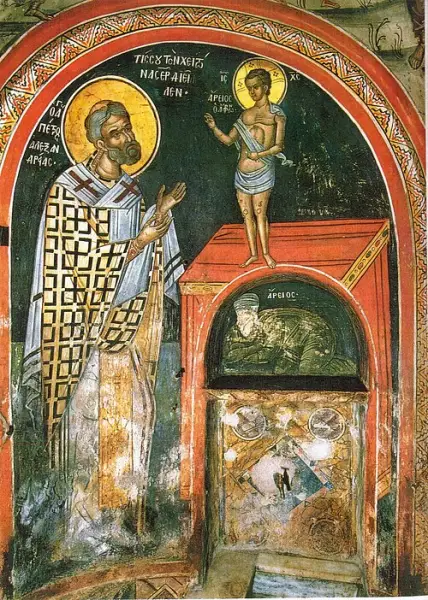
The memory of Peter I has been kept alive above all through his feast day. Christian tradition assigns a saint's feast to the day of death, and Peter's martyrdom on 29 Hatur fixed his celebration in the Coptic calendar on that date, a day that falls on 25 November by the Julian reckoning, and on 8 or 9 December in today's Gregorian calendar. The Coptic Church accordingly keeps his memory on 29 Hathor, while the other traditions that venerate him follow the November date. In sacred art he is recognizable by the attributes of his office: vested as a bishop and holding a Gospel Book, the emblems of a teaching shepherd who died for his flock. Byzantine illuminators placed his martyrdom before the eyes of the imperial court in the Menologion of Basil II, and a monastery fresco at Dionysiou on Mount Athos preserves a vision of the saint, evidence of the place he held in Orthodox devotion. In the lists of the patriarchs of Alexandria his name stands seventeenth, between Theonas and Achillas, and in the long line of Egyptian martyrs his title of Seal of the Martyrs has kept his memory distinct for sixteen centuries.
§ Feast day
Timeline
- 300
Chosen on the deathbed advice of Theonas as the seventeenth Pope and Patriarch of Alexandria.
§ Life
- 303
The Diocletianic Persecution begins, eventually forcing Peter into exile from Alexandria.
§ Life
- 311
Seized during the persecution and ordered beheaded by the emperor Maximinus Daia.
§ Martyrdom
- 25 Nov 311
Beheaded after arranging his own removal from prison, dying on 29 Hatur of the Coptic calendar.
§ Martyrdom
In Their Own Words
And he took off his omophorion, and bared his neck, which was pure before the Lord, and said to them: «Do as you have been commanded».
The Record
- Symbols
- Vested as a bishop·Gospel Book
- Canonization
- Pre-congregation; venerated as a martyr from antiquity by the Coptic Orthodox, Eastern Orthodox, and Catholic Churches
Prayer
Bibliography
Show 7 sources
- "البابا بطرس الأول خاتم الشهداء - البطريرك رقم 17 | St-Takla.org", st-takla.org, retrieved 2020-05-07
- Herbermann, Charles, ed. (1913). "St. Peter of Alexandria", Catholic Encyclopedia. New York: Robert Appleton Company.
- Dumitraşcu, Iulian. "Hieromartyr Clement, pope of Rome; Hieromartyr Peter, archbishop of Alexandria", Basilica.Ro., November 24, 2017
- Schaff, Philip. History of the Christian Church, Volume II: Ante-Nicene Christianity. A.D. 100-325.
- Rubenstein, Richard E. (1999). When Jesus Became God: The Struggle to Define Christianity during the Last Days of Rome. Harcourt.
- Severus of Al'Ashmunein (Hermopolis). "History of the Patriarchs of the Coptic church of Alexandria, Part 2, Chap. 6: Peter I, the seventeenth patriarch (300-311)", Patrologia Orientalis (1904), 1: 383–518.
- "Petros I (300–311)", Official web site of the Greek Orthodox Patriarchate of Alexandria and All Africa, retrieved 2011-02-08.
Profile text adapted from the Wikipedia article, licensed CC BY-SA 4.0.
Pray with this saint every day
Save St. Peter I of Alexandria to your favorites, read the full profile, and get feast-day reminders in the Saints app.
Get the Saints AppFree on the App Store for iPhone and iPad