
early 10th century – 970·Feast January 30
St. Peter I of Bulgaria
Tsar of Bulgaria and monk of humble end
Overview
Peter I ruled the Bulgarian Empire from 27 May 927 until his abdication in 969, one of the longest reigns in medieval Bulgarian history. The son of Tsar Simeon I by his second marriage, he was named heir after his father forced Peter's older brother Michael into a monastery. Peter opened his reign with a campaign into Byzantine Thrace, the final act of the war of 913–927, but quickly turned to diplomacy: in October 927 he signed a peace with Emperor Romanos I Lakapenos and married the emperor's granddaughter Maria, renamed Eirene. The treaty confirmed the Bulgarian ruler's imperial title, the autocephaly of the Bulgarian patriarchate, and an annual Byzantine tribute. His early years saw revolts by his brothers Ivan and Michael and the loss of Serbia to Časlav Klonimirović, yet the bulk of his reign brought internal peace and prosperity, generous endowment of the Church, and a determined struggle against the Bogomil heresy. In 968 the Rus prince Sviatoslav invaded Bulgaria at Byzantine instigation and seized dozens of fortresses; Peter steadied the crisis by inciting the Pechenegs to attack Kiev. A second Rus invasion in 969 broke him: after suffering a stroke he abdicated, took monastic vows, and died on 30 January 970. The Bulgarian Church enrolled him among its saints.
The Complete Life
A Prince of Simeon's House
Peter was born early in the tenth century, a son of Tsar Simeon I of Bulgaria, the warrior sovereign who had made his empire the rival of Byzantium. His mother was Maria Sursuvul, whom Simeon took in his second marriage, and her brother George Sursuvul proved a powerful figure at the beginning of Peter's reign. Peter grew up in a court that Simeon had raised to extraordinary brilliance, a capital at Preslav adorned with building and letters, where Bulgarian and Byzantine ambition met in nearly continuous contest. In 913 the boy may have traveled with his older brother Michael to the imperial palace at Constantinople, a visit that hints at the diplomacy and hostage exchanges that shaped relations between the two courts. Simeon's dynastic arrangements, however, cut across the natural order of succession: for reasons the sources do not specify, he compelled Michael to become a monk and designated Peter, a younger son, as his heir. The decision placed on Peter's shoulders the whole inheritance of his father's wars and ambitions, and it planted the seeds of the family resentments that would surface as rebellion in the first years of his rule.
§ Early reign
Accession and the Peace of 927
Peter came to the throne on 27 May 927, and to prove himself a worthy successor at home and abroad he at once took up arms, leading an offensive into Byzantine Thrace that closed the long war begun in 913. Yet his instinct was for settlement rather than spectacle. While his arms were still successful he opened secret negotiations, and the Byzantine government, headed by Emperor Romanos I Lakapenos, eagerly accepted peace before any retaliation could be organized. In October 927 Peter arrived near Constantinople, met Romanos, and signed the treaty; on 8 November he married the emperor's granddaughter Maria in the church of the Zoödochos Pege, the princess receiving the new name Eirene, meaning peace, to mark the dawn of a new era between the empires. The splendid Preslav Treasure is thought to preserve part of her dowry. The settlement was generous to Bulgaria: the frontiers were restored to the lines agreed in the treaties of 897 and 904, the Byzantines recognized the Bulgarian monarch's imperial title of basileus, the autocephalous status of the Bulgarian patriarchate was confirmed, and the annual tribute to Bulgaria was renewed. In effect Peter harvested the fruit of his father's victories and converted it into a durable peace.
§ Early reign
Rebellions and Northern Peoples
The early triumphs of the reign were soon shadowed by trouble within the royal family. Around 930 Peter's younger brother Ivan raised a revolt, was defeated, and was sent into exile in Byzantium. Soon afterward the elder brother Michael, whom Simeon had forced into monastic life, broke out of his monastery and raised a far more dangerous rebellion, one that closed only when he died young. Benjamin, the youngest, appears in Liutprand of Cremona's account as a werewolf and magician — the legendary Boyan — though he apparently never threatened Peter's authority. Enemies beyond the frontier took advantage of these distractions. In 933 the Serbian prince Časlav Klonimirović escaped from Preslav and, with tacit Byzantine support, raised a successful revolt; Serbia recovered its independence. Peter also confronted the incursions of the Magyars, whom his father had defeated in 896. Perhaps after an initial reverse he came to terms and turned the Hungarian clans into reluctant partners, allowing them to settle in Bulgarian territory north of the Danube and even to cross the land to raid Byzantine Thrace and Macedonia, perhaps in quiet retaliation for Constantinople's support of the Serbian rebellion. The arrangement bought short-term advantage at the cost of the region's eventual loss after his death.
§ Revolts and incursions
Piety, Wealth, and the Bogomils
The long middle years of Peter's reign were comparatively peaceful, and Bulgaria under him appears prosperous and increasingly well organized, an administration that impressed visitors and left its trace in the many imperial seals unearthed. Peter directed much of this wealth to the Church, endowing it lavishly year after year. His generosity reached a pitch that even Orthodox clerics found troubling: the writer Cosmas Presbyter judged it a corrupting influence on the monastic and clerical life of the country. Holy men drew the emperor's attention from the opposite direction — ascetics who fled the temptations of the secular world, above all Saint Ivan of Rila, still attracted the notice of the monarch, a sign of the reverence for holiness that marked his court. Beneath the prosperity, luxury and social tension may have nourished the spread of Bogomilism, the dualist heresy that denied the goodness of the material world. Peter took the threat seriously and worked to combat it, seeking counsel from celebrated hermits and even from his uncle-in-law, Patriarch Theophylact of Constantinople. The picture that emerges is of a believing ruler who saw the faith of his people as his first charge, and who treated the defense of orthodoxy as an affair of state.
§ Domestic rule
The Rus Invasion and a Monk's Death
Peter's fortunes declined with the death of his empress in the mid-960s. Emperor Nikephoros II Phokas, victorious over the Arabs, refused to pay the annual tribute in 966, complained of Bulgaria's alliance with the Magyars, and paraded his army at the frontier. Dissuaded from a direct attack, he sent word to Sviatoslav of Rus, inviting him to strike Bulgaria from the north. Sviatoslav came eagerly at the head of some sixty thousand men, routed the Bulgarian army on the Danube, and won a battle near Silistra, seizing some eighty fortresses in 968. Alarmed by the success of his own ally, Nikephoros hurried to make peace with Bulgaria and matched the two boy emperors, Basil II and Constantine VIII, with Bulgarian princesses, while two of Peter's sons traveled to Constantinople as negotiators and honorary hostages. Peter, meanwhile, engineered the Rus withdrawal by urging the Pechenegs, Bulgaria's old allies, to fall upon Kiev itself. The respite was brief. Sviatoslav invaded again in 969, the Bulgarians were defeated once more, and Peter suffered a stroke. He abdicated the throne and received the monastic habit, closing his life in penitence. He died on 30 January 970, leaving the crown to his son Boris II.
§ Conflict with Byzantium and Rus
Saint of the Bulgarian Church
The Bulgarian Orthodox Church canonized Peter, enrolling the emperor among its saints. The honor reflects the medieval judgment of his reign rather than a martyr's death: medieval opinion counted Peter among the good rulers, recalling a pious sovereign who enriched the Church, combated heresy, sought peace with Byzantium, and ended his days as a monk. Holiness of that kind — a crown laid down for the habit, an empire governed in the fear of God — carried real weight in the devotional memory of Orthodox Bulgaria. By his marriage to Maria Lakapene, renamed Eirene, Peter had several children, among them Plenimir, Boris II, who succeeded as emperor in 969, and Roman, who later regained the throne in 977. His canonization also served the dynastic memory of the Bulgarian state: a sainted tsar was a treasure of legitimacy for a people who would spend long centuries under foreign rule. Whatever the mixed record of his wars, the Church preserved the figure of the ruler who loved peace, honored the ascetics of Rila's wilderness, and died wearing not the purple of the basileus but the plain habit of a monk.
§ Reputation
Reputation and the Name of Peter
Set against the military brilliance of his father, Peter was traditionally judged a weak ruler — a sovereign who lost lands and prestige, let his army decay while invaders ravaged the country, and reduced Bulgaria to a Byzantine satellite governed through his empress and her retinue. Modern scholarship has overturned much of this portrait. Historians now emphasize the affluence and internal peace that Bulgarian society enjoyed across his long reign, re-examine his dealings with the semi-nomadic Magyars and Pechenegs, and question the alleged sinister role of Romanos' granddaughter and her household. Even the spread of Bogomilism in his day is now traced more to demographic origins, perhaps among Paulicians settled in Thrace by earlier Byzantine emperors, than to social collapse. The surest measure of his standing is the afterlife of his name. When Bulgaria fell under Byzantine rule in 1018, the leaders who rose to restore independence deliberately adopted the royal name of Peter to claim legitimacy and continuity with the great era of the first empire: Peter Delyan in the eleventh century, Constantine Bodin, and the rebel known as Theodore-Peter all took it in their bids for the throne. A saint on the calendars and a benchmark of kingship in the memory of his people, Peter I remains a defining figure of medieval Bulgaria.
§ Reputation
Timeline
- 913
Perhaps traveled with his brother Michael to the imperial palace at Constantinople.
§ Early reign
- 927
Opened his rule by leading an army into Byzantine Thrace, closing the war that had dragged on since 913.
§ Early reign
- Oct 927
Arrived near Constantinople, met Emperor Romanos I Lakapenos, and signed the peace treaty.
§ Early reign
- 8 Nov 927
Married Maria, renamed Eirene, in the church of the Zoödochos Pege at Constantinople.
§ Early reign
- 930
Crushed a rising of his younger brother Ivan, who after his defeat went into Byzantine exile.
§ Revolts and incursions
- 933
Časlav Klonimirović escaped Preslav and, with Byzantine backing, raised Serbia in revolt, recovering its independence.
§ Revolts and incursions
- 966
Emperor Nikephoros II Phokas refused the annual tribute to Bulgaria and staged a show of force at the border.
§ Conflict with Byzantium and Rus
- 968
Sviatoslav of Rus routed the Bulgarians near Silistra and seized some eighty fortresses; Peter incited the Pechenegs to attack Kiev, securing the Rus retreat.
§ Conflict with Byzantium and Rus
- 969
After a renewed Rus invasion and a stroke, Peter abdicated and became a monk.
§ Conflict with Byzantium and Rus
- 30 Jan 970
Died as a monk on 30 January 970.
§ Conflict with Byzantium and Rus
The Record
- Major works
- Lavish endowments to the Bulgarian Church throughout his reign
- Symbols
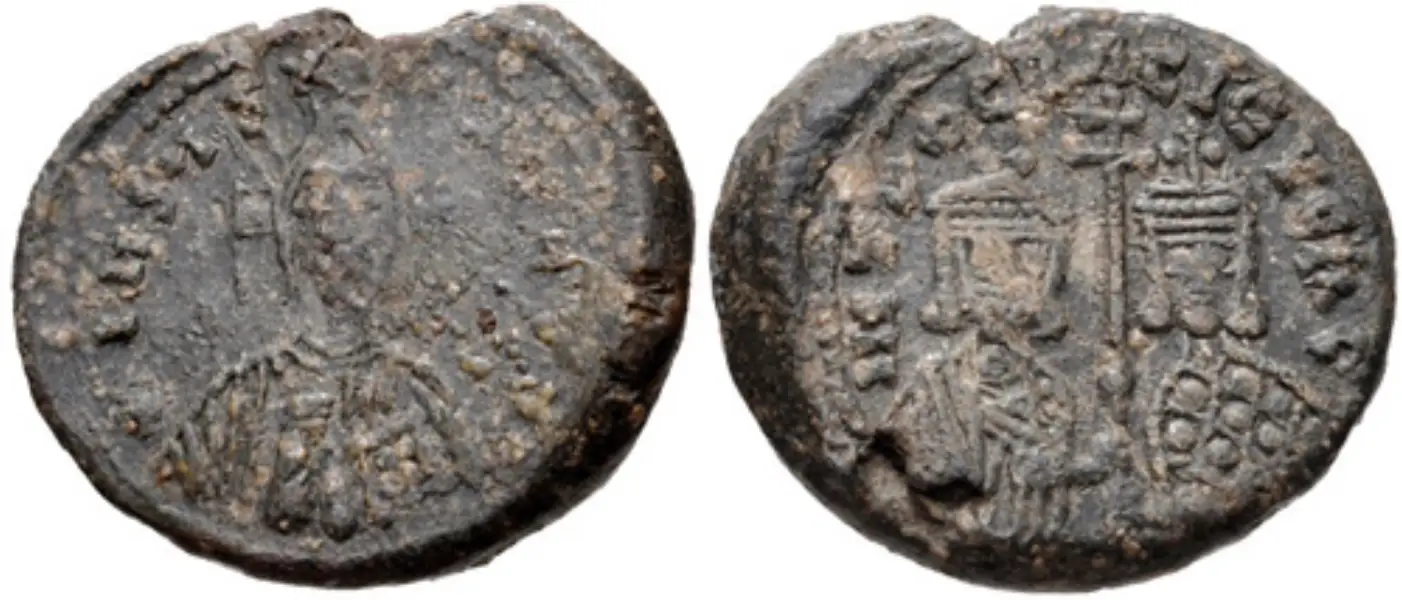
- Imperial seal bearing his image with Empress Irene Lekapene
- Canonization
- Canonized by the Bulgarian Orthodox Church
Prayer
Bibliography
Show 5 sources
- Fine, John V. A. Jr. (1991) [1983]. The Early Medieval Balkans: A Critical Survey from the Sixth to the Late Twelfth Century. Ann Arbor: University of Michigan Press. ISBN 0-472-08149-7.
- Andreev, Jordan; Lazarov, Ivan; Pavlov, Plamen (1999). Koj koj e v srednovekovna Bălgarija (in Bulgarian). Sofia.
- Leszka, Mirosław J.; Marinow, Kirił; Genova, Lyubomira; et al., eds. (5 February 2019). The Bulgarian State in 927-969: the epoch of Tsar Peter I (First ed.). Łodź, Poland. ISBN 978-8323345459. OCLC 1078891613.
- Wolski, Jan Mikołaj (5 February 2019). "The Portrayal of Peter in Modern Historiography", in The Bulgarian State in 927-969: the epoch of Tsar Peter I. ISBN 978-8323345459.
- Runciman, Steven. A History of the First Bulgarian Empire, p. 185.
Profile text adapted from the Wikipedia article, licensed CC BY-SA 4.0.
Pray with this saint every day
Save St. Peter I of Bulgaria to your favorites, read the full profile, and get feast-day reminders in the Saints app.
Get the Saints AppFree on the App Store for iPhone and iPad