
died 11 November 1089·Feast February 8
St. Peter Igneus
Fire-tried monk and cardinal of the Gregorian reform
Overview
Peter Igneus, born Pietro Igneo, was an Italian Benedictine monk of the Vallombrosian branch whose career spanned the great reform struggles of the eleventh-century Church. Born to a noble family of Florence and related to the saintly abbot John Gualbert, he entered the Order of Saint Benedict in 1018. His name was earned in one of the most famous ordeals of the age: when Bishop Pietro Mezzobarbo of Florence was accused of acquiring his see through simony, and the agitation between his prominent supporters and the Vallombrosian monks could be settled no other way, Peter underwent the judgment of God by walking through fire on 23 February 1068. He emerged unharmed, the bishop confessed, and Peter was called Igneo, fire-tried, ever afterward. He soon became abbot of San Salvatore in Fucecchio, serving until 1081, and founded the Abbey of Santa Maria in Montepiano in Tuscany. In 1072 Pope Alexander II created him cardinal and named him Cardinal-Bishop of Albano. Under Gregory VII he labored to repress simony and reform discipline, serving as papal legate in the German kingdom in 1079 and promulgating the emperor's renewed excommunication in France in 1084. He took part in the conclaves of 1086 and 1088 and co-consecrated Pope Victor III. He died on 11 November 1089 and was beatified in 1673.
The Complete Life
A Noble of Florence
Pietro Igneo was born in Florence into a noble family of the Tuscan margraviate, a city whose eleventh-century church life was turbulent with the quarrels that would soon convulse all of Latin Christendom. His family connections placed him at the center of the era's holiest circles: he was a relative of John Gualbert, the founder of the Vallombrosian congregation and one of the great Italian saints of the century, and the uncle of Bernardo degli Uberti, who would himself be raised to the altars. He had at least one sibling, though the sources preserve little of his family life. Tradition makes him an Aldobrandini, one of Florence's great houses, though no surviving document confirms the family link — a caution the historians of the Roman college of cardinals repeat explicitly. In 1018 he entered the Order of Saint Benedict as a monk, binding himself to the Benedictine tradition of liturgy, labor, and obedience. Within the reforming Vallombrosian branch of that order he found his life's two great themes: the pursuit of holiness in community and the uncompromising defense of the Church against corruption in high places.
§ Life
The Trial by Fire
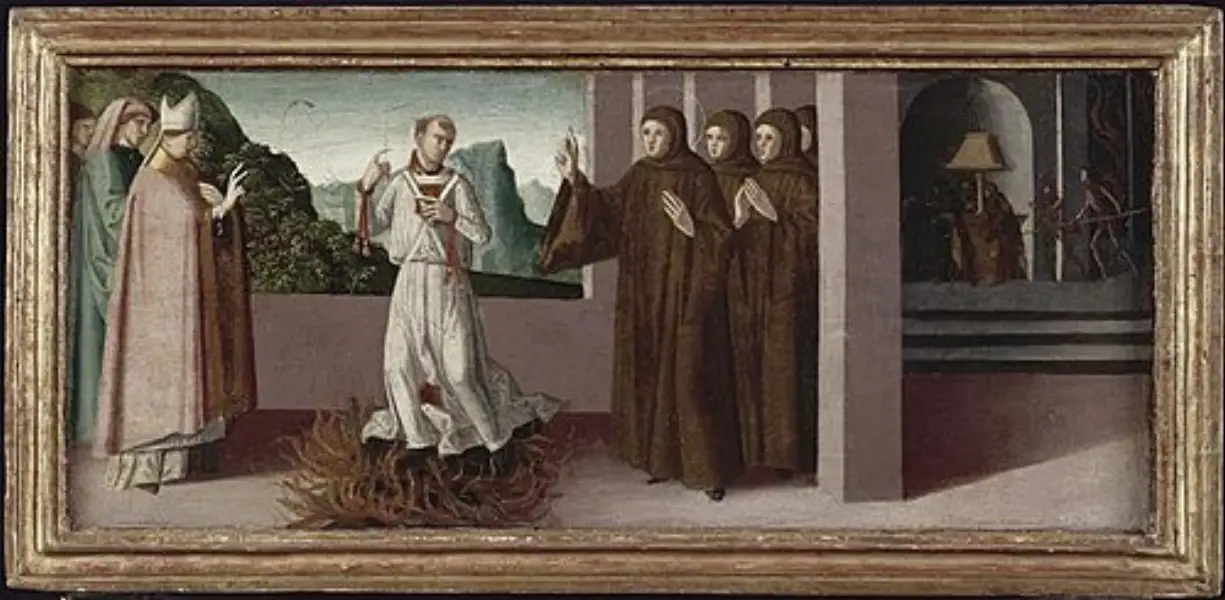
The crisis that made Peter's name began with an accusation. Bishop Pietro Mezzobarbo of Florence was charged with having acquired his episcopal dignity through simony — the purchase of sacred office — and he denied the charge utterly, enjoying the support of numerous and prominent partisans. The dispute convulsed Florence with intense agitation, and the Vallombrosian monks stood as the bishop's chief accusers, at considerable risk to themselves. As popular insistence on proof grew, the parties resorted to the judgment of God: a trial through fire, in which the accuser's cause would be tested by his survival of the flames. Abbot John Gualbert, Peter's kinsman, designated Peter to undergo the ordeal. On 23 February 1068 Peter passed through the fire and succeeded, emerging from the ordeal vindicated. The effect was decisive: the monks' victory forced the bishop at last to admit his guilt. From that day Peter bore the name by which history knows him — Igneo, the fire-tried — and the episode entered the legend of the Gregorian reform as a symbol of the monk's courage before a compromised hierarchy. Painters would later return to the scene, as Marco Palmezzano did in his image of Peter passing over the fire.
§ Life
Abbot, Cardinal, Legate
The fire ordeal made Peter a figure of the reforming party, and his subsequent career unfolded accordingly. He soon became abbot of San Salvatore in Fucecchio, holding that position until 1081, and in Tuscany he founded the Abbey of Santa Maria in Montepiano, adding a house of prayer to the Vallombrosian landscape. In 1072 his service to the Church was honored at the highest level: raised to the college of cardinals, he received from Pope Alexander II the suburbicarian see of Albano, one of the senior bishoprics of the Roman church. In October of that year he stood among the clergy at the dedication of Santi Donato e Nicola in Albano, and on 7 February 1077 he consecrated with his own hands the church of San Miniatis in Rubbicana. Under Alexander's successor Gregory VII, the great pope of the reform, Peter cooperated in the repression of simony and the reform of church discipline throughout Italy. In 1079 Gregory entrusted him with delicate diplomacy: together with the Bishop of Padua he served as papal legate in the German kingdom, attempting to mediate between Emperor Henry IV and his rival Rudolf of Swabia in the opening crisis of the investiture controversy.
§ Life
The Monk in the Curia
Peter's life joined two callings that might seem opposed: the cloistered stability of a Benedictine monk and the itinerant warfare of a Gregorian cardinal. His spirit remained that of Vallombrosa. He carried into the Roman curia the same plain conviction that had sent him through the fire — that the sanctity of the Church's ministry could not be compromised, and that a bishop who bought his office defraued both God and the souls entrusted to him. This conviction made him a natural instrument of Gregory VII, and in 1084, when the pope renewed the excommunication of Emperor Henry IV at Salerno, Peter was designated, at Gregory's behest, as one of two legates sent into France to promulgate the sentence — a mission that required courage among clergy and nobles sympathetic to the emperor. Yet the records show a man of ordinary fidelity rather than self-advertisement: consecrating country churches, founding abbeys, appearing in the curia when needed, and returning to his Benedictine identity in the habits in which artists would depict him. When a new pope had to be chosen, the cardinals found him at his post; he took part in the conclaves of 1086 and 1088, and in 1087 served as co-consecrator at the episcopal consecration of Pope Victor III.
§ Life
Last Years at Albano
The final years of Peter's life coincided with the hard-won settlement of the papacy after the crisis of Gregory VII's death. He was still active in the Roman curia in the last months of 1089: his name appears in a papal bull of Pope Urban II dated 8 July 1089, and the curia's records show him for the final time that September. He did not long survive. He died on 11 November 1089 at Albano, the suburbicarian see he had held as cardinal-bishop for seventeen years, his term ending with his death. His successor in the see of Albano was Nicholas Breakspear, the only Englishman ever to become pope, who took up the title decades before his own election as Adrian IV. Peter's death closed a life that had stretched, if the monastic date of 1018 is credited, across seven decades of religious profession and nearly the whole arc of the eleventh-century reform — from the simony disputes of Florence to the excommunications of emperors. He was buried in the Church he had served as monk, abbot, founder, diplomat, and prince-bishop, and the memory of the fire of 1068 remained the emblem of everything he stood for.
§ Life
Blessed Peter Igneus
Peter was never canonized in the modern formal sense; his cult arose from the veneration his holiness attracted and was later confirmed by the Holy See. His beatification was confirmed on 4 March 1673 by Pope Clement X in a ceremony at Saint Peter's Basilica in the Papal States, placing the fire-tried monk formally among the blessed of the Roman Catholic Church. The title by which he is honored, Blessed Peter Igneus, preserves both his given identity and the ordeal that defined him. He is venerated with a feast on 8 February, and in sacred art he is represented by the two signs of his double vocation: the Benedictine habit of the Vallombrosian monk and the attire of a cardinal of the Roman Church. The delay of nearly six centuries between his death and the formal confirmation of his cult was no obstacle to his fame; the Catholic Encyclopedia treated him as a settled figure of sanctity when it published his life in 1911, drawing on the scholarship of the Bollandist tradition. For the Vallombrosian congregation he remains one of the ornaments of their first heroic age, the companion of John Gualbert who proved the reform's cause in the flames of Florence.
§ Life
Fire-Tested Reform
The legacy of Peter Igneus belongs to the history of the eleventh-century reform, the movement that freed the Church from lay control and simony at the price of decades of conflict. The trial by fire of 1068 was one of the last great judicial ordeals of the Italian Church, and one of the most consequential: the confession it forced from Bishop Mezzobarbo vindicated the Vallombrosian monks' campaign in Florence and demonstrated that the reforming party could win popular confrontations against entrenched hierarchy. Peter himself carried the reform forward by every institutional means of his age — as founding abbot of Santa Maria in Montepiano, as cardinal-bishop of Albano, as Gregory VII's legate to the German kingdom in 1079 and to France in 1084, and as a participant in the conclaves that elected popes through the darkest years of the investiture controversy. Historians of the early college of cardinals, from Klewitz to Hüls, reckon him among the documented members of that body, and Salvador Miranda's biographical dictionary preserves the careful note that his Aldobrandini lineage is traditional rather than proven. In art his ordeal never lost its hold on the imagination: Marco Palmezzano's painting of Peter over the fire kept the scene before later centuries as an image of conviction tested and confirmed.
§ Life
Timeline
- 1018
Entered the Order of Saint Benedict as a monk.
§ Life
- 23 Feb 1068
Underwent the trial by fire to prove the simony charges against Bishop Pietro Mezzobarbo, succeeded, and received the name Igneo.
§ Life
- 1072
Designated a cardinal, with Pope Alexander II naming him Cardinal-Bishop of Albano.
§ Life
- Oct 1072
Was present at the dedication of the Albano church of Santi Donato e Nicola.
§ Life
- 7 Feb 1077
Consecrated the church of San Miniatis in Rubbicana.
§ Life
- 1079
Served as papal legate in the German kingdom, mediating with the Bishop of Padua between Emperor Henry IV and Rudolf of Swabia.
§ Life
- 1081
Ended his tenure as abbot of San Salvatore in Fucecchio.
§ Life
- 1084
Sent as one of two legates to France to promulgate the renewal of Emperor Henry IV's excommunication decreed at Salerno.
§ Life
- 1086
Participated in the papal conclave of 1086.
§ Life
- 1087
Served as co-consecrator at the episcopal consecration of the new Pope Victor III.
§ Life
- 1088
Participated in the papal conclave of 1088.
§ Life
- 11 Nov 1089
Died at Albano on 11 November 1089, after his last appearance in the papal curia that September.
§ Life
The Record
- Major works
- Abbey of Santa Maria in Montepiano, Tuscany
- Symbols
- Benedictine habit·Cardinal's attire
- Canonization
- Beatified by Pope Clement X on 4 March 1673 at Saint Peter's Basilica; venerated as Blessed
Prayer
Bibliography
Show 7 sources
- "Blessed Peter Igneus", Santi e Beati, retrieved 25 September 2017.
- Miranda, Salvador. "ALDOBRANDINI, O.S.B.Vall., Pietro Igneo (?-1089)", The Cardinals of the Holy Roman Church, Florida International University. OCLC 53276621, retrieved December 29, 2019.
- "Blessed Peter Igneus", Saints SQPN, 10 December 2012, retrieved 25 September 2017.
- Weber, Nicholas. "Blessed Peter Igneus", The Catholic Encyclopedia, Vol. 11. New York: Robert Appleton Company, 1911.
- Monks of Ramsgate. "Peter Igneus", Book of Saints, A. & C. Black Ltd., 1921.
- Klewitz, H.W. Reformpapsttum und Kardinalkolleg, Darmstadt 1957, p. 116 no. 9.
- Hüls, R. Kardinäle, Klerus und Kirchen Roms: 1049-1130, Tübingen 1977, pp. 90-91.
Profile text adapted from the Wikipedia article, licensed CC BY-SA 4.0.
Pray with this saint every day
Save St. Peter Igneus to your favorites, read the full profile, and get feast-day reminders in the Saints app.
Get the Saints AppFree on the App Store for iPhone and iPad