
1811 – 1868·Feast August 2
St. Peter Julian Eymard
Apostle of the Eucharist and founder
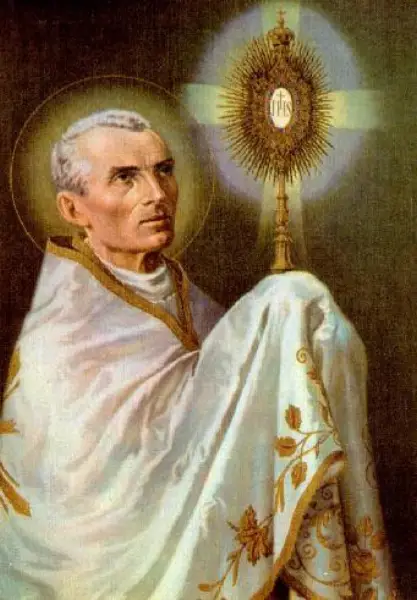
Overview
Peter Julian Eymard was a French Catholic priest who devoted his life to the Eucharist and brought two religious families into being, one for men and one for women, both vowed to the Blessed Sacrament. Born on 4 February 1811 at La Mure in the French Alps, the son of a blacksmith, he carried a lifelong devotion to Mary and overcome family opposition, illness, and repeated setbacks to be ordained a priest for the Diocese of Grenoble in 1834. Restless in parish work, he joined the Society of Mary in 1837, rose to provincial at Lyon, and encountered the practice of sustained eucharistic worship in Paris in 1849. Convinced that adoration of the Blessed Sacrament was the gift the modern age needed, he left the Marists and in 1856 obtained the Paris bishops' consent for a Society of the Blessed Sacrament, establishing public exposition in a run-down building on the rue d'Enfer in January 1857. His congregation prepared poor children for First Communion and welcomed back non-practicing Catholics, and he championed frequent Holy Communion. With Marguerite Guillot he founded the contemplative Servants of the Blessed Sacrament in 1858. Weakened by lifelong poor health, he died of a brain haemorrhage at La Mure on 1 August 1868. Canonized in 1962, he is honored as the Apostle of the Eucharist.
The Complete Life
The Blacksmith's Son of La Mure
Peter Julian Eymard was born on 4 February 1811 at La Mure, a town of the Isère in the French Alps. His father was a blacksmith, a man of toil whose second wife was Julian's mother, and the boy grew up in a household of modest means in the years just after Napoleon's fall. From childhood his life gathered around two devotions that would never leave him: a deep attachment to Mary, the Mother of God, and a growing love of the Eucharist. Before his First Communion on 16 March 1823, the boy set out afoot for the shrine of Notre-Dame du Laus before the great day, an early sign of the intensity beneath his quiet exterior. All his life he kept the habit of traveling to the Marian shrines of France, and he took joy in learning of the apparition of Notre-Dame de La Salette, reported in the mountains not far from his home. His path to the priesthood was thorny. His father opposed the vocation, and his first attempt at the novitiate of the Oblates of Mary Immaculate, which he entered in June 1829 after his mother's death, was cut short by serious illness. He suffered all his life from weak lungs and migraine headaches, ailments that shaped and limited everything he later attempted.
§ Life
Priest of Grenoble, Religious of Mary
After his father's death in 1831, and with the help of his former superior, Eymard won a place in Grenoble's grand seminary and reached priesthood on 20 July 1834. His early ministry was a series of country parishes: assistant pastor at Chatte, then pastor of Mount Saint-Eynard, and an assignment at Monteynard, where a dilapidated church, a poor rectory, and a farming community that seldom attended Mass awaited him. His two sisters, who had dedicated their lives to serving him, moved into the rectory and furnished it with their own hands, so destitute was the parish. Eymard revived the place, yet he remained dissatisfied with parish work, sensing another call. Over the grief of his sisters he left to join the Marists, entering the Society of Mary seminary at Lyon on 20 August 1837 and making his profession in February 1840. The Marists gave him his wider stage. He gave himself to lay groups that fostered love of Mary and of the Eucharist, above all through the Forty Hours devotion, and in 1844 he rose to Provincial of the Society at Lyon, with responsibility for the Third Order of Mary, a lay group devoted to Marist spirituality and the Christian family, whose members included the holy curé John Vianney.
§ Life
The Slow Kindling of a Eucharistic Call
Eymard's Eucharistic calling matured slowly rather than in one blinding moment, shaped over years of ministry, reading, and prayer. A journey to Paris in 1849 changed everything. His visitation duties brought him to the Basilica of Our Lady of Victories, where the Association of Nocturnal Adorers kept the Blessed Sacrament exposed in worship that never ceased. There he saw what would become his life's work made concrete: continuous worship before the tabernacle. On 21 January 1851 he knelt in prayer at Lyon's shrine of Fourvière and came away determined to found a Marist house of adoration. The idea met refusal: his superiors could not see such a fraternity as part of the Marist charism; far from yielding, they transferred him to the Marist College at La Seyne-sur-Mer to discourage the project. Eymard came to understand that the call was his own, not the Society's, and with the diocesan priest Raymond de Cuers he resolved to leave the Society of Mary altogether and found a new religious congregation wholly given to the Blessed Sacrament. It was a costly obedience in reverse: abandoning a secure position, against the wishes of his superiors, for an idea the authorities had rejected.
§ Life
The Society of the Blessed Sacrament
Consent arrived on 13 May 1856, when the bishops of Paris approved his scheme for a Society of the Blessed Sacrament. After many trials he and de Cuers opened public exposition on 6 January 1857, in a dilapidated house at 114 rue d'Enfer — the address means, literally, street of hell, ground the founder found fitting for the Sacrament of love. From that precarious beginning the work grew. The Congregation of the Blessed Sacrament took up the religious instruction of poor children of Paris, preparing them for their First Communion, and reached out to non-practicing Catholics, inviting them to repent and return to the table of the Lord. Eymard drew up a shared rule for the members and pressed steadily toward papal approval, which came when Pius IX granted a Decree of Approbation in June 1863. New houses followed: a second community at Marseille in 1859 and a third at Angers in 1862. The founder preached a message ahead of its time — frequent, even daily Holy Communion for ordinary faithful, an idea that would receive authoritative backing from Pius X in 1905. In 1862 the congregation also received, briefly and unexpectedly, a lay brother of genius: Auguste Rodin, grieving his sister's death, whom Eymard counseled to return to his sculpting rather than bury the gift God had given him.
§ Congregation of the Blessed Sacrament
Servants of the Sacrament and a Wearied Heart
In 1858, side by side with Marguerite Guillot, he brought the Servants of the Blessed Sacrament into being, a contemplative institute for women that completed the twofold family he had envisioned: adorers active in the world and adorers hidden in the cloister. To souls seeking holiness he offered counsel of striking simplicity, summed up in his reminder that Communion is received in order to become holy, not because one is holy already. His circle of friends reads like a roll call of the French Catholic revival: John Marie Vianney, Peter Chanel, Marcellin Champagnat, Basil Moreau, and Pauline-Marie Jaricot. His own body, never robust, bore the cost of the foundation. He had struggled since youth with weak lungs and migraines, and the burdens of leadership wore him down. He died at La Mure on 1 August 1868, of complications from a brain haemorrhage, at fifty-seven years of age, in the town of his birth. For nine years he rested in La Mure's cemetery; in 1877 the Congregation moved his body to its Corpus Christi Chapel in Paris, consecrated the previous September, where it rests today. The priest who had opened a house on the street of hell ended his days in the obscurity he had never sought, leaving a work whose future he could only trust to God.
§ Contemporaries
From Venerable to the Altars
The Church's judgment on Eymard came with remarkable speed by the measures of the age. He was declared venerable in 1908, forty years after his death, and the cause advanced through the following decades: the process of beatification and canonization was formally registered in the 1953 index of causes, and he was beatified by Pope Pius XI on 12 July 1925. The canonization cause was opened on 28 July 1926, and on 9 December 1962 Pope John XXIII canonized him during the opening period of the Second Vatican Council, together with the Servite priest Anthony Mary Pucci and the Capuchin lay brother Francis Mary of Camporosso. The feast of Saint Peter Julian Eymard is kept in the Roman Catholic Church on 2 August. Pope John Paul II gave him the title by which he is best known, naming him the Apostle of the Eucharist. His major shrine is the Roman church of Santi Claudio e Andrea dei Borgognoni, and his relics are venerated widely: a reliquary in Saint Jean Baptiste Catholic Church in New York City holds his right humerus bone beneath a statue of the saint, and portions of his remains draw pilgrims at the Corpus Christi Chapel in Paris.
§ Veneration
The Eucharistic Century
Historians of French spirituality rank Eymard among the formative figures of the nineteenth century, and his influence reached far beyond it. His insistence on frequent Communion anticipated the decrees of Pius X, and his vision of adoration entered the mainstream of Catholic life: in 1969 Paul VI addressed a letter to the Congregation's superior general, declaring adoration of the Eucharist meaningful for the men and women of the age, a teaching incorporated into the revised Roman Ritual on worship of the Eucharist outside Mass. The two institutes he founded continue his work on every continent. His memory is anchored in churches bearing his name from Mooroolbark and Sydney in Australia to La Mure, Koudiadiène in Senegal, New Orleans, Holiday in Florida, and Thome in Kenya, and in secular landmarks such as Rue Julien-Eymard in Shawinigan, Quebec, and Eymard Drive in Quezon City, where the Congregation's Philippine provincial house stands. Auguste Rodin's connection to Eymard gave the saint an unexpected monument: the bust the sculptor made of him, which the priest at first rejected and hid away, is now displayed in houses of the Congregation throughout the world, a pastoral act remembered as fondly as the art. In the communion of the Eucharistic revival he inspired, Eymard stands beside Vianney and the other saints of the French century as the man who taught the Church to keep watch before the tabernacle.
§ Legacy
Timeline
- 4 Feb 1811
Born at La Mure, Isère, in the French Alps, son of a blacksmith.
§ Life
- 16 Mar 1823
Made his First Communion, having walked as a pilgrim to the mountain shrine of Laus beforehand.
§ Life
- Jun 1829
Entered the novitiate of the Oblates of Mary Immaculate against his father's opposition; illness soon ended the attempt.
§ Life
- 20 Jul 1834
Ordained a priest for the Diocese of Grenoble after studies at its major seminary.
§ Life
- 20 Aug 1837
Entered the Society of Mary seminary at Lyon.
§ Life
- Feb 1840
Made his profession in the Society of Mary.
§ Life
- 1844
Appointed Provincial of the Society of Mary at Lyon, taking charge of the Third Order of Mary.
§ Life
- 21 Jan 1851
Prayed at the shrine of Our Lady of Fourvière and moved to found a Marist community dedicated to eucharistic adoration.
§ Life
- 13 May 1856
The Paris bishops consented to his plan for a Society of the Blessed Sacrament.
§ Congregation of the Blessed Sacrament
- 6 Jan 1857
Established public exposition of the Blessed Sacrament at 114 rue d'Enfer in Paris with Raymond de Cuers.
§ Congregation of the Blessed Sacrament
- 1858
Launched the Servants of the Blessed Sacrament, a women's contemplative institute, alongside Marguerite Guillot.
§ Servants of the Blessed Sacrament
- 1859
A second community of the Congregation was established in Marseille.
§ Congregation of the Blessed Sacrament
- 1862
A third Congregation community opened at Angers; the young Auguste Rodin entered the house as a lay brother.
§ Congregation of the Blessed Sacrament
- Jun 1863
Pope Pius IX granted the Congregation of the Blessed Sacrament a Decree of Approbation.
§ Congregation of the Blessed Sacrament
- 1 Aug 1868
Died at La Mure of complications from a brain haemorrhage, aged fifty-seven.
§ Contemporaries
- 1877
His remains were moved from the cemetery at La Mure to the Congregation's Corpus Christi Chapel in Paris.
§ Contemporaries
- 1908
Declared venerable.
§ Veneration
- 12 Jul 1925
Beatified by Pope Pius XI.
§ Veneration
- 9 Dec 1962
Canonized by Pope John XXIII, alongside Anthony Mary Pucci and Francis Mary of Camporosso.
§ Veneration
In Their Own Words
You take Communion to become holy, not because you already are.
The Record
- Major works
- Congregation of the Blessed Sacrament (1856)·Servants of the Blessed Sacrament (1858)·Promotion of frequent and daily Holy Communion
- Symbols
- Eucharist·Monstrance·Cope·Humeral veil
- Canonization
- Canonized by Pope John XXIII on 9 December 1962; beatified by Pope Pius XI on 12 July 1925; declared venerable in 1908
Prayer
Bibliography
Show 13 sources
- "Notice de personne: Pierre-Julien Eymard (1811-1868; saint)", Bibliothèque Nationale de France, 23 May 2011, retrieved 9 September 2026.
- "Julien Eymard", maristsm.org, archived from the original on 2018-07-28, retrieved 2026-08-08.
- "A Short Bio of St. Peter Julian Eymard", www.blessedsacrament.com, archived from the original on 2013-06-27, retrieved 2026-08-08.
- "Peter Julian Eymard", RCL Benziger Saints Resource, archived from the original on 15 August 2016, retrieved 9 September 2026.
- Our Sunday Visitor Catholic Publishing Company, "The Priest, October 2007", www.osv.com, archived from the original on 2009-06-20.
- May, Rich (2017-12-30). "Our Lady of the Blessed Sacrament - Part 2: Saint Peter Julian Eymard", Missio Immaculatae Magazine.
- "Our Story", Blessed Sacrament Congregation, Province of the Holy Spirit, archived from the original on 2013-04-09, retrieved 2013-04-03.
- "Devotion to Holy Eucharist Outside Mass", www.ewtn.com, archived from the original on 2016-12-20.
- Index ac status causarum beatificationis servorum dei et canonizationis beatorum (in Latin). Typis polyglottis vaticanis, January 1953, p. 191.
- "Saint Peter Julian Eymard", Franciscan Media, 2016-08-03, retrieved 2020-09-24.
- Cash, Damien S.S.S. The Road to Emmaus: A History of the Blessed Sacrament Congregation in Australia. David Lovell Publishing, 2007.
- Letellier, Arthur. "Venerable Pierre-Julien Eymard", The Catholic Encyclopedia, Vol. 5. New York: Robert Appleton Company, 1909.
- Tesniere, Albert. The Priest of the Eucharist. London: Burns & Oates, 1881.
Profile text adapted from the Wikipedia article, licensed CC BY-SA 4.0.
Pray with this saint every day
Save St. Peter Julian Eymard to your favorites, read the full profile, and get feast-day reminders in the Saints app.
Get the Saints AppFree on the App Store for iPhone and iPad