
1189 – 1256·Feast May 6
St. Peter Nolasco
Founder of the Mercedarians and Ransomer of Captives
Overview
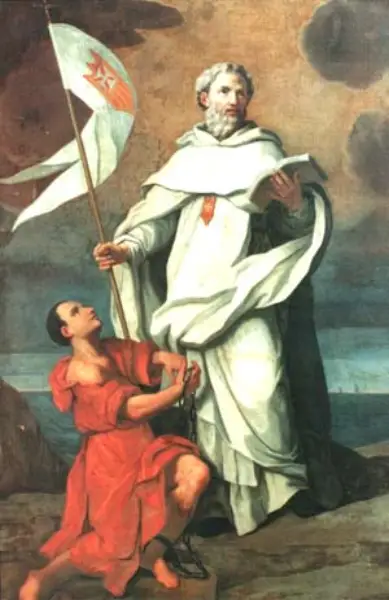
Peter Nolasco was a thirteenth-century Catholic nobleman remembered as the founder of the Royal and Military Order of Our Lady of Mercy for the Ransom of Captives, the religious order known as the Mercedarians, which Pope Gregory IX approved on 17 January 1235. The earliest Mercedarian chroniclers make him the son of a merchant from the village of Mas-Saintes-Puelles near Castelnaudary in Languedoc, though debate about a French or Spanish birthplace has never fully settled; what is certain is that he stood in Barcelona as a teenager and served in the armies fighting the Moors in the Iberian Peninsula. Sent to escort the captive boy-king James I of Aragon home after the Battle of Muret, he was appointed the young monarch's tutor. A pilgrimage to Our Lady of Montserrat turned his energy toward works of charity, and the plight of Christians seized in Moorish raids fixed his life's purpose. He began ransoming captives in 1203, directed Raymond of Peñafort's lay confraternity of ransomers from 1218, and in 1230 became the first Superior and Ransomer of the new order, laboring in Valencia, Granada, along the Spanish coasts, and as far as Algiers. He resigned his office seven years before his death, which came on 6 May 1256; Urban VIII enrolled him among the saints in 1628.
The Complete Life
A Borderland of Captives
Peter Nolasco was born into a century in which the Mediterranean frontier ran with captives. From the eighth century to the fifteenth, the Christian kingdoms of Europe's south and the Muslim states of North Africa, Sicily, and Iberia waged nearly ceaseless war, and along the coasts of Catalonia and Languedoc the danger of being seized by pirates, raiders, or invading armies was a fact of every year. Prisoners counted as booty; those whose ransom did not come were sold in the slave markets that flourished alongside the spice trade in the ports of both faiths. Alfonso VIII's Andalusian campaigns alone were said to have yielded thousands of captives and enormous ransoms, and expeditions from the Moorish side carried off whole herds and villages in a single stroke. The earliest Mercedarian chroniclers, Nadal Gaver and Pedro Cijar, place the founder's family in this contested world: the son of a merchant family of Mas-Saintes-Puelles, a French village near Castelnaudary in the present-day Aude. Whether the family was French or Spanish remained disputed, but while still a teenager Nolasco was in Barcelona, already a soldier in the wars against the Moors.
§ Background
Tutor to a King, Servant of the Captive
The turning point of his early manhood came through the wreckage of war. Simon de Montfort, fighting the Albigensian campaign, had defeated and killed King Peter II of Aragon at the Battle of Muret and taken the king's son James, a child of six, as a prisoner of state. Nolasco, then twenty-five, was charged with conducting the boy back to Aragon and was appointed his tutor, so that the future king James I owed his schooling to the man who would later kneel beside him in founding an order. Having made a pilgrimage to Our Lady of Montserrat, Nolasco settled in Barcelona and gave himself to the works of charity for which the city offered constant occasion. There one misery pressed on him above the rest: the Christians dragged off in Moorish coastal raids, whose fate — captivity, slavery, or the slow extinction of faith and hope in a foreign land — cried out for a remedy more organized than alms. He resolved to establish a religious order dedicated to their rescue, a plan he would build steadily for the rest of his life.
§ Life
The Ransomer
Nolasco had begun paying ransom for Christian captives as early as 1203. In 1218 Raymond of Peñafort brought into being a lay confraternity devoted to buying back slaves held by the Moors, and Nolasco took charge of it as procurator, while his own design reached further: a stable, well-ordered redemptive religious institute under the patronage of the Mother of God. Pope Gregory IX approved the Royal and Military Order of Our Lady of Mercy and the Redemption of the Captives on 17 January 1235. In 1230 Nolasco had become the order's first Superior, holding in his own person the office of Ransomer. His first field was the Kingdom of Valencia, then Granada; he journeyed again and again along the coasts of Spain, and once voyaged to Algiers; Raymond Nonnatus would later succeed him in the office. The order drew young noblemen, whose inheritance made them effective negotiators of ransom, alongside friars in holy orders who filled the choir. The knights guarded the coasts against Saracen raiders yet were bound to the choir when off duty. To himself and his followers the founder added a fourth vow beyond the ordinary three, by which each man pledged all he owned and his personal freedom to the freeing of slaves, even to the point of standing hostage in another's place. The institute's own records count some seventy thousand rescues in all, around two thousand seven hundred of them accomplished while the founder lived.
§ Ransomer
The Vow That Costs
The spirituality Nolasco forged was a spirituality of substitution. The fourth vow he required — surrendering substance and liberty for the captive — made every friar a potential hostage, one man's freedom purchased at the price of another man's voluntary bondage. It was an asceticism aimed outward at another's suffering rather than inward at the self. The order clothed this ideal in white, a habit chosen to signify innocence, and some histories tell that the Blessed Virgin herself directed the choice when she appeared to Nolasco, the patroness under whose protection he had placed the whole work. King James I, delighted with the new institute, authorized its members to wear his own distinguished Aragonese arms upon their long scapulars, so that the knights of the ransom went about marked with the heraldry of the crown their founder had once served as tutor. He himself was never ordained a priest; the first seven generals of the order were chosen from among the knights, though the friars in holy orders always outnumbered them. Rank in the order followed the redemptive mission, not the altar — a structure that kept the rescue of captives, not clerical standing, at the center of its common life.
§ Ransomer
Resignation and Death
After more than two decades at the head of the order he had raised up, Nolasco laid the Superior's office aside and passed his last years in the community's ordinary life, the office of Ransomer having already passed to others such as Raymond Nonnatus. He died in 1256, seven years after that resignation. Tradition long fixed his death on 25 December, a date the calendar kept for centuries; modern researches in the Royal Archives of Barcelona have shown that he actually died on 6 May, the day now inscribed for him in the Roman Martyrology. He had not lived to see the end of the captivity traffic his order was founded to fight, and he had never sought priestly ordination or worldly rank. What he left was an institute still young but already proven — thousands of captives brought home in his own lifetime, a rule that bound the brothers to ransom even with their own bodies, and the confidence of kings. The founder who had crossed the sea to Algiers and stood in the slave markets of Valencia and Granada died quietly in Barcelona, mourned by the order whose white habit he had chosen.
§ Life
Raised to the Altars
The narrative of Nolasco's life had taken shape between the fifteenth and early seventeenth centuries, elaborated by Mercedarian chroniclers, and it culminated in his canonization by Pope Urban VIII on 30 September 1628 in Saint Peter's Basilica in Rome. His festival was first appointed by Pope Clement VIII for 31 January, and it was later moved to 28 January, once that earlier date had been given over to the feast of John Bosco in the revised calendar. The studies of the Royal Archives that corrected the date of his death also settled the question of his feast in the modern reckoning: he is now inscribed in the Roman Martyrology on 6 May, the true day of his death. For the Mercedarian order the canonization crowned a tradition of veneration that had grown with the order's own spread, and it fixed the founder's white-habited figure among the saints of the Catholic Church — the nobleman who never became a priest, honored as the father of a religious family and the servant of the captive Christ in his imprisoned members.
§ Veneration
An Order That Crossed Oceans
The Mercedarian order outgrew the frontier that bore it. It spread through most of Spain and tied itself closely to the Reconquista by which Ferdinand and Isabella took the southern provinces, the redemptive work advancing hand in hand with the frontier. Beyond the peninsula the order flourished in France, England, Germany, and Portugal, carrying Nolasco's fourth vow into kingdoms far from the Moorish coasts. When the age of discoveries opened the Atlantic, the order went with the conquistadors' wake in a different spirit: from Spain it carried a missionary presence into the New World, where the old work of ransom gave way to evangelization among peoples newly encountered. The white habit and the Aragonese arms on the scapular traveled with it. Seven centuries later the institute founded on 17 January 1235 still stands in the Church, its founding vow — the whole substance and very liberty of the friar staked for the slave — remembered as one of the most radical commitments ever written into a religious rule, and its founder honored wherever Christians recall that the works of mercy are worth a man's entire fortune and freedom.
§ Legacy
Timeline
- 1189
Born at Mas-des-Saintes-Puelles in Languedoc, according to the earliest Mercedarian chroniclers
§ Life
- 1203
Begins ransoming Christian captives from Moorish hands
§ Ransomer
- 1214
Escorts the six-year-old James I of Aragon back to his kingdom after the Battle of Muret and serves as the boy's tutor
§ Life
- 1218
Becomes procurator of the lay confraternity for ransoming captives begun by Raymond of Peñafort
§ Ransomer
- 1230
Named first Superior of the new order, holding also the office of Ransomer
§ Ransomer
- 17 Jan 1235
Receives papal approval of the Order of Our Lady of Mercy from Pope Gregory IX
§ Ransomer
- 1249
Resigns as Superior, seven years before his death
§ Life
- 6 May 1256
Dies in Barcelona on the date established by recent studies of the Royal Archives, though tradition held 25 December
§ Life
- 30 Sep 1628
Canonized by Pope Urban VIII at Saint Peter's Basilica in Rome
§ Veneration
The Record
- Major works
- Royal and Military Order of Our Lady of Mercy and the Redemption of the Captives (the Mercedarians)
- Symbols
- White habit signifying innocence·The arms of Aragon on the scapular
- Canonization
- Canonized by Pope Urban VIII on 30 September 1628 at Saint Peter's Basilica, Rome
Prayer
Bibliography
Show 8 sources
- Brodman, James William, Ransoming Captives in Crusader Spain: The Order of Merced on the Christian-Islamic Frontier, 1986
- Ibn Khaldun, Histoire des Berbères et des dynasties musulmanes de l'Afrique septentrionale, ed. Paul Casanova and Henri Pérès, trans. William MacGuckin, baron de Slane (Paris, 1925–56), 3: 116–17
- Ambrosio Huici Miranda, Historia política del imperio almohade (Tetuán, 1956–57), 1:286
- Ibn Abi Zar' al-Fasi, Roudh el-Kartas, Histoire des souverains du Maghreb, trans. M. Beaumier (Paris, 1860), 307–8
- Allaria, Anthony. "St. Peter Nolasco." The Catholic Encyclopedia. Vol. 11. New York: Robert Appleton Company, 1911
- Butler, Rev. Alban, The Lives of the Saints, Vol. I, 1866
- Duffy, Patrick. "St. Peter Nolasco", Caitlicigh Ar An NGreasan
- Stevens, Barbara E., "Our Lady's Coat of Arms", Our Sunday Visitor, Huntington, IN, December 15, 1996
Profile text adapted from the Wikipedia article, licensed CC BY-SA 4.0.
Pray with this saint every day
Save St. Peter Nolasco to your favorites, read the full profile, and get feast-day reminders in the Saints app.
Get the Saints AppFree on the App Store for iPhone and iPad