
died c. 715·Feast January 13
St. Peter of Capitolias
Martyr of Bosra Under the Umayyad Caliphate
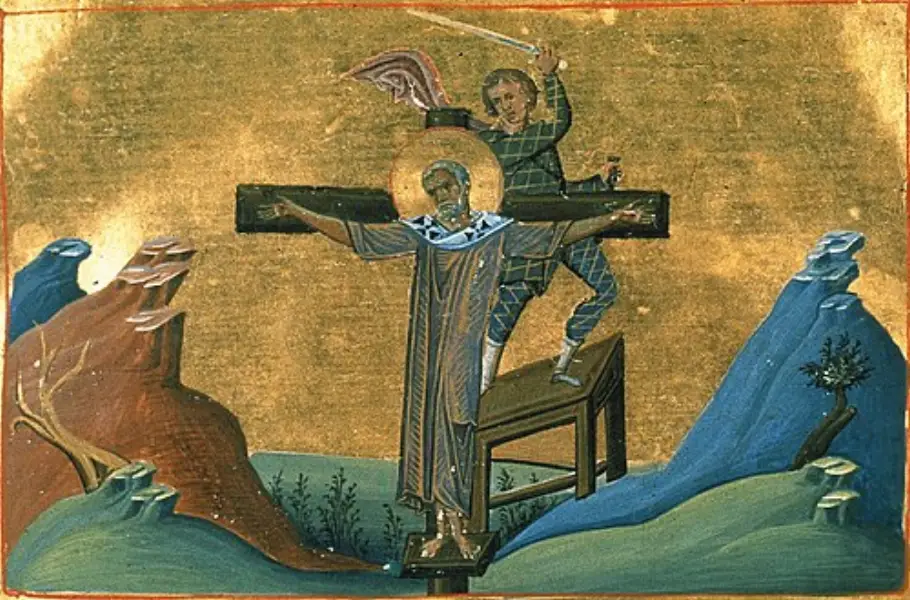
Overview
Peter of Capitolias was an eighth-century Christian saint whose life bridged the ordinary and the heroic. Born in Capitolias, a city in what is today Jordan, he lived for years as a householder: he married, raised three children, and bore the responsibilities of a father in a land under early Muslim rule. Only after the death of his wife did he withdraw to become a monk, and according to some traditions he was later consecrated bishop of Bosra. His public criticism of Islam brought him before a chain of authorities — the governor of the district of Jund al-Urdunn, the governor's deputy, and finally Caliph al-Walid I — and his refusal to be silent cost him his life: he was executed by stoning at Bosra. The Passion of Peter of Capitolias, a hagiographic account of his martyrdom attributed to a John, monk and priest of Damascus, survived in a single Old Georgian manuscript and reached modern readers through a series of scholarly editions, from Kekelidze's text of 1915 to an English translation in 2016. His witness is commemorated on 13 January and 4 October.
The Complete Life
A Family Man of Capitolias
Capitolias, a city that lies within present-day Jordan, was Peter's birthplace and the setting of the first act of his life. He was not drawn from the ranks of those set apart from childhood; he belonged to the ordinary Christian population of the region under early Islamic rule, and for years his vocation was domestic rather than ascetic. He married, and the marriage brought three children. So ordinary and so believing a household prepared a character whose confession would one day cost its head everything. When his wife died, the man who had carried the responsibilities of a father found himself released into a different form of service, one the Eastern Christian tradition has always honored: the widowed Christian, freed of earthly ties, who turns the remainder of life wholly toward God. The change redirected Peter's energies without erasing them. The same steadiness that had sustained a family now sustained a monastic vocation, and the experience of ordinary burdens would inform the boldness with which he later spoke of Christ in public, heedless of the price the authorities might exact.
§ Introduction
From Monastery to Episcopacy
After the death of his wife, Peter became a monk, turning from the life of a householder to the discipline of the cloister. Traditions differ about how far his ascent within the Church proceeded: some accounts relate that he was later consecrated bishop of Bosra, though the sources do not all agree on the point. What is certain is that the widower of Capitolias became a figure conspicuous enough that his words about the faith drew the attention of the Umayyad authorities themselves. Monastic life in the conquered provinces of the Near East carried real risk for anyone willing to speak plainly, and Peter proved willing. Whatever his precise rank at the end, his standing among his contemporaries rested on the conviction with which he confessed Christ, not on any administrative achievement. The distinction between the certainty of his martyrdom and the uncertainty of his episcopal consecration is instructive: the memory of the Church preserved above all the witness he gave at the close of his life, which the Passion narrative records in full and which later generations of scholars would labor to recover.
§ Introduction
Martyrdom at Bosra
Peter's death followed a formal sequence that his Passion narrative preserves. Arrested for criticizing Islam, he was questioned successively by three authorities: Umar ibn al-Walid, governor of the district of Jund al-Urdunn; the governor's deputy Zur'a; and finally Caliph al-Walid I, who reigned from 705 to 715. At each stage the same demand was pressed upon him, and at each stage he refused to retract what he had said. The escalation from district governor to deputy to caliph shows how seriously the authorities took a public confession made by a prominent Christian: this was no summary execution but a judicial process with the caliph himself at its summit. The sentence was carried out by stoning before the people of the city, and so Peter died at Bosra, a witness whose blood sealed his words. A death by thrown stones was a public spectacle, and it made of the martyr's last moments his final and unanswerable discourse. The Church counted him among the martyrs of the early Islamic period, fixing his commemoration on 13 January in the Roman Martyrology, while another Western calendar remembers him on 4 October.
§ Introduction
The Passion and Its Long Journey
The martyrdom is recounted in a hagiographic text known as the Passion of Peter of Capitolias, whose author identifies himself as John, a monk and priest of Damascus — quite possibly the great John of Damascus himself, in Korneli Kekelidze's judgment. Theophanes the Confessor, for his part, attests that John composed hagiographic works in his retirement at Mar Saba, among them an account of this martyrdom. The text itself hangs by a single thread: one copy in the Old Georgian tongue, written out at the Gelati Monastery in 1565, by which the martyr's memory hung across the centuries. Modern scholarship recovered it slowly and deliberately: Kekelidze published the Georgian text with a Russian translation in 1915, Paul Peeters offered a French summary in 1939, and Stephen J. Shoemaker produced an English translation in 2016 within a collection of martyrdoms from early Islamic Palestine. Few witnesses of the Umayyad period can point to so continuous a documentary chain, running from a passion composed near the martyr's own generation to a modern critical edition — a reminder that the voices of the earliest Christian martyrs under Islam reach us only through such patient acts of transmission.
§ Introduction
Timeline
- 1565
The sole surviving copy of his Passion was transcribed in Old Georgian at the Gelati Monastery
§ Introduction
- 1915
Korneli Kekelidze published the Georgian text of the Passion together with a Russian translation
§ Introduction
- 1939
Paul Peeters published a French summary of the Passion of Peter of Capitolias
§ Introduction
- 2016
Stephen J. Shoemaker published an English translation of the Passion in a collection of martyrdoms from early Islamic Palestine
§ Introduction
The Record
- Canonization
- Pre-congregation martyr, honored since the early centuries; his feasts are kept on 13 January in the Roman Martyrology and 4 October in a modern Western calendar.
Prayer
Bibliography
Show 5 sources
- Roman Martyrology.
- Walsh, Michael J. A New Dictionary of the Saints: East and West.
- Sahner, Christian C. (2020). Christian Martyrs Under Islam: Religious Violence and the Making of the Muslim World, p. 167.
- Kennedy, Hugh N. The Byzantine and Early Islamic Near East. Ashgate Publishing, 2006, p. 333.
- Shoemaker, Stephen J., ed. Three Christian Martyrdoms from Early Islamic Palestine: Passion of Peter of Capitolias, Passion of the Twenty Martyrs of Mar Saba, Passion of Romanos the Neo-Martyr. Brigham Young University Press, 2016; published online by Brill, 2019, pp. xv–xxx.
Profile text adapted from the Wikipedia article, licensed CC BY-SA 4.0.
Pray with this saint every day
Save St. Peter of Capitolias to your favorites, read the full profile, and get feast-day reminders in the Saints app.
Get the Saints AppFree on the App Store for iPhone and iPad