
fl. c. 1156 – 1157·Feast February 9
St. Peter of Damascus
Byzantine Monk and Teacher of the Spiritual Life
Overview
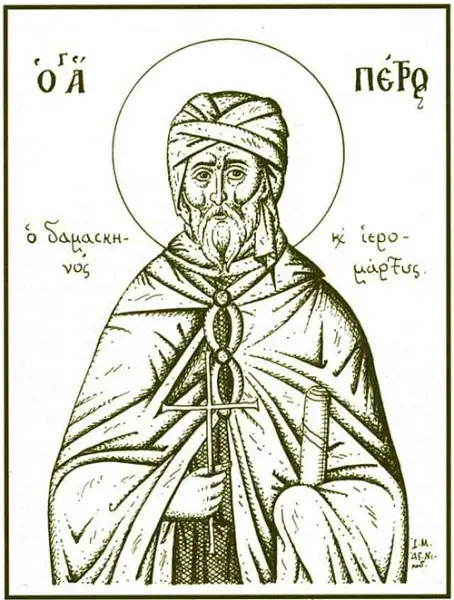
Peter of Damascus was an Eastern Christian monastic, theologian, and Church Father of the twelfth century, whose collected writings make him the second largest single author in the Philokalia. Of his life almost nothing can be established: no hagiography survives, and for centuries he was confused with an eighth-century bishop and martyr of the same name. His own writings reveal the essentials — a monk who lived in a cell, owned no books or possessions, obeyed a spiritual father, and likely followed the semi-eremitic form of monasticism during the high tide of Byzantine monastic reform. He is generally thought to have composed his works around 1156 to 1157. Two great books survive: a Treasury of Divine Knowledge and Twenty-Four Discourses, practical teaching that insists ascetic labor and divine grace work together and that salvation is open to layperson and monk alike. Of the 107 known manuscripts of his writings, most were absorbed into the two books printed in the third volume of the Philokalia in 1782. Translated into Slavonic by Paisius Velichkovsky and carried through the Philokalia into many languages, his teaching remains a fixture of Orthodox spiritual literature.
The Complete Life
A Saint Obscured
Of all the authors gathered in the Philokalia, few are harder to see clearly than Peter of Damascus. No hagiographical account of his life survives, and for centuries he was confused with another Peter of Damascus who lived some four hundred years earlier — an eighth-century bishop and martyr likewise called the Damascene, honored in both the Eastern and Western traditions. Nicodemus the Hagiorite, editing volume three of the Philokalia, attributed the monk's writings to that earlier martyr, and the commemorations of both came to rest on the same day, February 9. The later Peter, the one whose teachings fill two books, lived in the twelfth century, as monastic reform within Byzantium reached its height. Even the origin of his name is uncertain, for the designation of Damascus does not necessarily mean he was born in the Syrian city, as the case of the more famous John of Damascus shows. The obscurity is a paradox: a writer whose works would travel across the Orthodox world in many languages, taking up more space in the Philokalia than any author but Maximus the Confessor, remains without a face, a birthplace, or a date of death.
§ Biography
The Fully-Tested Monk
Whatever his origins, Peter's own words establish his way of life beyond doubt. He speaks of us monks, mentions his monastic habit, and describes himself as a fully-tested monk — the phrase of a man writing from long experience rather than from theory. His pages tell of a life spent in a single cell, without books or possessions of his own, and lived under obedience to a spiritual father. From this poverty of circumstance came an astonishing wealth of memory: his writings are thick with quotations drawn from Athanasius and Anthony, Basil of Caesarea and Dionysius the Areopagite, Isaac the Syrian and John Chrysostom, John of Damascus and Abba Philimon. Since he possessed no books, he must have carried the Fathers in his memory, which would account for the occasional slight inaccuracy of his citations. Peter distinguishes three forms of the monastic life — cenobitic, eremitic, and semi-eremitic — and although he never states plainly which he followed or where he lived, the evidence of his texts suggests the semi-eremitic path, a balance of community and solitude suited to a writer who served the whole Church from a single cell.
§ Biography
Salvation for Every Christian
The teaching that fills Peter's two books is practical rather than speculative, addressed to monastics yet written with a wide door. He holds ascetic labor and the grace of God together as the two poles of salvation, refusing to let either swallow the other. Most striking is his insistence that salvation is not a monopoly of the cloister: he writes that marriage is natural, and that the one who wants to be saved is stopped by no person, no time, no place, and no occupation. Bishop Kallistos Ware summarizes the point in observing that although Peter wrote for monks, he insists that salvation and the knowledge of God belong to all, and that unbroken prayer may be kept in every circumstance of life. Scholars divide over his originality. Jean Gouillard judged that Peter invented nothing, but only set the teachings of the greatest Eastern contemplatives into clear formulas — a verdict that may explain the long lack of academic research devoted to him. Greg Peters replies that Gouillard sold short the originality with which Peter handled his inheritance, and that the Damascene did bequeath to spiritual theology work of his own. His two exhaustive lists — 228 virtues and 298 passions — alone display a mind of rare precision.
§ Works
A Concentrated Philokalia
In 1782 Nicodemus the Hagiorite and Macarius of Corinth published in Venice an anthology of spiritual masters from the fourth through the fifteenth century under the title Philokalia of the Sacred Neptic Ones, compiled from manuscripts available to Nicodemus on Mount Athos and at Vatopedi. Peter's writings occupied so much of it that he became, by bulk, its largest author after Maximus the Confessor, filling a large portion of the third volume. Nicodemus praised the collection as a distillation of holy watchfulness, one circle nested inside another — the whole Philokalia gathered up in small compass. The Slavonic translation of Paisius Velichkovsky carried the texts onward; Paisius himself recorded his unutterable astonishment at finding such a book in a holy place on the Holy Mountain. Theophan the Recluse's Russian Dobrotoliubie left Peter out, probably because the hieromonk Juvenal Polovtsev had already rendered his writings into Russian at Optina Hermitage. Of the 107 known manuscripts containing works attributed to Peter, most were edited into the two Philokalia books, and the compilers occasionally shortened the text or silently dropped misattributions. Gouillard's 1939 study and Greg Peters's later monographs have restored the twelfth-century monk to view as a spiritual theologian in his own right.
§ In the Philokalia
Timeline
- 1156
Composed the spiritual works generally dated to about 1156–1157, later gathered as his two books in the Philokalia
§ Biography
- 1782
Nicodemus the Hagiorite and Macarius of Corinth published the Philokalia in Venice, including Peter's writings
§ In the Philokalia
- 1877
Theophan the Recluse's Russian Dobrotoliubie appeared without Peter's writings, likely because Juvenal Polovtsev had already translated them at Optina Hermitage
§ In the Philokalia
- 1939
Jean Gouillard's study fixed scholarly attention on Peter as a Byzantine spiritual author of the twelfth century
§ Works
- 1984
The complete English Philokalia, translated by Palmer, Sherrard, and Ware, was published in London
§ Select quotations
- 2011
Greg Peters published a full monograph on Peter as Byzantine monk and spiritual theologian
§ Further reading
In Their Own Words
Knowledge comes like light from the sun. The foolish man through lack of faith or laziness deliberately closes his eyes — that is, his faculty of choice — and at once consigns the knowledge to oblivion because in his indolence he fails to put it into practice.
What health and sickness are to the body, virtue and wickedness are to the soul, and knowledge and ignorance to the intellect.
If someone wants to be saved, no person or no time, place or occupation can prevent him
The Record
- Major works
- A Treasury of Divine Knowledge·Twenty-Four Discourses
- Canonization
- Pre-congregation saint honored by the Eastern Orthodox Church and the Melkite Catholic and other Eastern Catholic Churches; his feast falls on 9 February.
Prayer
Bibliography
Show 6 sources
- "The Saints of Antioch". Melkite Greek Catholic Church: Eparchy of Newton. 31 May 2015. Archived from the original on 25 September 2022.
- Peters, Gregory Scott (2003). A Treasury of Divine Knowledge and Wisdom: The Twelfth-Century Byzantine Spiritual Theology of Peter of Damascus. Ottawa: National Library of Canada. ISBN 0-612-86265-8.
- The Philokalia: The Complete Text compiled by St. Nikodimos of the Holy Mountain and St. Makarios of Corinth. Translated by Palmer, G. E. H.; Sherrard, Phillip; Ware, Kallistos. London: Faber and Faber, 1984. ISBN 057111377X.
- Gouillard, Jean. "Un auteur spirituel byzantin du XIIe siècle, Pierre Damascène". Échos d'Orient 38 (1939): 257–278. Reprinted in La vie religieuse à Byzance. London: Variorum Reprints, 1981.
- Kazhdan, Alexander P.; Talbot, Alice-May, eds. (1991). The Oxford Dictionary of Byzantium. New York: Oxford University Press. ISBN 9780195046526.
- Peters, Greg (2011). Peter of Damascus: Byzantine Monk and Spiritual Theologian. Toronto: Pontifical Institute of Mediaeval Studies. ISBN 978-0-88844-175-1.
Profile text adapted from the Wikipedia article, licensed CC BY-SA 4.0.
Pray with this saint every day
Save St. Peter of Damascus to your favorites, read the full profile, and get feast-day reminders in the Saints app.
Get the Saints AppFree on the App Store for iPhone and iPad