
c. 1260 – 1326·Feast October 5
St. Peter of Moscow
Metropolitan Who Made Moscow the Spiritual Capital
Overview
Peter of Moscow, also called Peter of Kiev or Peter of Rata, was the Eastern Orthodox metropolitan of Kiev and all Rus' whose decision to move his see to Moscow altered the shape of Russian history. Born around 1260 in Volhynia to Theodore and Eupraxia, he entered a monastery at twelve, learned iconography, and was ordained a hieromonk. After years of ascetic labor he withdrew to a cell on the Rata River, where a monastery — the Novodvorsk — later took shape. As igumen of the Ratsk monastery he painted the famed Icon of the Mother of God 'Of St Peter' and presented it to Metropolitan Maximus. In 1308, nominated by King Yuri I of Galicia and appointed by the Patriarch of Constantinople, he was consecrated Metropolitan of Rus by Patriarch Athanasius. Amid the turmoil of Tatar dominance he shifted his duties from depopulated Kiev to Vladimir, and in 1325, at the request of Grand Prince Ivan Kalita, he transferred the metropolitan cathedra to Moscow, buttressing the city's political standing and setting it at the spiritual head of the divided Rus' lands. He died on December 21, 1326, was canonized in 1339, and is honored as the patron saint of Moscow.
The Complete Life
A Boy of Volhynia
Peter was born around 1260 in Volhynia, a province of the Kingdom of Galicia–Volhynia, to parents named Theodore and Eupraxia. Piety marked the household early: at the age of twelve the boy entered a monastery, where among the skills of the cloister he learned the art of iconography — the painting of sacred images that would remain joined to his name for the rest of his life. The monastery's igumen judged the youth ripe for Holy Orders and had him ordained a hieromonk, a monk who is also a priest. After years of ascetic labor within the community, Peter obtained his elder's blessing to leave in search of a solitary place. He built himself a cell beside the Rata River and gave himself to asceticism in silence. Around the scene of those struggles a monastery in time took shape, called the Novodvorsk — the New Monastery. The road from parental home to monastery to hermit's cell traces the classic curve of Russian sanctity, but in Peter's case it pointed onward to something rarer still: the primatial see of the Russian Church and the patronage of a capital yet to be.
§ Life
The Icon of the Metropolitan
Peter's gift as an icon painter became the occasion of his first contact with the wider Church. While serving as igumen of the Ratsk monastery near Volhynia, he painted an image of the Most Holy Theotokos that came to bear his own name — the Icon of the Mother of God 'Of St Peter'. When Maximus, Metropolitan of Kiev and all Rus', visited the neighboring Ratne monastery, Peter presented the icon to him as a gift. The encounter placed the hermit of the Rata before the first hierarch of the Russian Church, and it foreshadowed his own elevation. Maximus died, and the metropolitan see fell vacant. In 1308 King Yuri I of Galicia nominated Peter, and the Patriarch of Constantinople appointed him to the metropolitante of Kiev and all Rus'. Rival interests had advanced another candidate on behalf of Mikhail Yaroslavich, Grand Prince of Vladimir and Tver, and the disappointment bred a hostility that shadowed Peter for years. But the appointment was sealed at the highest level: at Constantinople, the Patriarch Athanasius gave him consecration as Metropolitan of Rus, handing over with the office its vestments, staff, and icon.
§ Life
To Moscow
Peter's metropolitanate began amid upheaval. Returning to Rus' in 1308, he reached Kiev only after a year and then proceeded to Vladimir, obliged to change his residence again and again as Tatar authority left the land in turmoil. Kiev itself had emptied of its people, and Peter shifted his metropolitan duties from the ancient Dnieper city to Vladimir. The decisive act came in 1325. At the request of Grand Prince Ivan Kalita of Moscow, Peter transferred the metropolitan cathedra from Vladimir to Moscow as part of the prince's relocation. The consequences were immense: the move reinforced Moscow's political standing and made it the spiritual head of the divided Rus' lands; yet the office Peter carried kept its official designation of Kiev and all Rus' down to Jonah's autocephalous election in 1448, even after its seat had moved north. On the Kremlin hill Ivan Kalita built the Dormition Cathedral and other stone churches for the transferred hierarchy, and the foundation of Moscow's Vysokopetrovsky Monastery is ascribed to Peter himself, who also left behind a number of sermons and epistles — the written trace of a governing pastor.
§ Life
Repose in the Kremlin
Peter did not long outlive his great translation. The animosity of Mikhail Yaroslavich of Tver, aggrieved by the appointment of his rival's candidate, had pursued the metropolitan for years and grew so threatening that in 1325 Peter sought the protection of the Prince of Moscow — the same recourse that bound the hierarch's fate to the city forever. Under Ivan Kalita's protecting care the metropolitanate at last took root beside the Kremlin walls, and there, in the shadow of the new cathedral, Peter's final year of life was spent. He died on December 21, 1326, at about sixty-six years of age, and his body was laid in the Cathedral of the Dormition, the church his partnership with the prince had brought into being. The brevity of his Moscow ministry — scarcely a year separated the transfer of the see from his death — did nothing to diminish its effect. What he set in motion outlasted every rival and every dynasty: within a generation Moscow stood as the undisputed center of Russian church life, and Peter was honored as the saint whose practical choice had made it so.
§ Life
Canonized in 1339
Thirteen years after his repose, Peter was formally canonized in 1339 by Metropolitan Alexis of Kiev, and his veneration was then propagated throughout all Muscovy. Churches dedicated to Peter the Metropolitan rose in Moscow and in many other cities of Russia. Three commemorations mark his service in the calendar of the Russian Church. On August 24 the faithful keep the translation of his relics to the Dormition Cathedral in Moscow. On October 5 he is honored in common with Metropolitans Jonah and Alexis. On December 21 the Church recalls the day of his repose in 1326. His principal shrine is the Cathedral of the Dormition itself, where his relics rest within the very walls of the church his move to Moscow had brought into being, so that pilgrim and cathedral share one history. Few Russian saints have been so closely identified with a single city's destiny; the title of patron and wonderworker of Moscow was the Church's recognition that the metropolitan's decision of 1325 had been, in the economy of Providence, an act of prophetic significance for the whole Russian land.
§ Life
Patron of Moscow
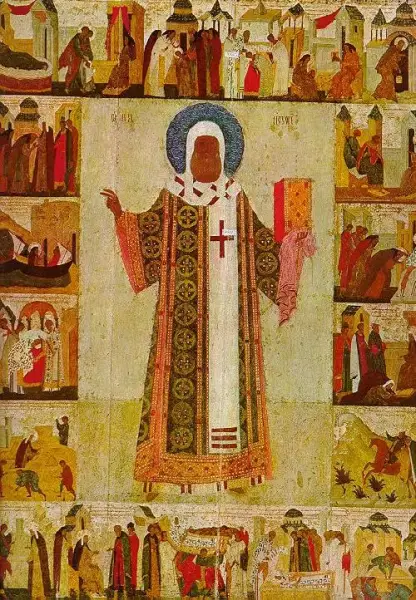
Peter's legacy is written into the political and spiritual geography of Russia. By moving the metropolitan see to Moscow he joined the fate of the Russian Church to the town on the Moskva, and under his successors the city grew into the gathering point of the Russian lands and, eventually, the seat of the patriarchate. The Cathedral of the Dormition he inspired became the great church of the Russian hierarchy, and the Vysokopetrovsky Monastery, whose foundation is ascribed to him, long bore his name in the heart of the capital. His own works survived him as the memory of a hierarch who was also a craftsman of sacred art: sermons, epistles, and the icon of the Mother of God that carries his name. Iconographers honored him in return; the fifteenth-century master Dionisius painted the Metropolitan surrounded with scenes from his life. In the calendar of the Russian Church his three feasts — the translation of his relics, the synaxis of the hierarchs, and the day of his repose — keep alive the memory of the Volhynian monk who became the first great saint of Moscow and its enduring heavenly patron.
§ Life
Timeline
- 1260
Born in Volhynia, in the Kingdom of Galicia–Volhynia, to Theodore and Eupraxia
§ Life
- 1308
Nominated by King Yuri I of Galicia and appointed by the Patriarch of Constantinople to the see of Kiev and all Rus'
§ Life
- 1325
At the request of Grand Prince Ivan Kalita, transferred the metropolitan cathedra from Vladimir to Moscow
§ Life
- 21 Dec 1326
Died in Moscow at about sixty-six years of age
§ Life
- 1339
Canonized by Metropolitan Alexis of Kiev, after which his veneration spread throughout Muscovy
§ Life
The Record
- Major works
- Icon of the Mother of God 'Of St Peter'·Sermons·Epistles
- Patron of
- Moscow
- Canonization
- Canonized in 1339 by Metropolitan Alexis of Kiev; veneration spread throughout Muscovy thereafter.
Prayer
Bibliography
Show 6 sources
- "Petro of Kyiv, Metropolitan". Encyclopedia of Ukraine.
- "Repose of St Peter the Metropolitan of Moscow and Wonderworker of all Russia". Orthodox Church in America.
- "Ratne, Volyn Oblast". In The History of Cities and Villages of the Ukrainian SSR.
- "Icon of the Mother of God of St Peter of Moscow". Orthodox Church in America.
- Janos, S. "Sainted Peter, Metropolitan of Moscow". Holy Trinity Orthodox Church.
- "Translation of the relics of Saint Peter, Metropolitan of Moscow and All Russia". OCA. Archived from the original on February 21, 2025. Retrieved May 10, 2025.
Profile text adapted from the Wikipedia article, licensed CC BY-SA 4.0.
Pray with this saint every day
Save St. Peter of Moscow to your favorites, read the full profile, and get feast-day reminders in the Saints app.
Get the Saints AppFree on the App Store for iPhone and iPad