
died 1123·Feast March 4
St. Peter of Pappacarbone
Abbot of Cava and Bishop of Policastro
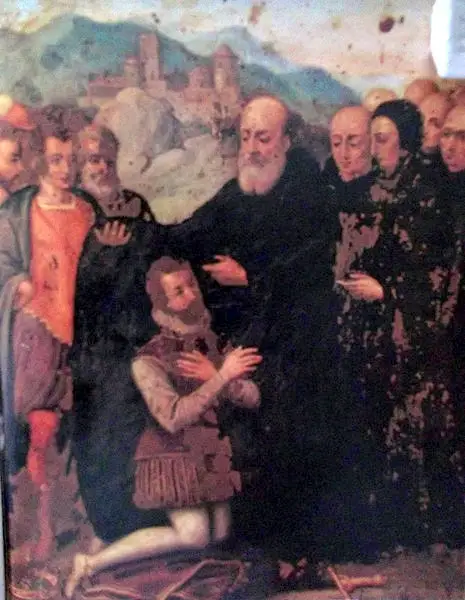
Overview
Peter of Pappacarbone was an Italian abbot and bishop who led the abbey of La Trinità della Cava at Cava de' Tirreni during a formative period of its history. A native of Salerno, he entered monastic life at Cava under its second abbot, Leo I, before spending six years at Cluny, the great Burgundian monastery whose observance shaped religious life across eleventh-century Europe. He returned to Italy and in 1079 was chosen bishop of Policastro, a southern Italian see. He later laid aside the episcopal office and went back to the abbey that had formed him, where Leo I named him coadjutor and eventual successor. His tenure as abbot, counted from 1079, was marked by a severity of discipline that provoked strife within the community, and Peter withdrew for a time before being recalled. Restored to office, he governed Cava for several decades, until his passing. His death on 4 March 1123 brought Constabilis, once his coadjutor, to the abbacy in his place. In 1893 Pope Leo XIII officially recognized the first four abbots of Cava as saints, placing Peter among the founding fathers of that religious house.
The Complete Life
A Monk of Cava
Peter was born at Salerno, the principal city of the southern Italian principality that in the eleventh century stood at the crossroads of Lombard, Byzantine, and Norman power. In that world the abbey of La Trinità della Cava, nestled at Cava de' Tirreni in the hills near Salerno, had recently risen as a center of monastic renewal. There Peter received the habit and made his profession under Leo I, the second abbot of the young community. The house had been founded around the middle of the century, and its earliest abbots were building both its spiritual tradition and its temporal security. As a monk Peter would have known the long rhythm of the liturgy, manual labor, and study that defined Benedictine life, and under Leo I he saw at close range the kind of firm, personal governance that held a reforming abbey together. Those early years at Cava formed the man who would later be counted third among the abbots of that house, standing in the line between his own abbot, Leo, and his eventual successor, Constabilis. Salerno gave him birth; Cava gave him his entire vocation.
§ Peter of Pappacarbone
Cluny, Policastro, and the Call Back to Cava
In 1062 Peter left southern Italy for Cluny, the Burgundian abbey whose customs influenced monasteries from England to Rome. His six years there placed him at the heart of the most celebrated observance in Latin Christendom, and he returned in 1068 bearing that formation back to a church in southern Italy that was negotiating its place between Rome and Constantinople. The range of his experience did not go unnoticed: in 1079 he was raised to the episcopate as bishop of Policastro, a see on the Tyrrhenian coast of Lucania. Yet the episcopal office was not to be the final shape of his life. In time he resigned the see of Policastro and made his way back to Cava, the abbey of his profession, where Abbot Leo I, now aged, appointed him coadjutor to share in the government of the house. This double career, as bishop and then as monk-administrator, was unusual but not unheard of among the reforming clergy of the eleventh century, and it prepared Peter to govern Cava at a moment when firm leadership mattered greatly. The line of succession at Cava records his abbacy from 1079, counting his service alongside Leo toward the decades he would ultimately lead.
§ Peter of Pappacarbone
Strictness, Exile, and Long Governance
When Peter succeeded to the abbacy in his own name, he governed with a severity that unsettled the community. His administration, the record notes, was strict enough to cause strife within the abbey, and rather than preside over a divided house, Peter withdrew for a time. The gesture recalls the patience of monastic tradition, in which an abbot's authority is ordered to the peace of the brethren rather than to his own standing. His absence did not last: the community recalled him, and he resumed the government of Cava, serving for several decades until his death. Those long latter years consolidated the abbey's continuity between its founding generation and its mature stability, for Peter held office across the turn of the twelfth century, linking the era of Alferius and Leo I to the abbots who followed. He trained and supported Constabilis as coadjutor, ensuring an orderly succession. Peter died on 4 March 1123, and the date became his feast. Constabilis, who had borne the office of coadjutor under him, succeeded him as abbot, continuing the unbroken line of holy superiors that Cava came to venerate.
§ Peter of Pappacarbone
Honor Among the First Abbots of Cava
The memory of Peter's sanctity was preserved at Cava chiefly through his place in the unbroken succession of its first abbots. On 21 December 1893 Pope Leo XIII officially confirmed the cultus of the founding line of the house, enrolling four early superiors among the saints: Alferius, the founder and first abbot; Leo I, Peter's own abbot; Peter of Pappacarbone, the third in the line; and Constabilis, his successor and former coadjutor. This act of recognition came at the end of the nineteenth century, when the Holy See systematically confirmed many ancient local cults that had flourished from the first centuries of their foundations without formal canonization. For the abbey of Cava the confirmation of 1893 ratified what the community had celebrated for nearly eight hundred years: that its earliest abbots had governed the house in holiness and that their tombs and memory deserved the public veneration of the Church. Peter's feast is kept on 4 March, the day of his death in 1123, and he is honored in the diocesan calendars of the region as San Pietro I Pappacarbone, abbot of Cava and bishop of Policastro.
§ Veneration
Timeline
- 1062
Left Cava for the monastery of Cluny, where he would remain six years.
§ Peter of Pappacarbone
- 1068
Concluded his stay at Cluny and returned to Italy.
§ Peter of Pappacarbone
- 1079
Appointed bishop of Policastro and recorded as beginning his tenure among the abbots of Cava.
§ Peter of Pappacarbone
- 4 Mar 1123
Died at Cava de' Tirreni after decades as abbot.
§ Peter of Pappacarbone
- 21 Dec 1893
Pope Leo XIII officially recognized him, with the first three abbots of Cava, as a saint.
§ Veneration
The Record
- Canonization
- Cultus confirmed by Pope Leo XIII on 21 December 1893
Prayer
Bibliography
Show 1 sources
- San Constabile (Costabile)
Profile text adapted from the Wikipedia article, licensed CC BY-SA 4.0.
Pray with this saint every day
Save St. Peter of Pappacarbone to your favorites, read the full profile, and get feast-day reminders in the Saints app.
Get the Saints AppFree on the App Store for iPhone and iPad